United States Army
The Devil All the TimeThe United States Army is depicted through the wartime experience of Willard Russell, whose service carries the violence of the South Pacific back into his postwar life. The novel presents the Army less as an institution than as the setting for acts and memories that shape Willard’s understanding of death, faith, and what can be spoken about at home.
Willard Russell’s Wartime Service
A private in the Army for three years, Willard served in the South Pacific and saw severe fighting, including on Bougainville. On one of the Solomon Islands, he and other men from his unit found Gunnery Sergeant Miller Jones, a Marine who had been left dying on a cross. Willard shot him to end his suffering, an act of mercy that became a defining memory of his service and, as the novel makes clear, altered him inwardly.
Afterward, Willard and two companions encountered four starving Japanese soldiers who surrendered. Willard later told his sergeant that the men had tried to escape and that his group had had no choice but to kill them. The incident places an act of deliberate deception alongside the earlier mercy killing: the war’s moral circumstances are not presented as simple, even as Willard’s own account conceals what happened. A companion collected the dead men’s ears as trophies, further showing how wartime violence could become entangled with callousness and plans for profit.
Postwar Return and Family Silence
The war remained present in Willard Russell’s first journey home. After three years in the United States Army, he rode back with two sailors and drank with them, while thinking that, if he made it home, he would never leave Coal Creek, West Virginia, again. The wish for a fixed home followed an experience he could not simply set aside: the memory of Miller Jones and the circumstances of his death continued to shape Willard’s understanding of violence and faith.
On that journey, Willard stopped at the Wooden Spoon, where a sign advertising meat loaf reminded him of the meal his mother had made before he left for the Army. He took it as a good sign. There he met Charlotte Russell, the waitress whose appearance left him momentarily unable to speak. The encounter links his return from military service to the family life that followed: only a few hours from home, he was beginning a relationship that would become central to his postwar years.
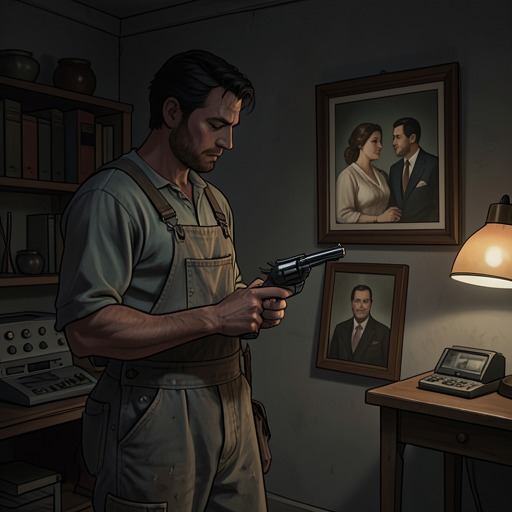
Willard did not readily tell his family what he had seen in the war. His brother-in-law Earskell Russell later recalled that, after Willard came back, questions about the Japanese soldiers he had encountered turned instead to Charlotte, whom Willard had noticed while she was waiting tables. Arvin Russell’s mother had also warned him against asking about his father’s wartime experiences. When Arvin eventually raised the subject, Earskell’s account and the Willard’s German Luger in Arvin’s hands made the past tangible without making it fully speakable.
The memory did surface in Willard’s conversation with a priest after he confessed to killing Miller Jones to end his suffering. The priest, exhausted by the deaths he had witnessed, described earthly life as preparation for what came after. Later, on the bus home, Willard drew on that conversation to answer a fellow passenger’s talk of military medals with an account of Christian persecution and the afterlife. His response does not resolve what he experienced; it shows how the war’s violence, his act of mercy, and religious ideas had become joined in the language available to him.
The Army’s Afterlife in the Household
Years after his service, Willard’s son encountered a household where violence was treated as both danger and a means of defense. In 1957, after Arvin came home from school with another black eye, Willard told him not to start fights for no reason but to finish the next one if a larger boy attacked him. The advice does not establish that the United States Army directly shaped Willard’s parenting; it does show how readily force enters his understanding of protection. His own work clothes, handed to Arvin after a day at the slaughterhouse, were stiff with blood and grease, joining the boy’s lesson in self-defense to the ordinary labor of killing animals.
The clearing where Willard prayed offered another kind of response to violence. He came there morning and evening when he was not drinking, and Arvin followed him through fog and wet pasture to kneel beside the weathered cross. When two hunters interrupted them, Willard stopped Arvin from turning fully toward the men and insisted that the moment belonged to the Lord. The scene places his postwar religious routine beside his instinct to shield his son from what is nearby: the Army’s experience is not explained again, but its remembered violence remains part of the life in which prayer, restraint, and readiness to fight coexist.
The Army Against Civilian Fantasy
The novel sets Willard Russell’s experience against the bus driver’s imagined version of military service. The driver, kept from fighting by an ulcer, regretted missing the chance to earn medals and believed he could have killed enough German soldiers to deserve them. Willard, returning from the war, had little patience for such boasting or for the sailors drinking beside him. Their talk makes military distinction appear less like an abstract honor than a public fantasy unable to account for what service actually involved.
Willard’s own way of answering the driver is oblique: he recalls a priest’s account of Christian persecution and the promise of glory beyond death. The exchange shows how the Army’s wartime experience enters the novel not through institutional ceremony or a record of campaigns, but through a returning soldier’s strained conversation, in which violence and religious language have become difficult to separate.