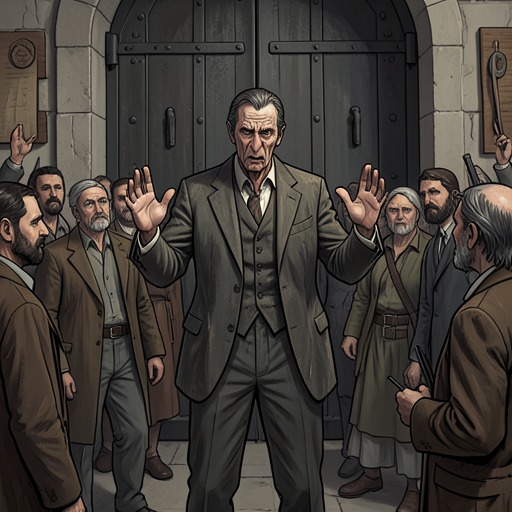
Bauer
The Disappearance of Josef MengeleBauer was a prosecutor in the State of Hesse whose efforts to pursue Adolf Eichmann and Josef Mengele made him a determined force in the struggle to bring Nazi crimes before the law. Once persecuted and driven into exile by the regime he later sought to prosecute, he worked against official reluctance, compromised institutions, and the delays of cross-border procedure. His role joined the search for individual fugitives to a larger demand that postwar Germany face its past.
Identity and Background
In November 1956, Bauer, prosecutor general of the State of Hesse, issued an arrest warrant for Adolf Eichmann, wherever he might be. His public office stood in sharp contrast to his earlier exclusion from the civil service: Bauer was a Jewish social democrat and a homosexual, and the Gestapo had interned him in a concentration camp before he fled to Scandinavia. He returned to Germany in the late 1940s and made it his mission to compel his compatriots to confront the Nazi past.
This history gives his pursuit of Nazi fugitives a personal and political context without reducing it to private vengeance. Bauer operated through warrants, evidence, and judicial channels, but the book places those methods against a society and state apparatus still struggling to acknowledge the crimes those processes were meant to address.
The Eichmann Investigation
In 1957, Lothar Hermann, a blind German Jewish refugee living in Argentina, wrote to Bauer with information that Adolf Eichmann might be in Buenos Aires. Hermann had become suspicious through his daughter’s former relationship with Nick Eichmann, who praised his father’s wartime record and expressed antisemitic views. Bauer chose not to rely on the German intelligence agencies or the embassy in Buenos Aires, which the narrative describes as compromised by former Nazis. Instead, he passed the information quietly to Mossad.
Mossad’s first investigation in Argentina proved inconclusive. The intelligence service discounted Hermann’s claim in part because he demanded money and because the suspected fugitive’s reported home seemed implausibly squalid. Bauer nevertheless believed the allegation and found a second source corroborating that Ricardo Klement was Adolf Eichmann. That confirmation changed the status of the report: in December 1959, the decision was made to abduct Eichmann. Bauer’s choice of a discreet channel, and his persistence after the initial investigation stalled, helped move the case toward an operation beyond the ordinary German diplomatic and intelligence apparatus.
Pursuit of Josef Mengele
Bauer’s work also intersected with Hermann Langbein’s patient investigation of Josef Mengele. Langbein, a former Auschwitz prisoner and co-founder of the International Auschwitz Committee, gathered evidence and passed case files to the German federal minister of justice. The minister said the matter belonged before a regional court; most judges declined to act. In Freiburg im Breisgau, where Mengele had last registered an address, a prosecutor issued an arrest warrant on 25 February 1959 for multiple cases of premeditated murder and attempted murder. Langbein then argued that, if Mengele was in Buenos Aires, the Ministry of Foreign Affairs should seek his extradition from Argentina.
The ensuing pursuit revealed how legal process could be slowed or blunted by jurisdictional disputes and official passivity. Requests passed through multiple Argentine and West German offices, while Mengele’s associates helped him escape to Paraguay and secure citizenship. The Paraguayan government resisted extradition and asserted its right to protect its citizens. In 1964, as international attention turned to the Frankfurt Auschwitz trials, Bauer renewed public pressure: he announced a reward of 50,000 marks for Mengele’s capture and said the fugitive was living under his true identity in Paraguay, with money and influential protection. Paraguay’s interior minister disputed that account and claimed Mengele was in Brazil or Peru.
Bauer’s efforts confronted not only foreign obstruction but also weaknesses within West Germany. The federal government devoted no special agents or spies to the hunt, and former Nazis remained embedded in intelligence agencies. Its response relied heavily on formal procedure and diplomatic pressure. When those measures failed to overcome Paraguay’s refusal, West Germany eased its pursuit in 1965. The contrast between the detailed legal case and the limited political will to enforce it is central to the book’s account of postwar accountability.
Prosecution, Evidence, and Legacy
Bauer’s work belonged to a wider effort to turn survivor testimony and accumulated evidence into criminal proceedings. The narrative sets his pursuit against the record of Auschwitz survivors, including Miklós Nyiszli’s account of Mengele’s work, and later testimony by victims at the 1985 mock trial in Jerusalem. Those accounts establish the human reality obscured by the language of official duty and scientific purpose; they are not presented as evidence Bauer personally gathered or as proceedings he directed. Rather, they show the continuing demand for justice that his prosecutorial campaign represented.
The book also emphasizes the distance between identifying a fugitive and securing his arrest. Bauer could issue or publicize legal measures, support the verification of reports, and urge governments to act, but his efforts depended on institutions willing to cooperate across borders. Eichmann’s case advanced through a quiet Israeli operation after German official channels were bypassed; Mengele’s case remained obstructed by procedural delay, political calculation, and protection abroad. Bauer’s significance lies in this persistent insistence that pursuit and prosecution were necessary, even when the machinery of justice moved slowly or failed to reach its intended destination.