Engelberg
The Disappearance of Josef MengeleEngelberg is the Swiss resort where Josef Mengele briefly fashioned an exile’s life into a family idyll. In March 1956, arriving under an assumed identity, he reunited with his son Rolf at the grand Hotel Engel; amid falling snow, fireside comfort, and the routines of a holiday household, he presented himself as Uncle Fritz while reviving the authority and ideology he had carried from Germany.
Arrival and setting
On 22 March 1956, after a short stop in New York, Mengele landed in Geneva. Hans Sedlmeier was waiting at the airport and drove him onward to Engelberg, a ski resort in the Swiss mountains. The destination’s grandest four-star establishment, Hotel Engel, supplied a setting of ease and respectability for a man living under an assumed name.
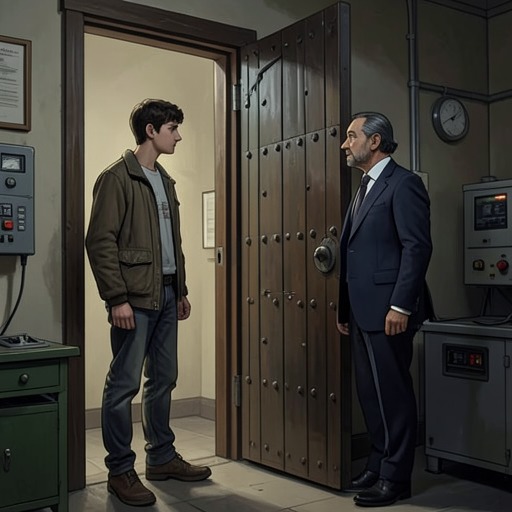
At the hotel reception, Mengele was met by Martha Mengele and two twelve-year-old boys: her son Karl-Heinz and Mengele’s son Rolf. The meeting placed him at the center of a ready-made household, but Rolf did not know the man as his father. Martha had introduced him as Uncle Fritz from America, while Rolf had been told as a child that his father, Josef, had died in combat in Russia shortly after Rolf’s birth.
Hotel Engel as a temporary home
The hotel’s domestic comforts shape the account of Mengele’s stay. While Martha hummed at the bathroom mirror and ran a bath, he lay on the bed in an adjoining room, listening to her and to the water. A fire crackled in the hearth; beyond the window, snow was falling. He looked out and smiled, finding the Swiss sojourn idyllic and the mountain air invigorating. The resort offered not merely shelter but a convincing interval of warmth and ordinary family life.
That apparent ease rested on a carefully managed performance. At meals and during walks or evenings together, Rolf and Karl-Heinz were punctual and disciplined, sitting upright and speaking only when their uncle permitted it. They admired Uncle Fritz as a world-class skier who had served with Alpine troops, and pressed him for stories. Karl-Heinz preferred accounts of tank battles, heroism, and comradeship on the Russian steppes; Rolf was drawn to tales of San Martín, gauchos, and the pampas. Mengele used these storytelling sessions to impart a racialized account of conquest, presenting the defeat of Argentina’s Indigenous peoples as a triumph of civilization and comparing it to German expansion in eastern Europe. The intimate setting made the lessons part of family life rather than an abstract political lecture.
Family roles and intimate conflict
Engelberg’s reunion also exposed the gap between Mengele’s concealed identity and the family role he claimed. In the privacy of the hotel suite, he regarded Rolf as a boy who needed to be hardened, and blamed his mother and the Freiburg shoe merchant for failing to do so. His ideas about toughness and masculinity informed the way he judged both the child and the adults around him; the boys’ obedience and admiration helped him occupy the position of unquestioned authority without revealing that he was Rolf’s father.
The hotel was also where his relationship with Martha became sexual. During their first evening together, while the boys ate supper, he studied her and desired her. He contrasted her with his former wife, Irene Mengele, yet resolved not to keep comparing the two women. Martha was, to him, a committed Nazi, a caring mother, and a woman of character; most consequentially, she was the widow of his younger brother Karl. Their intimacy therefore carried a private family rivalry alongside its erotic charge. When he undressed her on their second night, he experienced the act as a second defeat of his dead brother. The resort’s calm domestic surface thus contained a far more possessive and antagonistic understanding of family.
Narrative significance
Engelberg brings together the three roles Mengele tries to control: fugitive, father, and political storyteller. Snow, firelight, and the boys’ eager attention furnish the image of a peaceful household, while the false unclehood conceals the rupture in Rolf’s childhood and the stories reproduce the ideology behind Mengele’s past. The setting’s comfort does not resolve those contradictions. Instead, Hotel Engel makes them visible in close quarters: a family reunion shaped by concealment, an idyll sustained by performance, and intimacy shadowed by rivalry with the dead.