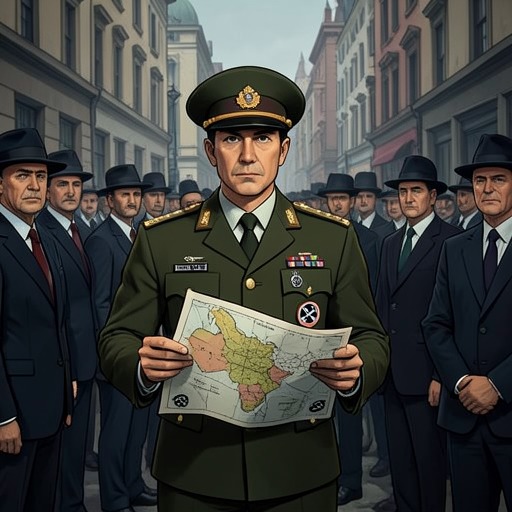
Hitler
The Disappearance of Josef MengeleHitler is presented as an absent but consequential figure: the leader at the summit of Himmler’s design, the embodiment of Nazi Germany’s political spectacle, and the historical reference point for postwar efforts to protect Nazi fugitives. The evidence traces his influence through Perón’s earlier admiration, the escape networks operating after the war, and Eichmann’s later account of the extermination program, while distinguishing those contexts from direct actions by Hitler in the scenes described.
Identity and Narrative Position
Hitler enters the narrative first as the supreme leader whose grand design gives ideological direction to Himmler’s blood-and-soil ambition. That placement establishes him as the source of an expansive political project, rather than as a figure introduced through private life or a personal biography. The account supplies no sustained portrait of his day-to-day conduct; instead, it shows how his authority and image are carried by institutions, political spectacle, and the postwar consequences of Nazi rule.
This indirect characterization matters to the entry’s structure. Hitler is often outside the immediate scene, yet other figures’ actions and memories make his influence legible. Himmler’s ambition is framed in relation to his design; Perón’s impression of Germany is shaped by the regime he sees; and later, Eichmann’s interviews connect the Nazi leadership’s wartime project to the scale of its crimes. These are distinct forms of evidence: ideological hierarchy, political admiration, and retrospective testimony, not a single continuous account of Hitler’s own actions.
Berlin as Political Spectacle
Perón’s visit to Berlin and the Eastern Front, following the invasion of Poland, supplies the most direct account of Hitler’s effect on an observer. Perón reads Mein Kampf in Italian and Spanish and encounters a Germany presented as organized, productive, and rapidly recovering under National Socialism. In his view, its orderly work and tightly calibrated state suggest a political machine functioning with extraordinary precision. That impression describes Perón’s response; it does not establish the narrative as endorsing his assessment.
The spectacle is also cinematic. Hitler appears as a mass hypnotist, while history itself seems staged through films directed by Leni Riefenstahl, including Storm over Mont Blanc and The White Ecstasy. Perón’s pilgrimage through German cultural and political display joins images of discipline to images of will and danger. The account’s volcanic imagery conveys the destructive force Perón associates with Hitler’s movement, even as his fascination with Germany’s apparent efficiency reveals the seduction built into that display. The scene therefore presents admiration and foreboding together, rather than reducing Perón’s response to either simple approval or simple rejection.
The Nazi Legacy after the War
The postwar escape networks show one practical consequence of Nazi political survival: former officials and supporters could be helped along routes organized through diplomats, corrupt officials, intelligence contacts, and clergy. Perón oversees the Great Escape and establishes an Information Office in Buenos Aires under Rudi Freude. He also sends former SS captain Carlos Fuldner on missions through Spain, Switzerland, Rome, and Genoa. Freude and Fuldner are associated with the coordinated expatriation system identified as the Nazi Ratlines. The evidence presents this as a postwar undertaking by Perón’s government and its intermediaries, not as an operation directed by Hitler himself.
The political language around those networks preserves a related ideological inheritance. At a gathering, Daye invokes reconciliation between Nazism and Christianity and portrays Argentina under Perón as a counterweight to the United States. He praises Perón’s role in bringing people together, while the audience applauds. This is Daye’s rhetoric, not a statement by Hitler; its significance lies in showing how Nazi ideas could be repackaged within a postwar political setting. The account places that appeal amid a wider expectation of conflict between the Soviet Union and the United States, making anti-communism part of the rationale offered for fraternization.
Testimony and the Scale of the Crimes
Eichmann’s six months of interviews with Sassen and Fritsch provide the most explicit retrospective connection between Hitler’s regime and the Holocaust. Eichmann speaks with pride about his role and acknowledges the murder of six million Jews, while regretting that the objective of total annihilation had not been achieved. His account describes mass killing, forced labor, death marches, and famine as parts of a war ordered by Hitler. The interviews thus make the extermination program impossible to treat as rumor or merely hostile propaganda within the circle conducting them.
The evidence makes a distinction between Eichmann’s testimony and Hitler’s presence: Hitler does not take part in the interviews, and the account does not provide a new personal revelation from him. Instead, Eichmann’s admissions expose the crimes carried out under Hitler’s leadership and connect the earlier image of a precisely organized state to its lethal purpose. Across the narrative, Hitler’s significance rests on this tension: the same regime that could impress an observer with order and spectacle was also responsible for an immense system of persecution and murder. His character is therefore constructed through the distance between political display and the consequences disclosed by those who served it.