Holocaust Denialism
The Disappearance of Josef MengeleHolocaust Denialism in the book is not merely a mistaken estimate of wartime deaths: it is a political project that recasts evidence of mass murder as conspiracy, seeks to restore Germany’s reputation, and hopes to rehabilitate Nazism and Adolf Hitler. Its central irony is that the men who invite Adolf Eichmann to help prove their case hear from a participant whose account confirms the extermination program they had insisted was fabricated.
Denial as a political project
The narrative places this campaign amid the nationalist and authoritarian politics of postwar Argentina. Juan Perón promised national renewal, expanded state control over strategic sectors, and built a movement around a direct bond between leader and people. His government also purged institutions and censored the press; in 1951, La Prensa was closed, expropriated, and turned into an instrument of the General Confederation of Labour. These details establish a political setting in which public speech and national identity are contested, without suggesting that Perón’s policies themselves constitute Holocaust denial.
The more immediate setting is the network around Eberhard Fritsch and Willem Sassen. Fritsch founded Dürer Publishing to assist German veterans and give a platform to writers censored in Europe. He offered stranded Nazi sympathizers practical connections as well as a place to publish. His reassurance to Gregor that Argentina was vast and that no one would ask about his past presents refuge as both geographical distance and social protection. Fritsch’s own attachment to Nazi gatherings and his rejection of accounts of Nazi crimes help explain the convictions behind that network; its support for fugitives was joined to an effort to shape how the past would be remembered.
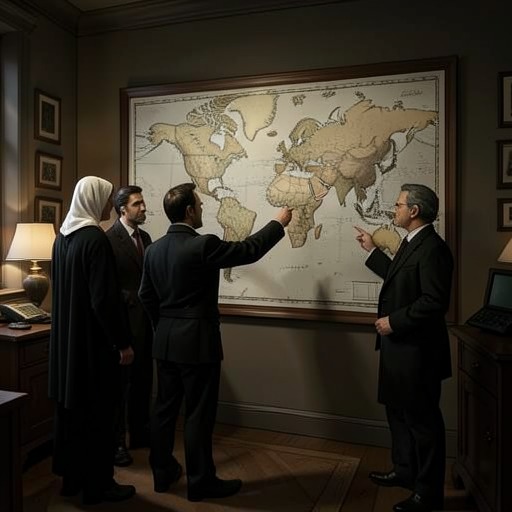
By 1956, the Dürer men’s club was answering growing public attention to the concentration camps and the murder of European Jews. It rejected the figure of six million Jewish victims and advanced an estimate of 365,000. It denied mass killing, deportations in loaded trucks, and poison-gas chambers, describing the larger death toll as fabricated history and a Zionist conspiracy. The club’s account redirected blame: Germany, it argued, had been made to feel guilty for the war and its destruction. Denial thus worked by diminishing the scale of the crimes while presenting Germans as the real targets of an accusation designed for political gain.
Recruiting Eichmann
For Fritsch and Sassen, Adolf Eichmann seemed capable of giving this narrative the authority it lacked. They regarded him as a central organizer of the campaign against the Jews and as a witness who knew its personnel and figures. They proposed that he set out his views in a book about what they called a supposed final solution, to be issued by Dürer Publishing. The project promised an apparent source of firsthand testimony and, they hoped, a public defense of Germany and Nazism.
The proposal also suited Eichmann’s circumstances and ambitions. After the closure of his laundry, he had worked for a bathroom-appliance company and farmed Angora rabbits and hens on the pampas. His life was monotonous, his income modest, and his name already appeared in newspapers in ways he considered inaccurate. A book offered him a chance to leave anonymity, defend his reputation, and provide his children with what he regarded as the truth. He imagined that Germans would support him and that his family might return to Europe with its standing restored. The prospect of book sales gave the plan a financial incentive as well as an ideological one.
The interviews overturn the plan
For six months, Sassen and Fritsch interviewed Eichmann. Instead of supplying material for denial, he described the scale and organization of the extermination program, including the killings, gas chambers, forced labor, death marches, and starvation. He confirmed the figure of six million Jewish victims and spoke with pride about the Nazi campaign, while regretting that it had not achieved its ultimate aim. In the narrative, his account is not an exculpatory claim that the crimes did not occur; it is testimony from a perpetrator that the crimes did occur.
This confirmation unsettled the men who had sought his help. Fritsch and Sassen had treated Nazism as essentially pure and had hoped, or at least wanted to believe, that Adolf Hitler had been betrayed or that Eichmann had been manipulated by foreign powers. The interviews made those explanations harder to sustain. They distanced themselves from Eichmann after hearing him, and Dürer Publishing cancelled the book. Sassen kept the recordings, but the intended public defense of Nazism did not appear through their publishing house. The attempt to turn a witness into an instrument of denial instead exposed the gap between the club’s preferred story and a perpetrator’s account.
Testimony against denial
The book places these postwar denials beside accounts of events in Auschwitz, including the testimony of Miklós Nyiszli, a Jewish doctor forced to assist Josef Mengele. Nyiszli later recorded his experience in a book first published in Hungary in 1946. His account describes Mengele’s role in selections, experiments on prisoners, and the processing of evidence gathered from victims. The narrative also recalls Mengele’s continued work with research materials late in 1944, presenting bureaucratic and scientific activity alongside the camp’s killing system. These details give the reader evidence against the denialists’ assertion that the extermination program was invented.
A later public confrontation comes in February 1985, when survivors testify at a mock trial for Mengele at Yad Vashem in Jerusalem. Their accounts describe experimentation and abuse in the camp; the testimony is broadcast internationally and prompts renewed pressure to investigate and arrest him. The scene shifts attention from perpetrators who debate numbers and reputations to survivors speaking about what was done to them. In the book’s structure, their testimony is a counter-record: it makes the consequences of denial visible and contests the distance that euphemism, conspiracy claims, and arguments over figures try to create.
Consequences and significance
The Dürer circle’s failure does not mean denial disappears, but it reveals a weakness in its method. The men seek a supposedly authoritative witness while assuming that his testimony will confirm their prior beliefs. Once Adolf Eichmann supplies an account that contradicts those beliefs, the project is abandoned rather than published. Their retreat exposes denial as a selective use of evidence, not an open inquiry into it.
The narrative also sets this episode within a changing postwar landscape. In 1957, Fritsch closed his publishing house and left for Austria; the next year, the Central Office for the Investigation of National Socialist Crimes was established in Ludwigsburg. The book presents these developments alongside the cancellation of Eichmann’s book as signs that the effort to rehabilitate Nazism was losing ground in Germany. Against that political shift, the preserved recordings and survivor testimony carry different kinds of weight: one record comes from a perpetrator whose words defeat his prospective defenders, the other from those who endured the crimes. Holocaust Denialism is therefore shown as both an attempt to manipulate historical memory and a contest repeatedly challenged by testimony.