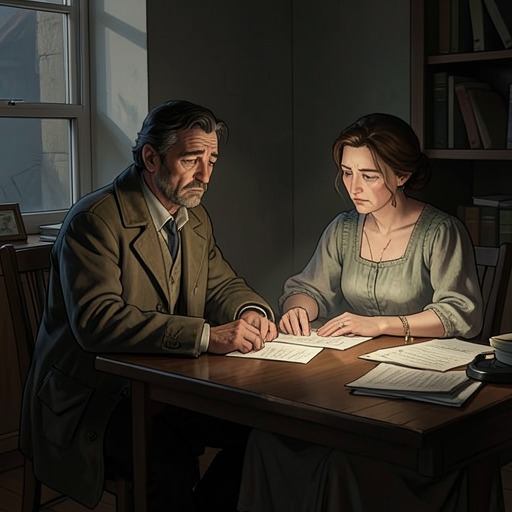
Irene Mengele
The Disappearance of Josef MengeleIrene Mengele is remembered in the book chiefly through the portrait, letters, and recollections of her former husband, Josef Mengele. Their marriage began with an encounter in Leipzig in 1936 and ended in divorce in 1954, after she refused to join his fugitive life in Argentina. Although the narrative often frames her through his attachment to her, her refusal, divorce petition, and intended remarriage mark decisions that redirect the story away from his wishes.
Meeting and Marriage
A bedside portrait dated 1936 becomes the point from which Josef Mengele recalls meeting Irene in Leipzig. He was working at a university hospital; she was passing through the city after studying art history in Florence. She was nineteen. His recollection emphasizes her appearance, idealizing her as blonde and slender and comparing her to a Cranach Venus. The portrait therefore records more than a remembered beginning: it also shows how the narrative presents Irene through the aesthetic judgments of the man looking at her.
His memories place her in the English Garden in Munich, wearing a summer dress and walking on his arm. Another scene follows in an Opel two-door coupe speeding along the Reich’s motorways on their wedding day, on the eve of war. Josef remembers Irene as happy in the car. These images of courtship and marriage are his recollections, not an account narrated from her perspective; they establish the intimacy he later invokes without telling the reader how she understood their life together.
Separation and Correspondence
The decisive separation comes when Irene refuses to accompany Josef Mengele and their young son to Argentina. He remembers her refusal as a rejection of the life of a fugitive across the ocean. His resentment is sharpened by the knowledge that his name appears on the United States list of war criminals and has been cited in several trials. The danger attached to his identity forms part of the circumstances of their separation, but the narrative specifically records her decision not to follow him rather than supplying a fuller explanation in her own words.
The distance does not immediately end their correspondence. On the third Sunday of Advent, seated at a bistro table in a harbour, Josef writes her a letter unusually ardent in its expression of love and regret at being far away. He revisits their shared past: nights together, a summer in Auschwitz, Christmases spent close together after his return from the front, and a final meeting in snowy woods. There, he had again asked her to cross the Atlantic. The remembered scenes culminate in another appeal to join him, making the letter a record of his continuing desire for reunion as well as a review of the past.
Irene’s response is more restrained in the account. She sends a photograph of Rolf wearing lederhosen, wishes Josef a happy new year for 1950, and advises him to buy something; the surviving passage breaks off before identifying what. The contrast between his emotionally expansive letter and her brief, practical reply is clear, though the text does not establish what she felt beyond what her response conveys. The photograph also keeps their son present in a correspondence otherwise shaped by separation.
Divorce and the Burned Portrait
When Irene files for divorce so that she can marry a shoe salesman from Freiburg, Josef’s remembered attachment turns to anger. He takes her photograph from its frame and burns it at the window. The portrait, which had carried the memory of their meeting, is reduced to ashes; a draft scatters what remains in the warm air of Buenos Aires. The destruction is a concrete response to the news, but it does not undo the separation or restore control over Irene’s decision.
Josef calls Haase and Rudel to find an Argentine defense attorney who can contact her lawyer in Günzburg. He says money is no obstacle, yet insists on placing numerous intermediaries between himself and Irene’s legal representative, like screens. He also refuses to do his former wife any favors. The practical arrangements thus carry the same opposition as the burning photograph: he involves himself in the divorce process while insisting on distance and withholding help. The divorce is finalized in Düsseldorf on 25 March 1954.
Narrative Perspective and Significance
Irene’s characterization is shaped by an imbalance of perspective. Josef’s memories supply the portrait, the scenes of courtship, and the emotional language of longing; her own position is most legible through actions and brief details reported by him or others. She declines to cross the Atlantic, sends a photograph of Rolf, files for divorce, and intends to marry again. These choices give her a consequential presence without making her an independently narrated viewpoint character.
Even years later, Irene remains a subject Josef asks about. When Hans Sedlmeier tells him that she is doing well and remains radiant, the report briefly reconnects him to the family life from which he is separated. Sedlmeier also says that Rolf is studying law in Freiburg im Breisgau and is distant from the wider family under his mother’s influence. The same conversation turns to the danger of continued correspondence: strangers are prowling around the factory and family home in Günzburg, and Sedlmeier says they must stop writing to each other. Irene’s place in the narrative is therefore neither simply that of a lost beloved nor merely a figure in Josef’s private recollections. Her independent decisions shape the end of the marriage, while the surviving account shows how his longing, resentment, and precarious circumstances continue to frame the way she is remembered.