Italy
The Disappearance of Josef MengeleIn the account of Josef Mengele’s flight after the war, Italy is less a destination than a passage between hiding in Europe and a new life under a false identity in South America. Its mountain paths offered a way out of Bavaria; Genoa became the port from which the fugitive embarked for Argentina. The route also connected him to a wider system of expatriation networks, in which intermediaries, officials, and forged identities helped fugitives cross borders. Italy’s importance lies in this double role: a terrain to traverse and a departure point from which concealment could continue overseas.
Crossing into South Tyrol
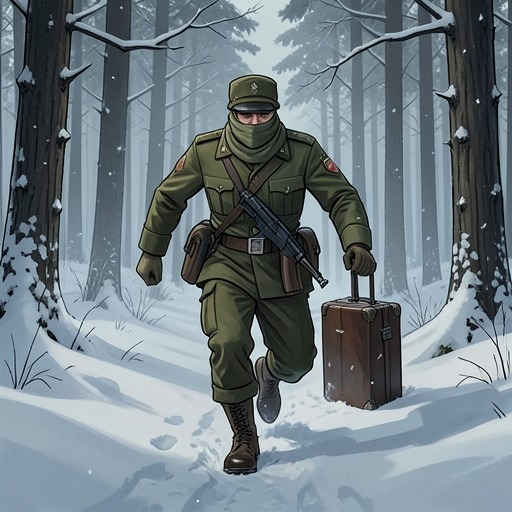
After leaving Poland in January 1945, Mengele first passed through several identities and circumstances: he escaped disguised as a German soldier, spent weeks in an American prisoner-of-war camp, and was released using papers in the name Fritz Ullmann. He then spent three years concealed on a farm in Bavaria near Günzburg, working with hay and potatoes under the name Fritz Hollmann. This rural concealment ended when he left at Easter, two months before his later arrival in Argentina.
The journey south took him across the Dolomites by forest paths and into South Tyrol, where he became Helmut Gregor. The crossing made Italy the first stage of a renewed escape rather than its conclusion. A fugitive who had spent years hidden on a farm now had to move through a route that depended on both physical passage and a replaceable identity. His arrival in South Tyrol marked another change of name, but not an end to the need for concealment.
Genoa and the departure overseas
From South Tyrol, Gregor reached Genoa. There he dealt with Kurt, a smuggler who helped smooth his emigration through Italian and Argentine authorities. Gregor presented himself as a scientist and high-level geneticist and offered money in the hope that Kurt could arrange for a secret-police official to spare him the customs process. Kurt accepted the money but explained that such privileges were reserved for more prominent figures of the old regime, not a former SS captain. He nevertheless promised to send a telegram to Buenos Aires.
The promised assistance at the port proved unreliable. Gregor had been told that a German doctor would meet him at the quayside and take him to the home of Gerard Malbranc, but no doctor appeared. Unsure whether to go on alone, he waited among the departing passengers until he was nearly the last left on the quay. He eventually followed two Calabrian travelers into a shared taxi, preferring company to facing his first day in South America alone. The episode shows the precariousness of the Italian transit: an intermediary could open a route, but could not guarantee that each link would work as promised.
Italy within the escape network
Genoa was not represented as an isolated point of improvisation. The account describes Carlos Fuldner being sent by Juan Perón to Spain, Switzerland, Rome, and Genoa, where Gregor embarked. Fuldner and Rudi Freude were responsible for networks of escape routes known as ratlines, built from chains of expatriates, diplomats, corrupt officials, intelligence contacts, and clergy. In this account, Italian cities form part of a larger transnational system that moved people toward South America; the route depended on contacts operating across national borders rather than on a single facilitator or institution.
That system offered assistance without erasing the individual dangers of travel. In Genoa, Gregor had enough money to seek favors, yet Kurt declined to secure him special treatment at customs. On arrival in Argentina, Gregor still had to present his International Red Cross travel document, landing card, and entry visa under his assumed name. Italy thus occupies a middle position in the account: it provided access to the port and to an organized escape route, but the passage through it did not itself confer safety or settle the fugitive’s status.
Narrative significance
The Italian leg gives concrete shape to the transformation from European concealment to South American exile. The route links the farm near Günzburg, the Dolomites, South Tyrol, and Genoa, while the sequence of names—Fritz Ullmann, Fritz Hollmann, and Helmut Gregor—makes identity change part of the journey itself. Italy is where the fugitive’s movement becomes an outward passage, but the account does not present that passage as smooth: the hoped-for official welcome fails, and the promised doctor is absent.
The country’s significance also comes from its place in the ratline geography. Rome and Genoa appear among the stops used by Fuldner, while Genoa is specifically identified as Gregor’s point of embarkation. From there, the route led to Argentina, where he found sanctuary on 22 June 1949. Italy is therefore not merely a backdrop to the escape. It is the threshold where local concealment, false papers, and transnational assistance converged to carry the fugitive beyond Europe, while leaving the uncertainty and dependence of flight intact.