Josef Mengele
The Disappearance of Josef MengeleJosef Mengele is presented as both a perpetrator of mass violence and a fugitive sustained by false identities, personal networks, and postwar failures of accountability. At Auschwitz he used the authority of a physician to select deportees for life or death and to conduct experiments on prisoners. After the war he repeatedly reinvented himself, eventually settling in Brazil under another name; he died without facing a court, and his identity was confirmed only years later through forensic investigation and DNA testing.
Identity and Wartime Role
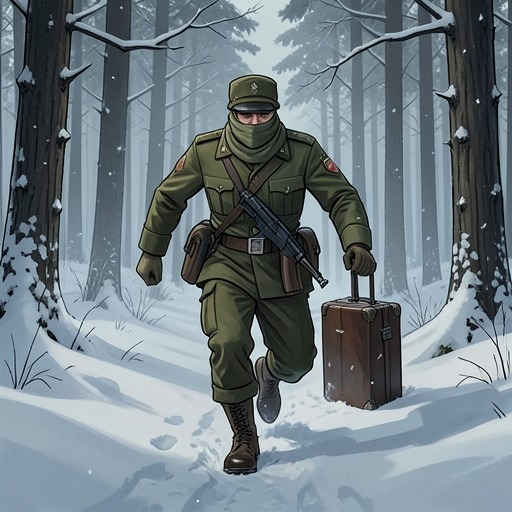
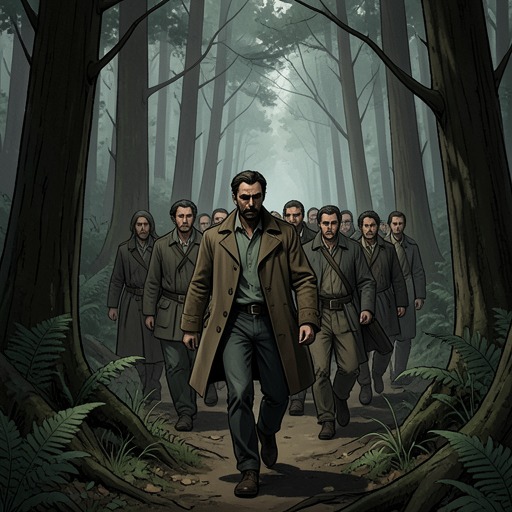
Mengele’s postwar flight begins with the collapse of Nazi Germany. In January 1945, he fled Poland disguised as a Wehrmacht soldier, ahead of the advancing Soviet forces. He was briefly held in an American prisoner-of-war camp, then released using false papers in the name of Fritz Ullmann. For three years he hid on a farm in Bavaria near Günzburg, working under the name Fritz Hollmann. In 1945 he crossed the Dolomites by forest paths into South Tyrol, adopted the name Helmut Gregor, and reached Genoa with the assistance of a smuggler. These identities were not incidental aliases: each allowed him to move farther from the life and crimes he was trying to conceal.
In May 1943, Mengele had arrived at Auschwitz, where the book identifies him as the Angel of Death. He worked amid the deportations and mass killing of Hungarian Jews, standing at the selection ramp and directing arrivals toward forced labor or death. His role joined the routine authority of a camp physician to the machinery of extermination: the gesture of selection made him an active decision-maker, not merely a witness to the system around him.
The account also sets out the connection between his medical work and the experiments he ordered. Miklós Nyiszli, a Jewish physician forced to work for Mengele, later recorded the experience in a published account. Prisoners, including twins and dwarves, were subjected to painful and exhausting procedures presented as research. Mengele’s interest continued even as Germany’s defeat became apparent. Nyiszli’s testimony describes a man who devoted sustained attention to case files and laboratory work, including concern over a stain on a dossier cover. The contrast is stark: meticulous care for the paperwork of research existed alongside complete disregard for the people being studied.
Reclaiming His Name
When Mengele reached Buenos Aires, he presented himself as Helmut Gregor, a mechanic born in South Tyrol. His International Red Cross travel document gave a date and place of birth, nationality, occupation, and local address that supported this constructed identity. During the customs inspection, however, officials found syringes, notebooks, anatomical drawings, blood samples, and cell fragments among his belongings. The contents sat uneasily beside his declared profession. He had kept the research materials from his former life while fleeing Poland, despite the risk that their discovery could expose him.
By 1956, practical needs made continued anonymity less useful. Mengele wanted to settle and remarry, and he needed to recover his legal identity to obtain financing for a house and invest in the pharmaceutical company Fadro Farm. He went to the West German consulate in Buenos Aires and supplied information that established he was Josef Mengele, including an admission that he had lived under a false name since entering Argentina. The consular process did not result in his arrest. In September 1956, he received a civil registration form and birth certificate in his own name; he then regularized his status with Argentine authorities and obtained a residence permit and German passport. His documents described him as an entrepreneur and maker of wooden furniture and toys.
The ease of this return to his name is one of the account’s central reversals. The false identity had protected him, but the official restoration of his identity did not expose him to meaningful consequences. Mengele could acquire a house and resume business activity while remaining a wanted war criminal. His wife Martha and nephew Karl-Heinz joined him in Buenos Aires; Karl-Heinz was presented as his son. The family’s domestic and commercial arrangements thus helped turn an escaped perpetrator into a man apparently re-established in ordinary life.
Pursuit, Networks, and Renewed Flight
The threat to this arrangement grew through the work of Hermann Langbein, an Auschwitz survivor who investigated Mengele and assembled evidence against him. On 25 February 1959, a prosecutor in Freiburg im Breisgau issued an arrest warrant for multiple cases of premeditated murder and attempted murder. Langbein pressed for the authorities to seek Mengele’s extradition from Argentina. When news of the warrant reached Mengele through Hans Sedlmeier, he began dismantling his life there: he sold his villa and shares in Fadro Farm, closed bank accounts, and prepared to leave with scientific journals packed away. Martha and Karl-Heinz remained in Argentina, with a promise that they would meet again in Asunción.
Mengele’s next refuge depended on a broader network of former Nazis and sympathizers. Hans-Ulrich Rudel helped him pursue Paraguayan citizenship, where the absence of an extradition treaty with West Germany offered protection. The application did not meet the ordinary five-year residency requirement, but Rudel intervened with Paraguayan officials, presenting Mengele as a useful political refugee. In November 1959, Mengele received Paraguayan citizenship, a residence permit, a certificate of good behaviour, and an identity card. The case shows how borders and bureaucratic procedures could impede prosecution while personal influence helped him cross them.
Mossad’s plans briefly brought the danger closer. Isser Harel intended to use the operation to capture Adolf Eichmann in Buenos Aires as an opportunity to seize Mengele as well. The intelligence service had only incomplete information about Mengele’s identity and whereabouts, and planned to act after Eichmann’s arrest in May 1960. Mengele, meanwhile, continued moving among Paraguay and Argentina, meeting Martha, Karl-Heinz, and Sedlmeier and considering property in the Alto Paraná region. The planned capture did not take place. By September 1960, Mossad’s surveillance of his family and associates had made the Paraguayan refuge feel unsafe, and he chose flight again.
Rudel supplied a new Brazilian identity card in the name of Peter Hochbichler. Mengele separated from Martha and Karl-Heinz, burned his notes and German passport, and destroyed the Auschwitz specimens he had kept. Before dawn on an October morning, Rudel and Alban Krug drove him by jeep to the Brazilian border. He entered a new phase of concealment, eventually living in Brazil under the name Wolfgang Gerhard. The repeated changes of name and country did not amount to a break with his past; they were attempts to prevent that past from locating him.
Denial, Relationships, and a Fugitive Life
Mengele’s response to exposure was not remorse but self-justification. In 1964, after the universities of Frankfurt and Munich withdrew his doctoral degrees because of his crimes at Auschwitz, he burned Martha’s letter informing him of the decision and left the plantation for the jungle. The loss struck at a source of pride and professional standing. Yet his anger focused on what he regarded as an unjust punishment, not on the victims. He blamed German society and its institutions for having encouraged racial and eugenic ideas, while insisting that he had served a national mission. His reasoning shifted responsibility outward: from himself to the regime, from individual decisions to the state, and from his crimes to the postwar society that had now disowned him.
He also resented that many figures associated with Nazi research and industry had resumed careers or avoided prosecution. He remembered his mentors Eugen Fischer and Otmar von Verschuer, with whom he had been connected through eugenics and research, and complained that they had escaped consequences. That resentment did not amount to an acknowledgment of the prisoners harmed by the work. The book places his grievances beside the evidence of what he had done, making the distance between his self-image and his actions part of his portrait.
His relationship with his son Rolf brings that distance into direct confrontation. Rolf eventually traveled to Brazil to ask what his father had done at Auschwitz. Mengele answered by describing selection as military and scientific duty, claiming that he had saved lives and that obedience to Hitler’s policy left him no choice. He cast prisoners as threats to a biological community and portrayed the killing of those deemed unable to work as an unavoidable consequence of war. Rolf did not accept this account as an answer; he turned away rather than continue listening. The exchange exposes the difference between Mengele’s fluent ideological defense and the moral question his son had asked.
Mengele’s life in Brazil remained dependent on others and increasingly shaped by fear, secrecy, and conflict. After Herberts Cukurs was killed by a Mossad unit in 1965, Mengele heightened his security, adding dogs, using binoculars, and watching the surrounding countryside from a tower. He also concealed his correspondence with Germany through initials and intermediaries, sending letters through postal addresses in Switzerland and Brazil and shifting from handwriting to a typewriter. At the same time, his domestic refuge was unstable. His relations with Geza Stammer were openly hostile, and when the Stammers planned to sell their farm and move in 1968, Mengele refused to abandon his own position. Rudel suggested a possible refuge with Klaus Barbie in Bolivia, but Mengele would not go: he distrusted the risk of changing countries again and preferred the control he believed he possessed in Brazil.
Death, Identification, and Significance
In 1979, while staying near the Brazilian coast, Mengele went into the sea and drowned. Wolfram Bossert tried to bring him back to shore, but Mengele was dead. He was buried the next day in Embu das Artes under the false name Wolfgang Gerhard. The burial initially preserved the concealment that had defined his fugitive years: his death was known to a small circle, but his real identity was not publicly established.
The question resurfaced in 1985, when survivors gave testimony at a mock trial at Yad Vashem in Jerusalem. Their accounts described the experiments and selections they had endured, and the proceedings renewed pressure to find and arrest Mengele. Investigators in Brazil followed documents and correspondence seized in Germany to the people who had sheltered him. Bossert disclosed that Mengele had died and was buried under the name Gerhard; Gitta Stammer recognized the man in a photograph under the identity Peter Hochbichler but said she did not know Josef Mengele. These accounts revealed both the aliases and the network that had kept them useful.
On 6 June 1985, the contents of Gerhard’s grave were exhumed at Embu das Artes before a large press presence. Forensic specialists compared the skeleton with photographs and records, examining features that included fingerprints, bones, teeth, and a known pelvic fracture. On 21 June, investigators announced that the remains were Josef Mengele’s to a reasonable degree of scientific certainty. DNA testing confirmed their conclusion in 1992. His remains were stored at São Paulo’s Legal Medical Institute, unclaimed by his family; he was left without a grave.
Mengele’s trajectory is therefore not a story of successful reinvention so much as prolonged evasion. False papers, restored official identity, Paraguayan citizenship, Brazilian aliases, financial and familial assistance, and delays across national jurisdictions repeatedly extended his freedom. The eventual identification answered the question of where he had ended his life, but not through a trial or testimony from him under legal scrutiny. The account closes on that distinction: the perpetrator was named and his remains identified, while the victims’ demand for justice outlasted the possibility of holding him personally to account.