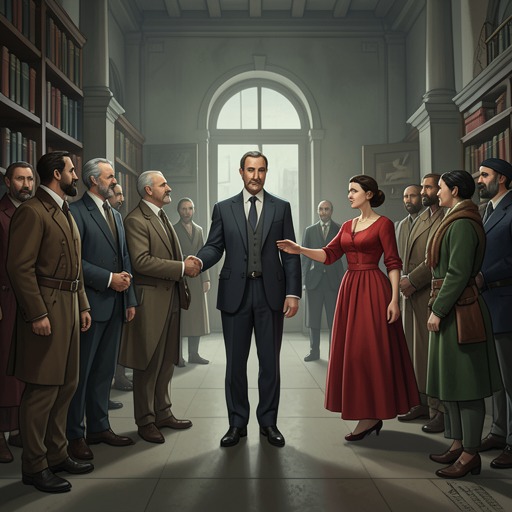
Juan Perón—Eva Perón
The Disappearance of Josef MengeleJuan Perón—Eva Perón is both a marriage and a political partnership: their personal union formed within Juan Perón’s ascent, then became a public instrument of Peronism. He supplied the movement’s governing authority and promise of national transformation; she became its most visible advocate among workers and the poor. Their alliance presented political power not simply as a president’s rule, but as a union between leader and popular representative.
Meeting, Attachment, and Marriage
The relationship began in the wake of the January 1944 earthquake that devastated San Juan. At a charity gala for survivors, the young actress Eva Duarte met Colonel Juan Domingo Perón, then a rising figure among the military officers in power. Perón mobilized the country to aid the devastated city. After the fundraiser, he appeared on the radio program where Eva earned a modest living, and later hired her to work in his department at the Ministry of Labour, where he was pursuing his political career.
Eva became attached to Perón’s passion and generosity, and the two moved in together. Her declarations of loyalty placed him at the center of her world: she cast him as the source of her life and as a figure raised above ordinary political stature. This language of devotion became part of the relationship’s public character, but the partnership also took shape through concrete political proximity: Eva worked in the department through which Perón advanced, and she remained beside him as his offices and influence grew.
Perón became secretary of war and vice president. His growing power met opposition within the military, and in September 1945 he was forced to resign and arrested. His supporters, led by the General Confederation of Labour, mobilized workers, unionists, and the underprivileged to march to May Square in Buenos Aires and demand his release and return to power. The account places Perón and Eva’s marriage in the aftermath of this crisis; a few months later, he won the presidential election. Their personal union thus coincided with his passage from military office, through arrest and mass support, to elected leadership.
A Shared Political Project
Once in power, the couple were presented as joint architects of Argentina’s promised renewal. In 1946 they stood at the head of a coalition backed by the church, the military, nationalists, and the proletariat. Their program called for national liberation and an aesthetic and industrial revolution, with Peronism offering a new beginning and a more dignified life. Perón’s radio performances made him the movement’s commanding voice: he addressed mass audiences with sweeping promises and presented himself as their savior.
The partnership drew strength from a division of public roles. Perón pursued structural changes from the presidency and government, strengthening public services with union support and bringing the national union into the state apparatus. His administration also centralized and nationalized railways, the telephone network, and strategic sectors previously in foreign hands. Eva’s political work was more directly embodied in public encounters. As secretary of welfare, she received trade-union delegates, visited hospitals and factories, opened newly built road sections, and distributed practical goods, including dentures and sewing machines. She established a foundation to assist poor and underprivileged people, and toured the country speaking for the Peronist cause.
Eva’s public visibility made her more than a supportive figure beside the president. Crowds gathered at the Ministry of Labour and the foundation’s headquarters to speak with her or catch sight of her. Her work connected the couple’s national program to acts of assistance and personal access, while Perón’s authority gave that work a place within the state’s political order. Her 1947 tour, during which she was received by Pope Pius XII and several heads of state, extended this role beyond Argentina. Together they embodied a project that claimed to overcome dependence and restore national pride, though its political order also purged universities, the press, and legal and administrative systems and expanded the secret service.
Public Image and Political Strain
The couple’s partnership was also staged through a shared image. During Perón’s later campaign, posters across Buenos Aires paired their names, and enormous banners on 9 de Julio Avenue called on voters to support the two of them as icons of the homeland. The image made Eva’s political importance explicit: she was not merely the president’s spouse but a figure whose presence could be mobilized as part of the regime’s appeal.
On 22 August 1951, hundreds of thousands gathered on the city’s broadest avenue for the announcement of the couple’s candidacy. Perón stood on the official platform as the crowd awaited the appearance of Eva. Her arrival brought an intense reception from supporters, and when the General Confederation of Labour’s secretary-general asked the crowd to proclaim her candidacy for vice president, she did not immediately accept. She asked for time to reflect, first requesting several days, then a day, and then a few hours. The crowd continued to press her to decide; she said she would announce her decision that evening on the radio. The scene showed both the scale of her popular following and the demands it placed on her public role. Perón’s candidacy and authority were joined to a political choice about whether Eva herself would formally share the government.
The narrative places this public spectacle beside the private uncertainty of Eva’s health. Away from the crowd, Hans-Ulrich Rudel told Gregor an unconfirmed rumor that she was seriously ill, adding that if it were true their friend was in grave difficulty. The report is presented as confidential hearsay, not as a public disclosure by either Perón or Eva. Even in that limited form, it reveals how much the political alliance appeared to depend on her continued presence: the prospect of her illness was treated as a threat to Perón’s position as well as a personal concern.
Significance of the Partnership
The relationship’s importance lies in the way private attachment and political function repeatedly meet without becoming identical. Eva’s devotion to Perón is described in intimate language, yet her public work has its own reach: she travels, receives delegates, distributes assistance, and becomes the focus of crowds. Perón, meanwhile, builds power through government, radio, unions, and the presidential campaign. Their partnership makes these different kinds of authority appear complementary, binding the leader’s national promises to Eva’s direct, highly visible contact with supporters.
That union also carries the contradictions of the political order they represent. Their project promises dignity, welfare, and a break with established privilege, while the regime tightens its control over institutions and public expression. Eva’s charitable and popular role gives the couple’s rule a language of service and closeness; it does not erase the authoritarian measures accompanying it. The relationship therefore functions in the narrative as more than a personal history: it is a means by which Peronism joins affection, mass loyalty, social assistance, and state power in a single public image.