Liberating Revolution and Perón’s Fall (1955)
The Disappearance of Josef MengeleThe Liberating Revolution and Perón’s Fall in 1955 transformed Argentina’s political order and disrupted the protection that Nazi fugitives had enjoyed under Juan Perón. The change did not immediately bring them to justice: it replaced a comparatively secure refuge with uncertainty, political repression, and a continuing struggle over extradition and state sovereignty.
Background: Argentina as a refuge
In the late 1940s, Perón’s government welcomed thousands of Nazis, Fascists, and collaborators, including military personnel, scientists, engineers, and doctors. Perón personally oversaw an escape system coordinated from Buenos Aires by an Information Office headed by Rudi Freude. Freude and former SS captain Carlos Fuldner helped organize the ratlines: networks of diplomats, officials, intelligence operatives, and clergy through which fugitives could leave Europe and establish themselves in South America. Their importance lay not only in helping individuals travel, but in connecting them to a political environment willing to receive them.
Buenos Aires became a gathering place for former members and supporters of the defeated European far right. The city’s Nazi social world included former officials, Fascists, and collaborators from several countries. At a December gathering aboard the Falken, Gregor and Willem Sassen encountered prominent figures including Ante Pavelić, while Sassen identified other former Fascist and Nazi associates. In the city, former spy and arms dealer Gerard Malbranc also hosted a circle of German-speaking visitors that included Ludolf von Alvensleben, Eberhard Fritsch, Sassen, and Frederico Haase. These connections illustrate the social landscape in which fugitives could find company and assistance; they were not, by themselves, proof that every member of the circle took part in the same escape operation.
Revolt and Perón’s departure
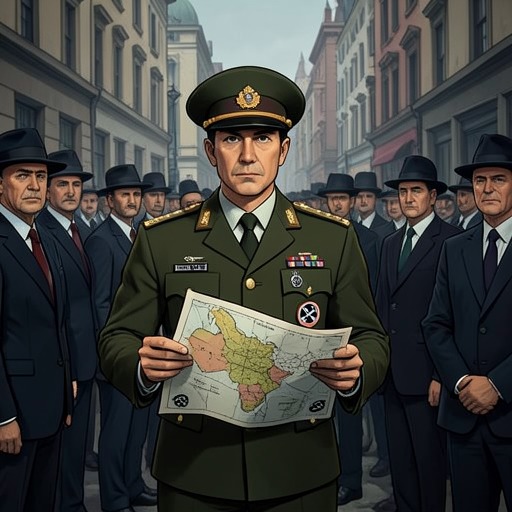
The crisis sharpened on 16 June 1955, when anti-Peronist military leaders known as the Gorillas bombed the presidential palace and May Square. Perón survived the coup attempt, but his political position weakened as conflict spread. The Church opposed his policies, including the cancellation of subsidies to religious schools and the legalization of divorce and prostitution. Demonstrations and counter-demonstrations accompanied arrests, excommunication, attacks on chapels, and escalating threats of retaliation.
In September, mutinies broke out in Córdoba and Bahía Blanca. On 16 September the navy blockaded Buenos Aires and threatened to bomb its refineries. With Argentina on the brink of civil war, Perón resigned and fled aboard a Paraguayan gunboat bound for Asunción. He burned compromising files before leaving. A military junta took power; after one general was deposed, Pedro Eugenio Aramburu became the leading figure of the new regime and promised to purge the country of Peronism.
The Liberating Revolution and its measures
From his home, Gregor listened to Aramburu announce penalties for public display of images of Perón or his deceased wife, and for publicly using Peronist names and expressions. Under the banner of the Liberating Revolution, union leaders were arrested and thousands of public officials dismissed. The authorities renamed places associated with Perón, while the name Evita was also removed from children who had been given it. The Foundation associated with Eva Perón was closed; its property and objects were destroyed or displayed as evidence of the fallen couple’s alleged excesses. Eva Perón’s embalmed body disappeared.
The measures reached beyond the removal of individuals from office. The new government sought to erase Peronist symbols from public life, from place names and public language to objects associated with the former leadership. Perón himself took refuge in Panama, where he lived in exile and began a relationship with dancer María Estela Martínez, whom he renamed Isabel and later married. Meanwhile, Jorge Luis Borges was appointed head of the National Library and professor at the Buenos Aires Faculty of Letters.
Consequences for fugitives and the pursuit of Mengele
The fall of Perón alarmed Nazis who had regarded Argentina as a reliable refuge. Aramburu’s government threatened a purge, German-backed companies faced closure, and police placed Hans-Ulrich Rudel under house arrest at his home in Córdoba. Some war criminals left the country. Josef Mengele considered escaping to Paraguay, but decided to wait, reasoning that he had kept out of politics and was an honest entrepreneur. He stopped performing illegal abortions and hoped that Aramburu’s admiration for Prussian military traditions might make accommodation possible.
That calculation did not restore the security of the Perón years. Mengele later left Argentina, and the possibility of extradition became a central danger. In 1959, after Hermann Langbein’s investigations contributed to an arrest warrant issued in Freiburg im Breisgau, Hans Sedlmeier warned Mengele that he had to leave Buenos Aires. The extradition request became entangled in procedures between West Germany, Argentina, and Paraguay. In November 1959 Paraguay granted Mengele citizenship, a residence permit, a certificate of good behaviour, and an identity card, despite the legal requirement that applicants have lived in the country for five years.
The cross-border pursuit continued after the fall of Perón. Isser Harel planned to capture Mengele after the Mossad operation against Adolf Eichmann, but the attempt did not succeed. In 1962 West Germany requested Mengele’s extradition from Paraguay; President Alfredo Stroessner refused to cooperate, and Paraguayan officials defended the country’s authority over its citizens. In 1964 West German officials publicly stated that Mengele was a Paraguayan citizen living near the tri-border region and traveling to Brazil, while Stroessner insisted that he had already left Paraguay and rejected foreign pressure. The political rupture of 1955 had therefore unsettled the refuge system without ending the protections, jurisdictional obstacles, and delays on which fugitives could continue to rely.