Mengele’s Arrival in Argentina
The Disappearance of Josef MengeleJosef Mengele’s arrival in Argentina on 22 June 1949 marked the transition from a European fugitive’s improvised escape to a South American life sustained by false identity, personal connections, and political protection. He landed in Buenos Aires as Helmut Gregor, presenting himself as a mechanic while keeping the traces of his medical and scientific past close at hand.
Escape route and assumed identity
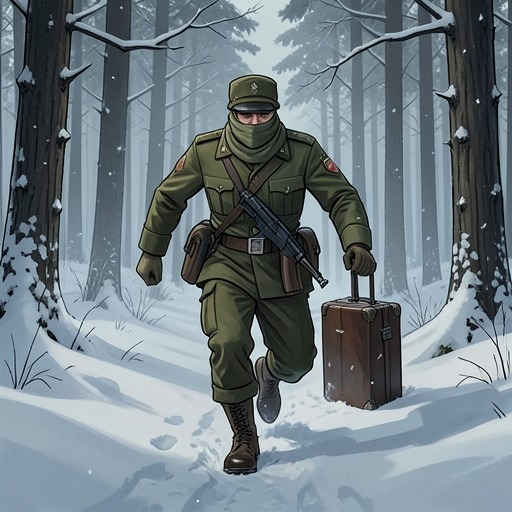
After fleeing Poland in January 1945, Mengele had escaped in the clothing of a German soldier and spent a short period in an American prisoner-of-war camp. False papers secured his release under the name Fritz Ullmann. He then hid for three years on a farm near Günzburg, living as Fritz Hollmann, before crossing the Dolomites by forest paths to South Tyrol. In Italy he became Helmut Gregor, and a fixer named Kurt arranged his emigration through the Italian and Argentine authorities.
The passage to Argentina took three weeks aboard the North King. As the ship reached the harbour, passengers watched for land: some Germans sang a military song, Italians crossed themselves, and Jewish passengers prayed. Mengele had hoped a secret-police contact would meet him and ease his passage through customs, but the contact never appeared. Kurt had taken his money and sent a telegram, yet no official came to receive him.
Customs and the Gregor papers
At the customs desk, Mengele presented an International Red Cross travel document, a landing card, and an entry visa. These identified him as Helmut Gregor, born in Termeno, South Tyrol, a German citizen of Italian nationality, Catholic, and a mechanic. The paperwork also gave his height, eye colour, date of birth, and a Buenos Aires address in Florida, care of Gerard Malbranc.
The inspection exposed a conspicuous discrepancy between the declared occupation and the contents of his luggage. Alongside carefully folded clothes, books, opera records, and a portrait of a blonde woman, the smaller case held hypodermic syringes, notebooks, anatomical drawings, blood samples, and cell fragments. The port doctor examined the material and questioned Gregor in Spanish. Mengele answered in German that he was an amateur biologist; the doctor, unable to make much of the notes and apparently eager to leave for lunch, signalled that customs could let him through.
The case mattered because Mengele had carried it out of Europe despite the danger of discovery. He had first entrusted it to a nurse in the Soviet zone of Germany, later recovered it, and then passed it to Hans Sedlmeier, his childhood friend and confidant of his industrialist father. Sedlmeier returned it before Mengele left Italy, with an envelope of cash inside. The scientific materials therefore travelled with him through successive disguises and borders, even as his official identity reduced him to a mechanic.
Argentina as refuge
Mengele initially waited on the quay for the German doctor he had been promised, but no one appeared. Unsure about going directly to Malbranc’s address and reluctant to spend his first day in South America alone, he eventually shared a taxi with two other passengers. The address on his papers linked him to Malbranc, a former Nazi spy and arms dealer who later became one of his hosts in Buenos Aires. After they met through the city’s German exile community, Malbranc invited him to move into his villa.
Mengele’s arrival took place within a larger system of organized escape. Juan Perón established an Information Office in Buenos Aires under Rudi Freude, while Carlos Fuldner was sent through Spain, Switzerland, Rome, and Genoa. Freude and Fuldner helped coordinate the Nazi Ratlines: networks of expatriation involving diplomats, corrupt officials, intelligence operatives, and clergy. Buenos Aires became a gathering place for former Nazis, Fascists, and collaborators, a political and social environment in which fugitives could find contacts and assistance.
The city’s exile networks were visible in private gatherings as well as official arrangements. At a meeting aboard the Falken, Mengele accompanied Willem Sassen into a gathering that included Ante Pavelić and other European Fascist figures. Malbranc’s home later brought together former Nazi officials and supporters; among its regular visitors were Sassen and Eberhard Fritsch, while Frederico Haase also became part of the circle. These connections help explain how a false identity could be paired with practical support and a place in an established community of exiles.
Pursuit across borders
The sanctuary did not end the possibility of prosecution. Hermann Langbein, a survivor of Dachau and Auschwitz and a co-founder of the International Auschwitz Committee, gathered evidence and traced Mengele to Buenos Aires. After German courts resisted taking up the case, a prosecutor in Freiburg im Breisgau issued an arrest warrant on 25 February 1959 for multiple cases of premeditated murder and attempted murder. Langbein pressed for an extradition request to Argentina.
The request moved slowly through Argentine and West German institutions as Mengele’s allies prepared an escape to Paraguay. In November 1959, Paraguay granted him citizenship and other official documents, despite the residency requirement that made his application unlawful. The new citizenship gave him another barrier against extradition: Paraguay’s president, Alfredo Stroessner, refused West German pressure to surrender him. The route that had first carried Gregor from Europe to Argentina thus became part of a wider contest among national jurisdictions, diplomatic requests, and the protection offered by political allies.
Significance of the arrival
The customs inspection briefly brought Mengele’s concealed past into view: the documents named a mechanic, while the small case contained the tools and records of a scientific life. Yet the discrepancy did not stop his entry. The episode shows how escape depended not only on forged or misleading identities but also on the movement of people, money, documents, and personal connections across borders.
Argentina was a destination, but also a staging point in a longer fugitive life. The networks that helped Mengele settle in Buenos Aires connected him to a broader community of former Nazi and Fascist exiles; later, legal pursuit and Paraguay’s refusal to extradite him demonstrated how national institutions could obstruct one another as readily as they could assist a fugitive. His arrival therefore began a period of refuge without bringing the danger of exposure to an end.