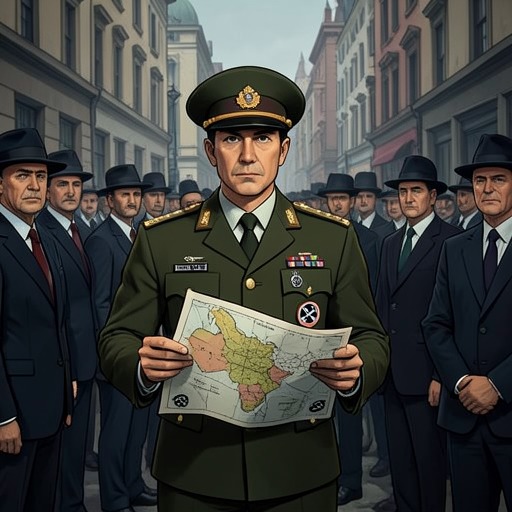
National Socialist Centre in Buenos Aires
The Disappearance of Josef MengeleThe National Socialist Centre in Buenos Aires was a postwar gathering point for European fascist movements and Nazi sympathizers who sought to recast their cause in Christian and anti-Communist terms. Its significance lies in the way it joined calls for amnesty and political coordination to a larger fantasy of a renewed European struggle, while treating Juan Perón’s Argentina as a potential sponsor and hemispheric counterweight to the United States.
Formation and Aims
A few months before a gathering addressed by Pierre Daye, he had helped establish the Centre in Buenos Aires. It brought together Rexists, Fascists, and Ustaše, presenting their common cause as opposition to both American capitalism and Russian Bolshevism. The group also agitated for amnesty for war criminals imprisoned in Europe, describing those prisoners as Christian and framing their release as a political necessity. The Centre’s program thus linked several objectives: coordination among far-right movements, resistance to the two powers it identified as its principal enemies, and the rehabilitation of imprisoned wartime allies. Its appeal to Christian solidarity made the demand for amnesty part of a broader attempt to give fascist politics a renewed moral and religious vocabulary.
Daye’s Political Vision
At the gathering, Daye cast social conflict as an enduring struggle rooted in the biblical story of Cain and Abel. He condemned cosmopolitan materialism and the rejection of God as the source of society’s misfortunes, then called on like-minded families to continue the fight. The Centre’s envisioned future was not limited to activity in Argentina: Daye presented Europe as a destination to which the movement would eventually return. Daye credited Juan Perón with making a rapprochement between Nazism and Christianity a mission, and described Argentina as a possible counterweight to the United States across the hemisphere. He portrayed this project against the prospect of conflict between the United States and the Soviet Union, invoking the recent Berlin blockade as evidence of mounting international tension. These were Daye’s political claims, not evidence that the Centre itself controlled Argentine policy or that its projected return to Europe took place.
Argentina and the Wider Nazi Milieu
The Centre emerged in a country whose political climate offered a receptive setting for nationalist and authoritarian rhetoric. Juan Perón’s government promised social transformation and national independence while consolidating power and restricting dissent. Daye’s praise of Perón and his claim that Argentina had granted the movement freedom connected the Centre’s ambitions to that political context, but the evidence presents the organization as a grouping of European far-right adherents rather than as a formal arm of the state. The later capture of Adolf Eichmann in Buenos Aires changed the atmosphere for Nazi exiles and their allies. The book records that Nazi groups in the city fell apart in its aftermath, as suspicion and public scrutiny intensified. It does not establish that the Centre alone dissolved at that moment; rather, its history belongs to a wider network whose efforts at solidarity and political revival were undermined as the hunt for Nazi war criminals became more visible.