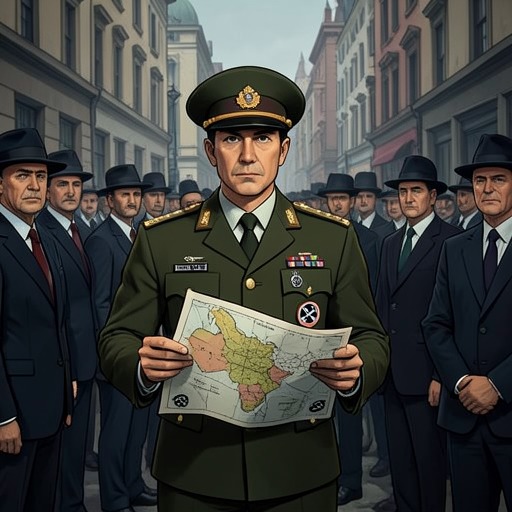
Pedro Eugenio Aramburu
The Disappearance of Josef MengelePedro Eugenio Aramburu was the Argentine general who succeeded Juan Perón’s government in 1955 and promised to purge the country of Peronism. His administration tried to erase Peronist symbols and language from public life. The campaign also unsettled Nazi fugitives who had relied on Argentina as a place of refuge, exposing how abruptly a change of government could alter the risks of their exile without, by itself, securing justice for their crimes.
Rise to Power
In September 1955, Argentina approached civil war. After the navy blockaded Buenos Aires and threatened the refineries, Juan Perón resigned, burned compromising files, and fled aboard a Paraguayan gunboat bound for Asunción. A military junta led by an alcoholic general took power; within weeks, Aramburu displaced him and pledged to purge the country of Peronism.
Aramburu’s government called its project the Liberating Revolution. The name promised national restoration, but the measures described in the account were also a systematic campaign against the symbols and public presence of the defeated movement. His authority was exercised not only against political leaders but through rules governing what Argentines could display, say, and name.
Suppression of Peronism
Listening to his radio, Gregor heard Aramburu announce prison sentences of six months to three years for displaying images or sculptures of the fugitive Juan Perón or his deceased wife, Eva Perón, and for publicly using Peronist names and expressions or praising the former dictatorship. Union leaders were arrested, and thousands of officials lost their positions. The reach of the campaign extended through everyday geography: cities, neighborhoods, provinces, streets, stations, squares, pools, racetracks, stadiums, and dance halls named for Perón were renamed. Even children called Evita had to change their first names.
The treatment of Eva Perón’s legacy made the political reversal material. Her foundation was closed; its sheets were burned and its cutlery melted down. Statues were toppled, while objects belonging to the former couple, including mopeds and ornaments, were publicly exhibited as signs of their alleged vice and greed. Eva Perón’s embalmed body disappeared amid this effort to dismantle the fallen government’s public presence.
Effects on Nazi Exiles
Aramburu’s promise to punish those who had profited from the previous regime alarmed Nazis living in Argentina. Companies backed by German capital were forced to close, police searched Uli Rudel’s home in Córdoba and placed him under house arrest, and war criminals including Bohne left the country. One exile recorded the bitterness of displacement in his diary. Josef Mengele considered escaping to Paraguay but decided against it: he believed he had avoided politics and had not belonged to Juan Perón’s inner circle. He stopped performing illegal abortions and waited for conditions to change, reasoning that Aramburu’s admiration for Prussian military traditions might make the new authorities more accommodating to Nazis.
That expectation proved a calculation, not protection. In 1959, a prosecutor in Freiburg im Breisgau issued an arrest warrant for Mengele on multiple counts of premeditated murder and attempted murder. The later effort to secure his extradition encountered delays across Argentine and West German institutions, while supporters in Paraguay helped him obtain citizenship. Aramburu’s government had made Argentina less secure for some Nazi fugitives, but the subsequent record shows that political disruption and persecution of Peronism did not amount to a sustained, effective pursuit of Mengele.
Political Legacy in the Narrative
Aramburu’s importance lies in the sharpness of the transition he imposed: the symbols of Peronist rule were removed from public life, while people associated with the former regime faced arrest or dismissal. For the exiles, the same transition brought a sudden threat of exposure and flight. Yet the account contrasts the breadth of the anti-Peronist campaign with the slow, fragmented pursuit of Nazi criminals that followed. The state could act forcefully to rename streets and suppress political expression, while cross-border criminal accountability remained vulnerable to delay, jurisdictional obstacles, and protection by allies.