Poland
The Disappearance of Josef MengelePoland occupies two connected roles in the account of Josef Mengele: it is where his wartime career in the Nazi medical system led to Auschwitz concentration camp, and the place he fled in January 1945 as the German defeat approached. His departure removed him from the immediate reach of the advancing Soviet forces, but it did not erase the traces of his work there. The country remains the point of origin for both his escape and the evidence, testimony, and later efforts to bring him to justice.
Wartime Assignment and Auschwitz
Mengele’s service in Poland followed earlier military and Schutzstaffel (SS) appointments. He had joined the Nazi Party in 1937 and the SS a year later; he later worked as a medical expert in the SS Race and Resettlement Main Office in occupied Poland. After the German invasion of the Soviet Union, he served as a medical officer with SS Division Wiking, including on the Eastern Front, before being posted to Ukraine. His account of his service to Eberhard Fritsch included his military record and awards, but he did not identify Auschwitz by name in that conversation. The omission is notable because his public self-presentation emphasized military service and exile while leaving his central role in the camp unspoken.
At Auschwitz concentration camp, Mengele’s authority extended over selection and medical experimentation. The narrative situates his work within a system in which deported people were subjected to life-or-death decisions and prisoners were compelled to assist the camp’s medical operations. Miklós Nyiszli, a Hungarian Jewish doctor and one of the Sonderkommando prisoners, was forced to carry out procedures under Mengele’s orders. His later written account described the medical examinations imposed on twins and the lethal consequences of the experiments. Poland is therefore not merely a military posting in Mengele’s biography: it is the setting in which his medical title and institutional power served the camp’s machinery of persecution and murder.
Flight from Poland and the Carried Record
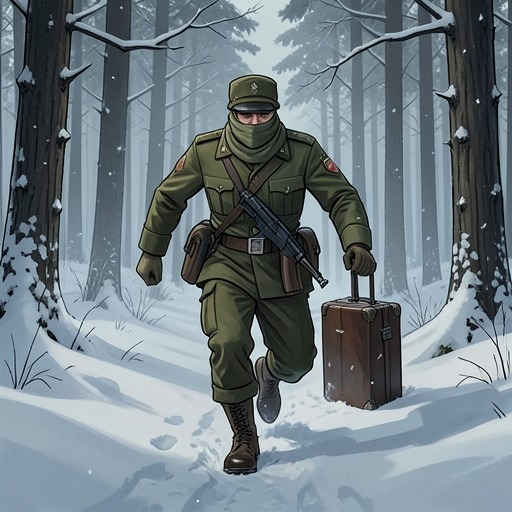
In January 1945, Mengele left Poland in panic, disguising himself as a Wehrmacht soldier as he tried to escape the Red Army. His flight began a sequence of concealment and assumed identities. After a few weeks in an American prisoner-of-war camp, false papers under the name Fritz Ullmann helped secure his release. He then spent three years hidden on a farm near his hometown of Günzburg, using the name Fritz Hollmann, before crossing the Dolomites into South Tyrol and taking the identity Helmut Gregor.
He did not leave behind all the material from his Polish assignment. Among his belongings was a small case containing syringes, notebooks, anatomical drawings, blood samples, and cell fragments. He regarded these materials as the product of lifelong research and feared that discovery by Soviet authorities would cost him his life. During his postwar movements, he entrusted the case to a nurse in the Soviet zone of Germany, later recovered it, and passed it to Hans Sedlmeier, his childhood friend and a confidant of his industrialist father. Sedlmeier returned it before Mengele left Europe, along with cash. The case thus carried a physical connection to his work out of Poland and through the successive stages of his escape.
Poland, Testimony, and the Search
The consequences of Mengele’s service in Poland outlasted his departure. Survivors’ accounts and the records gathered by former prisoners helped sustain the effort to identify and prosecute him. Hermann Langbein, a former prisoner of Dachau and Auschwitz and co-founder of the International Auschwitz Committee, investigated Mengele and assembled evidence. In 1959, a prosecutor in Freiburg im Breisgau issued an arrest warrant for multiple cases of premeditated murder and attempted murder. The ensuing extradition effort crossed national jurisdictions: German authorities sought action in Argentina, while Mengele’s location and changing status frustrated the pursuit. Poland’s place in the story is thus linked not only to the crimes but also to the later work of preserving testimony and converting it into a legal case.
The search repeatedly encountered political and administrative obstacles. Requests moved among ministries, courts, police, and diplomatic offices; in Paraguay, Hans-Ulrich Rudel intervened on Mengele’s behalf as the extradition effort advanced. Years later, German authorities publicly stated that Mengele was living under his own identity in Paraguay and sought to increase pressure for his capture. These developments show how the site of his wartime crimes and the countries through which he escaped became entangled in a wider struggle over jurisdiction, state cooperation, and accountability.
Remembrance and Narrative Significance
Poland also returns as a place of public remembrance. On the fortieth anniversary of Auschwitz’s liberation, survivors gathered at the camp to call for justice, and a group of survivors later traveled to Israel for a mock trial at Yad Vashem. Their testimony recalled the experiments and deaths inflicted under Mengele’s authority. The account places these testimonies alongside the long delay in locating him: the survivors could speak publicly about what had happened even while the man they accused remained beyond the reach of the courts.
Across these episodes, Poland is both a point on Mengele’s wartime and escape route and the ground against which his later concealment is measured. His departure did not close the history of his actions there. The transported research case, survivors’ testimony, the arrest warrant, and renewed investigations each carried parts of that history into other countries and decades, making Poland an enduring reference point for the gap between flight and justice.