Rolf Mengele Visits and Confronts His Father
The Disappearance of Josef MengeleIn 1977, Rolf Mengele’s visit to Brazil turns years of anxious distance into a direct confrontation with his father, Josef Mengele. Rolf asks what his father did at Auschwitz and whether he bears responsibility for its crimes; Josef answers with an elaborate defense of Nazi ideology and duty, not an admission or expression of regret. The visit ends with Rolf leaving early, convinced that the man before him is an unrepentant war criminal. Its decisive revelation is not a hidden confession but the persistence of denial when the question is put face to face.
A Visit Arranged Under Threat
Josef presses for the meeting through letters that mix lamentation, muddled threats, and appeals to his loneliness. He says he may kill himself if Rolf does not come, describes himself as near collapse, and fears that Israelis will murder him. Rolf, a young lawyer, eventually agrees. His father then treats the journey like a military operation: he gives instructions about false trails, multiple hotel bookings, disguises, recognizing surveillance, and arriving with a fake passport. He even recommends training and says Wolfram Bossert could provide a weapon in São Paulo. These precautions reflect Josef’s persistent fear of capture, but the account makes clear that they outstrip the actual danger at the time: in the mid-1970s, West Germany still thought he was in Paraguay, while Israel lacked current information and was no longer planning to kidnap him. Since the Six-Day War, concern about Latin American votes at the United Nations and about violating national sovereignty had also made Israel wary of pursuing an old Nazi in the region.
The preparations bring further delay and strain. Josef insists that Rolf travel alone because he does not know the friend Rolf trusts; he floods Sedlmeier with letters and blames him when Rolf postpones the trip. Rolf falls in love in Germany, and the departure is delayed until 10 October 1977. Before leaving, he meets Karl-Heinz in the Sedlmeiers’ garden. Karl-Heinz gives him several thousand dollars to pass on to Josef, whom the family calls their dear Uncle Fritz. Josef also requests gifts for Bossert and Elsa, including razor parts and Spreewald gherkins, and lace doilies for Elsa. The mundane requests sit strangely beside the elaborate escape precautions: the journey is simultaneously imagined as a dangerous infiltration and managed through family money, errands, and favors.
Arrival in Brazil
Rolf and his friend land in Rio de Janeiro. Rolf presents a passport he has taken from the friend; the friend carries his own valid passport as a backup. The border officer lets Rolf enter. After a night in Rio, Rolf continues alone toward São Paulo, changing taxis at designated points before reaching Bossert’s home. From there the two men drive to Eldorado and Alvarenga Street. Their route ends at number 5555, where an older, moustached man stands outside. The man is Rolf’s father, Josef Mengele.
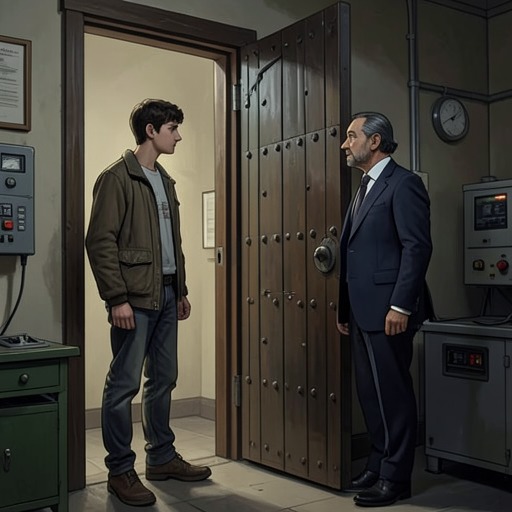
Inside the bungalow, Rolf registers the change in his father from the forceful figure he remembers from a childhood mountain holiday to an old man with a quavering voice. Josef welcomes him tearfully, but Rolf refuses to let the reunion displace the reason for coming. Sedlmeier has warned him that Josef is a formidable actor, and Rolf does not take the tears as an answer. He asks directly why his father went to Auschwitz, what he did there, and whether the accusations against him are true. Josef offers beer and wine, asks about food, and objects to Rolf’s long hair and bell-bottom trousers. Rolf insists that the questions come first.
Josef’s Defense of Auschwitz
Josef responds by presenting a theory of history and biology. Drawing on ideas about the decline of the West, he blames modern technology, capitalism, mass society, individualism, and cosmopolitanism for Germany’s crisis after the First World War. He describes the German nation as needing a renewed vitality and cites Hitler’s projected population: 100 million Germans as a base, 250 million in the medium term, and one billion by 2200. In this account, the state’s racial ambitions become a supposed necessity of historical survival.
When Rolf asks what he himself did at Auschwitz, Josef calls it a military and scientific duty. He describes the arriving prisoners as foreign bodies to be sorted, claims that he selected as many people as possible for labor, and says that the twins used in his research owed their lives to him. He compares selection to decisions in a military hospital and presents the killing of prisoners deemed unable to work as a way of ending suffering. The claims reverse the moral meaning of his actions: the doctor who participated in selection casts himself as a rescuer, and mass murder becomes, in his telling, a consequence of impersonal laws of life.
Rolf drums his fingers on the table and refuses to accept this ideological lecture in place of an answer. He knows the theories about Western decline and did not travel to Brazil to hear his father repeat Nazi doctrine. He listens, however, in the hope that Josef may acknowledge guilt or regret. Instead, Josef says he obeyed orders out of love for Germany and loyalty to its Führer, insists that he did not create Auschwitz or its killing apparatus, and describes himself as one cog among many. He also claims that any excesses were not his responsibility. Rolf turns away and looks out at children playing with a ball, stopping his attention to his father’s explanation without ending the interrogation.
The Questions That End the Visit
Rolf returns to the issue of the Jews and asks whether his father ever felt compassion for the children, women, and old people sent to their deaths, or felt remorse. Josef answers through a dehumanizing biological analogy, comparing Jews to disease-carrying pests. He denies that mercy applies, claims that Jews threaten Nordic humanity, and presents their elimination as necessary. He further calls conscience a sickness that inhibits action and portrays judges as avengers rather than legitimate authorities. These are not passing evasions: they expose the premises holding his defense together, in which an entire people is denied human standing and moral judgment itself is treated as an obstacle.
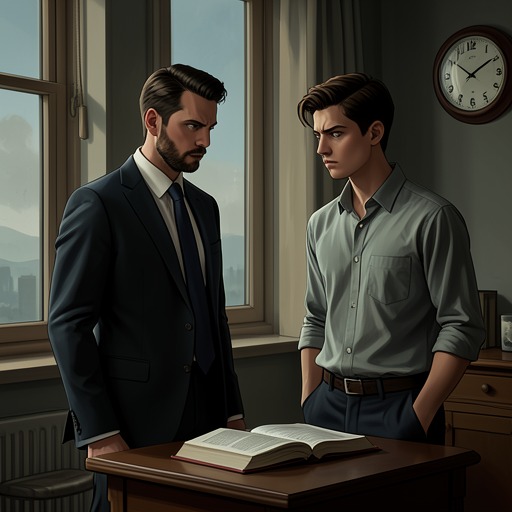
That night, Rolf asks whether Josef killed or tortured people. Josef sits upright, swears that he harmed no one, and compares his role to that of a pilot bombing an enemy city. He argues that Germans did not protest and that the Pope did not protest either; he describes his work as serving the future of the Aryan race and says the individual did not count. When Rolf continues to believe the accounts of his crimes, Josef erupts at his son, blaming his legal education, stepfather, the media, and the younger generation for his disbelief. He demands respect and again insists that he did nothing wrong. The outburst makes the distance between father and son explicit: Rolf seeks an answer about human beings, while Josef continues to defend an abstraction that erases them.
After two days and two nights of discussion, Rolf gives up. He judges his father stubborn, evil, and unrepentant, and concludes that he is a war criminal and criminal against humanity. The remainder of the visit—walks, photographs with Bossert, and a picnic at Bertioga Beach—becomes, in Rolf’s view, a sham rather than a reconciliation. He departs earlier than planned. At the airport Josef mutters that he hopes they will meet again, but Rolf walks toward the boarding area. The ending offers no recovered family bond or belated confession: the encounter instead confirms that proximity cannot make Josef acknowledge what he has done.