Uli Rudel
The Disappearance of Josef MengeleUli Rudel was a celebrated German wartime pilot who became one of the most consequential Nazi expatriates in South America. In Argentina, he moved between military, industrial, political, and fugitive networks; for Josef Mengele, he was both an admired ideological ally and a practical protector. His trajectory links the prestige of his wartime reputation to the organized assistance that helped former Nazis evade accountability after the war.
Identity and wartime reputation
Rudel’s standing among German exiles rested on an extraordinary combat record. He was shot down thirty-two times and returned to German lines each time. After being seriously injured and losing part of a leg, he returned to flying in February 1945, only two months after his operation, and attacked twenty-six Soviet tanks before surrendering to the Allies on 8 May. His survival and return to combat became central to the heroic image he carried into postwar life.
That image had a symbolic dimension for Mengele. Rudel showed him the Knight’s Cross with golden oak leaves, swords, and diamonds, a decoration awarded to Rudel alone by Hitler in person. Mengele saw in him an embodiment of the racial and martial ideal he admired. The book makes the contrast between the two men’s ranks explicit: Rudel was a colonel and celebrated ace, while Mengele had been a relatively junior SS captain. Yet Rudel welcomed him as a fellow German warrior, a recognition that helped give Mengele access to a community in which he could speak openly about his past.
Rudel’s image was not confined to military memory. As a young man, Mengele had heard tales of the Teutonic Knights from Beppo Mengele during summer-solstice gatherings, and he later connected Rudel to that inherited warrior tradition. Rudel had also climbed Aconcagua and played tennis despite his prosthesis. Such details reinforced the self-presentation of a man defined by endurance, disciplined action, and refusal to yield.
Argentina and a network of influence
In Argentina, Rudel’s importance came from the breadth of his connections and the freedom with which he moved between continents. He advised Juan Perón and helped develop the Pulqui II, described as the first South American jet fighter, working alongside German aircraft designer Kurt Tank. He also earned substantial sums as an intermediary between Argentina’s air force and German industrial companies, including Daimler-Benz and Siemens-Dornier, using import licences granted by Perón.
Rudel travelled between Europe and South America and was described as being at the heart of intrigues and behind the ODESSA and Spider escape networks. He co-founded Kameradenwerk, a relief organization that sent parcels to imprisoned former comrades in Germany and paid their legal expenses. These activities show different parts of his postwar role: maintaining assistance for former Nazis, connecting expatriate networks, and using his public standing and commercial access to operate across borders.
He also became a direct point of entry for Mengele. Willem Sassen, who knew Rudel through occasional driving and ghost-writing work, planned to introduce Mengele to him. The two men eventually met at the ABC Restaurant when Rudel was passing through town. They talked at length, shared a preference for avoiding alcohol, and found common ground in their political outlook and private disappointments. Rudel’s stature mattered to Mengele, but so did the sense of recognition between them: in Rudel’s company, Mengele could present his own past not as a crime but as service to an imagined racial community.
Ideological affinity and conflict with justice
Their conversations disclosed the beliefs that joined them. They shared hostility toward the Weimar Republic, the conviction that Germany had been betrayed in 1918, and a devotion to German people and bloodlines. Both treated struggle and the survival of the fittest as governing principles and endorsed the elimination of people they deemed weak or undeserving. Mengele used this shared worldview to recast his work at Auschwitz as a duty to defend racial purity. Rudel’s companionship thus did more than provide social cover: it offered a sympathetic setting in which Mengele’s justification of his crimes could be affirmed rather than challenged.
Rudel’s position in expatriate circles also made him a useful intermediary when Mengele’s safety became precarious. After a court in Freiburg im Breisgau issued an arrest warrant for Mengele on charges of premeditated murder and attempted murder in February 1959, the prospect of extradition from Argentina prompted Mengele to prepare to leave. Rudel helped him acquire Paraguayan citizenship, exploiting the fact that there was no extradition treaty between West Germany and Paraguay. At Mengele’s request, he also sought a place of refuge in a German-speaking rural community, turning to Alban Krug, who owned a farm in the Nueva Bavaria enclave near the Argentine border.
The naturalization process was irregular: Paraguayan citizenship required five years’ residence, which Mengele had not completed. As extradition pressure approached, Rudel intervened with Paraguay’s minister of the interior on his friend’s behalf, presenting Mengele as a politically pursued doctor who could be useful to the country. In November 1959, Paraguay granted Mengele citizenship, a residence permit, a certificate of good behaviour, and an identity card. The outcome illustrates how personal sponsorship and national sovereignty could frustrate the pursuit of a wanted fugitive.
Flight to Brazil and narrative significance
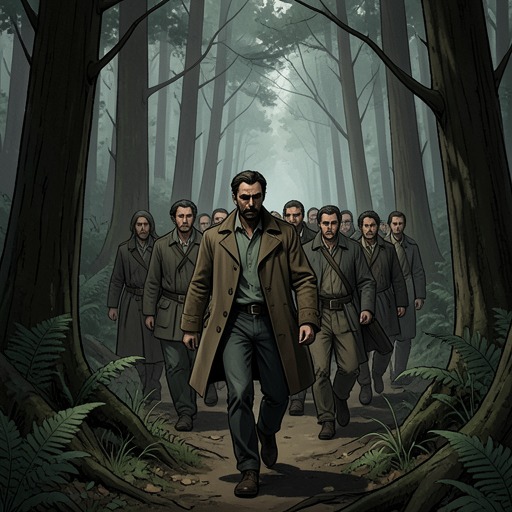
Rudel’s assistance continued when Mengele feared that Mossad was closing in. In September 1960, Mengele decided to abandon Paraguay and disappear. Rudel supplied him with a Mauser pistol and a new Brazilian identity card in the name of Peter Hochbichler. He and Krug drove Mengele to the Brazilian border in a jeep at dawn in October. Mengele left behind his wife and son, destroyed documents and research materials, and entered Brazil without turning back. Rudel’s role had shifted from helping secure a legal identity in Paraguay to equipping and transporting Mengele for another flight.
The book presents Rudel as more than a colorful exile or a surviving war hero. His military reputation opened doors, while his business dealings, relief work, political contacts, and personal loyalties formed a functioning network of protection. His relationship with Mengele shows how ideological kinship became practical assistance: admiration and shared beliefs led to introductions, advocacy, citizenship, forged identity, and escape. Rudel’s central narrative significance lies in this conversion of prestige into impunity, and in the way his international connections helped keep Mengele beyond the reach of justice.