World War II
The Disappearance of Josef MengeleWorld War II is the central rupture linking Josef Mengele’s service in the Nazi state, his work at Auschwitz concentration camp, and his postwar flight across Europe and South America. The book presents the war not only as a military conflict but as the setting for competing political ambitions, organized persecution, and crimes whose consequences persisted long after Germany’s defeat. Its aftermath appears in the fugitives’ new identities, the slow movement of extradition requests, and survivors’ continuing demands for justice.
War, ideology, and political ambition
The war also forms part of Juan Perón’s political education. Before Argentina’s postwar ambitions took shape, Perón studied Fascism and war, traveled in Italy and Germany, and admired the disciplined state he encountered under Adolf Hitler. His account of Germany’s revival under Nazism treated its political and military organization as a model of national power. In Italy, he watched Benito Mussolini address a crowd from the balcony of the Palazzo Venezia as the country entered the war in 1940.
After returning to Argentina, Perón interpreted the conflict as a contest in which Fascist Italy and Nazi Germany offered an alternative to both communism and capitalism. He imagined Argentina taking the place of the defeated Axis powers and emerging as a third force in a future struggle between the United States and the Soviet Union. The war’s end therefore did not close this political story: in Perón’s vision, defeat left behind materials and opportunities from which a new national project might be built.
Mengele’s military and medical career
Josef Mengele’s wartime record, as he recites it to Eberhard Fritsch in Buenos Aires, combines military service with Nazi racial policy. He said that he joined the Nazi Party in 1937 and entered the association of Nazi doctors and the SS the following year. After service in the Tyrolean Alpine Hunter Corps, he volunteered for the Waffen-SS and worked as a medical expert in the SS Race and Resettlement Main Office in occupied Poland. He later served as a medical officer with SS Division Wiking on the Eastern Front after Operation Barbarossa, including postings in Ukraine and participation in the Caucasus offensive and fighting near Rostov-on-Don and Bataysk. He also described rescuing two tank crewmen from a burning vehicle and receiving the Iron Cross First Class.
That account was selective. Mengele spoke of transfer to a prison camp in Poland but withheld the name Auschwitz from Fritsch, presenting himself as an exiled soldier grieving for his country and its lost uniform. The narrative sets this self-presentation against evidence of his work at Auschwitz concentration camp. In 1944, deported Hungarian Jews arrived in multiple trainloads each day; as camp physician, Mengele made selections that sent people either to forced labor or to their deaths. His authority in that process was exercised repeatedly, not as an isolated episode but as part of the camp’s routine.
The account of Miklós Nyiszli, a Jewish physician and Sonderkommando prisoner forced to assist Mengele, further connects the camp’s medical work to Mengele’s research. Nyiszli describes painful experiments on twins and the compilation of case files, with research materials sent to the Berlin institute directed by Otmar von Verschuer. Even in autumn 1944, when Germany had already lost the war, Mengele continued spending long hours in the dissection room and laboratory. Nyiszli’s recollections make the contrast stark: meticulous attention to dossiers and scientific procedures existed within a system organized around persecution and killing. He later recorded his experience in a book first published in Hungary in 1946 and in France in 1961.
Defeat, flight, and the postwar refuge
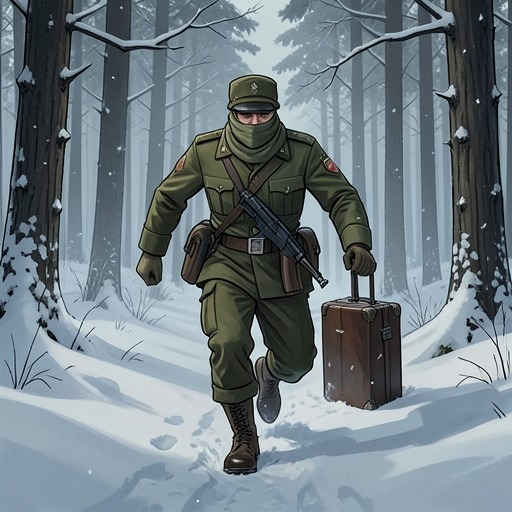
As the German defeat approached, Mengele fled Poland in January 1945 disguised as a Wehrmacht soldier. His route through the immediate postwar years involved successive identities and jurisdictions: a few weeks in an American prisoner-of-war camp, release using false papers in the name Fritz Ullmann, and three years in hiding on a farm in Bavaria near Günzburg, where he worked under another name. At Easter 1949 he crossed the Dolomites by forest paths into South Tyrol, adopted the name Helmut Gregor, and traveled from Genoa to Buenos Aires. By the time he arrived, the war had ended, but evasion depended on the movement of people, documents, money, and assistance across borders.
The book links that escape to a broader postwar willingness in West Germany to set aside prosecutions. In a letter to Mengele, his father reported that war-crimes proceedings had been suspended and former Nazis were taking important positions in government and industry. He urged his son to forget the war and look toward reconstruction. The political logic of the Cold War, as the letter presents it, helped recast former Nazis as useful participants in a new order, even as Mengele remained wanted for mass murder.
Pursuit and the long afterlife of the war
Efforts to bring Mengele to trial exposed the obstacles created by borders and official delay. Hermann Langbein, an Auschwitz survivor who had helped found the International Auschwitz Committee, gathered evidence and passed the case to West German authorities. After most judges declined to act, a prosecutor in Freiburg im Breisgau, Mengele’s last registered address, issued an arrest warrant on 25 February 1959 for multiple counts of premeditated murder and attempted murder. The next steps depended on extradition requests to Argentina and Paraguay, where procedure, jurisdiction, and political protection repeatedly slowed the pursuit.
By November 1959, Paraguay had granted Mengele citizenship, a residence permit, a certificate of good behavior, and an identity card, despite the legal problem that citizenship required five years of residence. In 1960, Isser Harel planned to pursue Mengele after the operation to capture Adolf Eichmann, but the intelligence available to him was scattered and outdated. Later West German efforts likewise met resistance: Paraguay’s government rejected extradition pressure, disputed claims about Mengele’s location, and invoked its sovereignty. In 1964, while the Frankfurt Auschwitz trials drew international attention, West Germany publicly renewed pressure and offered a reward. The pursuit nevertheless faltered amid diplomatic conflict and political calculations.
The war’s history returned to public view with survivor testimony. At a 1985 mock trial at Yad Vashem, survivors of Mengele’s experiments testified over three days; their accounts were broadcast internationally and prompted renewed calls to arrest him. The trials, investigations, and rewards did not undo the crimes or end the fugitive’s concealment. They did, however, challenge the postwar distance that had allowed Mengele to present himself as a displaced former soldier. In the book’s account, World War II remains present through that unresolved contrast: the perpetrator’s continued evasion and the survivors’ insistence that the crimes be named and judged.