Alchemy
The Divine ComedyAlchemy, the art of falsifying metals by attempting to transmute base substances into gold, occupies a distinct place in Dante's moral geography of fraud. In the Inferno, alchemists are punished in the tenth Bolgia of Malebolge, the circle reserved for falsifiers—those who corrupted the natural order of matter for gain. The sin is treated not merely as a deception of the gullible but as a violation of the relationship between nature and art, a counterfeit of the divine creative process itself.
The Punishment of the Alchemists
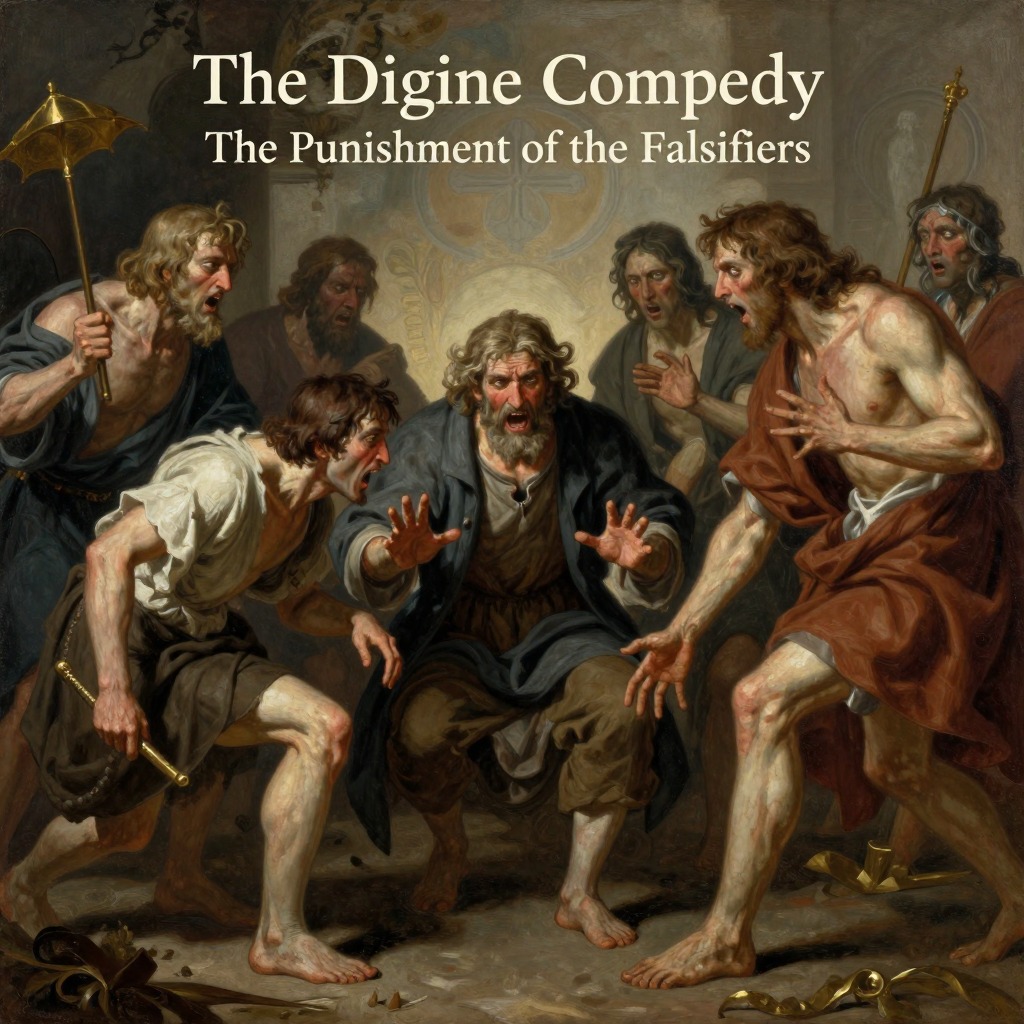
The tenth Bolgia is a valley of disease and stench, where the alchemists languish in heaps, covered with scabs and leprous sores. Dante describes them as "bespotted o'er with scabs" from head to foot, scratching themselves with their nails "as a knife the scales of bream" . The punishment is one of contrapasso: as the alchemists had corrupted the true nature of metals, so their own bodies are corrupted and disfigured. They lie "this on the belly, that upon the back" , crawling along the dismal road, unable to lift themselves. The air is filled with a stench "as from putrescent limbs" , and the lamentations are so piercing that Dante covers his ears with his hands . The justice of God, the "ministress of the high Lord" , is shown to be infallible in recording and punishing these forgers.
The Alchemists Themselves
Two alchemists are named and speak to Dante. The first is Griffolino d'Arezzo, who was burned at the stake in Siena by Albert of Siena for claiming he could fly . He explains that his execution was for a jest, but his damnation is for the practice of alchemy: "for alchemy, which in the world I practised, Minos, who cannot err, has me condemned" . The second is Capocchio, who identifies himself as one "who metals falsified by alchemy" . He describes himself as "a skilful ape of nature" , a phrase that captures the essence of the sin: alchemy is an imitation of nature's true work, a fraudulent parody of the divine art of creation. Capocchio also mentions other Sienese wastrels—Stricca, Niccolo, Caccia d'Ascian, and the Abbagliato—who squandered their wealth in extravagant living .
The Encounter with Gianni Schicchi and Myrrha
While Dante is speaking with the alchemists, two maddened shades rush through the Bolgia, biting and rending like wild boars. One of them, Gianni Schicchi, seizes Capocchio by the nape of the neck and drags him away, his belly grating the ground . The other is Myrrha, who sinned by counterfeiting another's form to commit incest with her father . These two are not alchemists but falsifiers of identity—Schicchi having impersonated Buoso Donati to forge a will—and their violent, raving punishment contrasts with the slow, wasting disease of the alchemists. The presence of both types of falsifiers in the same Bolgia underscores the theme that alchemy is a form of counterfeiting, a false stamp on the coin of nature.
Thematic Significance
Alchemy in the Divine Comedy represents a profound violation of the order established by God. The practice usurps the role of nature, which Dante, following Aristotle and Aquinas, sees as the handmaid of divine art. The alchemist, by attempting to create gold from base metals, denies the inherent goodness of the created order and seeks to improve upon it through fraudulent means. This sin is placed among the falsifiers, the most contemptible of the fraudulent, because it attacks the very fabric of reality—the distinction between true and false, real and counterfeit. The punishment of disease and decay mirrors the corruption of matter that the alchemist sought to exploit, and the stench of the Bolgia is a physical manifestation of the moral putrefaction of the sin.