Archbishop Ruggieri
The Divine ComedyArchbishop Ruggieri is a figure of ultimate treachery in Dante's Inferno, appearing in the frozen lake of Cocytus as the eternal victim of Count Ugolino's cannibalistic vengeance. His story is not told directly but emerges from Ugolino's own account, making Ruggieri a silent but central presence in one of the poem's most harrowing episodes. He represents the corruption of spiritual authority for political ends, a betrayal so profound that it earns him a place in Antenora, the circle of traitors to their country or party, where he is gnawed for eternity by the man he destroyed.
Identity and Background
Ruggieri was a historical figure, the Archbishop of Pisa in the late 13th century. He was a political enemy of Count Ugolino della Gherardesca, a powerful Ghibelline nobleman who had switched allegiances to the Guelph party. In 1288, Ruggieri, along with other Pisan leaders, conspired against Ugolino. The Archbishop's role was particularly egregious because he was a spiritual leader who used his position to orchestrate a political betrayal. He is identified in the text by Ugolino himself, who calls him "Ruggieri the Archbishop" , and his crime is the imprisonment and starvation of Ugolino and his sons and grandsons.
The Betrayal and Imprisonment
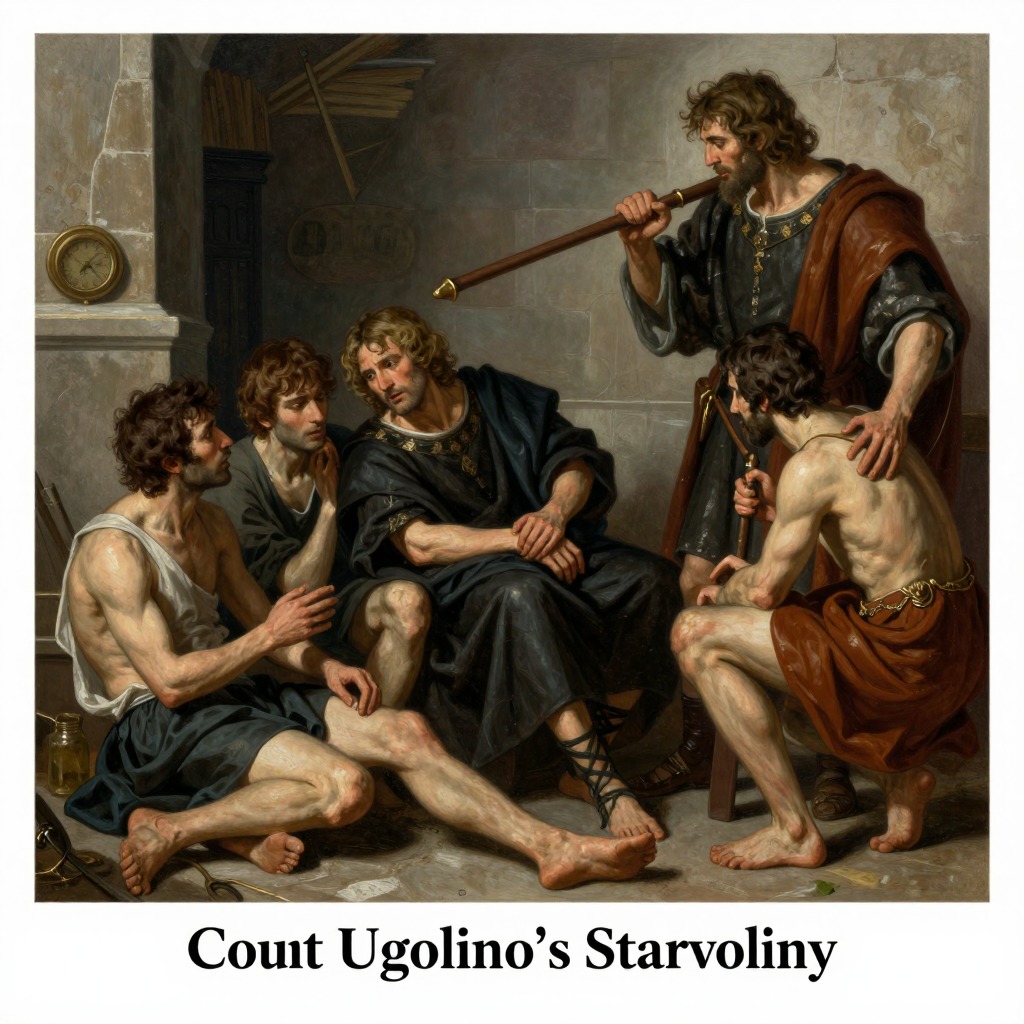
Ugolino explains that he was made prisoner "by effect of his malicious thoughts, trusting in him" , indicating that Ruggieri exploited Ugolino's trust to capture him. The betrayal culminated in Ugolino and his children being locked in a tower, which later became known as the Tower of Famine. Ugolino describes the moment of their final imprisonment: "I heard locking up the under door of the horrible tower" . This act of locking the door sealed their fate, and Ruggieri's role as the architect of this cruelty is the foundation of his eternal punishment.
The Starvation and Death of Ugolino's Family
The most devastating part of the narrative is the slow death of Ugolino's sons. After days of starvation, Ugolino's son Gaddo threw himself at his father's feet, crying, "My father, why dost thou not help me?" and died. Ugolino then watched his other three sons die one by one between the fifth and sixth days . In his final, desperate act, Ugolino, now blind, groped over their dead bodies and called to them for three days after their death . The narrative concludes with the line, "Then hunger did what sorrow could not do" , implying that Ugolino himself died of starvation, though the text leaves open the possibility that he resorted to cannibalism.
Punishment in Cocytus
In the frozen lake of Cocytus, Ugolino and Ruggieri are locked together in a single hole of ice, with Ugolino's head above Ruggieri's, gnawing on his skull . This grotesque union is a perfect example of contrapasso: Ruggieri, who starved Ugolino and his children, is now himself consumed by Ugolino in an eternal, cannibalistic feast. Ugolino's punishment is to be forever reminded of his own suffering and his children's deaths, while Ruggieri suffers the physical torment of being devoured. The scene is one of the most visceral and memorable in the entire Inferno, a testament to the depth of Dante's condemnation of treachery.
Thematic Significance
Ruggieri's story serves as a powerful indictment of the corruption of the Church. As an archbishop, he was supposed to be a spiritual guide, but he used his authority for political gain and personal vengeance. His betrayal of Ugolino is not just a personal crime but a sin against the sacred bond of trust that should exist between a spiritual leader and his flock. Dante places him in Antenora, the circle for traitors to their country or party, but his crime also resonates with the deeper sin of betraying the divine office he held. The narrative of Ugolino and Ruggieri is a stark warning about the consequences of political ambition and the abuse of spiritual power, themes that run throughout the Commedia.