Beatrice
The Divine ComedyBeatrice is the central female figure of Dante Alighieri's Divine Comedy, the object of the poet's lifelong devotion, and the agent of his salvation. She descends from Heaven to commission Virgil as Dante's guide through Hell and Purgatory, and she herself leads him through Paradise, rebuking his past sins and revealing the divine order. Her role transforms from a beloved memory into a living symbol of theology, grace, and the love that moves the sun and the other stars.
Identity and Background
Beatrice is first mentioned in the Inferno as the heavenly lady who sets the entire journey in motion. She appears to Virgil in Limbo, her eyes "shining brighter than the Star," and speaks with a voice "angelical" in her own language. She identifies herself: "Beatrice am I, who do bid thee go; / I come from there, where I would fain return; / Love moved me, which compelleth me to speak." She explains that a "gentle Lady" in Heaven—the Virgin Mary—grieved at Dante's peril and besought Lucia, who in turn urged Beatrice to act because Dante had loved her so greatly and had "issued from the vulgar herd" for her sake. Beatrice thus descends through Hell to the first circle, confident that the misery of the damned cannot touch her, because God "in his mercy such created me / That misery of yours attains me not." Her intervention breaks the stern judgment of Heaven and provides Dante with the guide he needs.
Life and Plot Trajectory
Beatrice does not appear in person until the end of the Purgatorio, when the pageant of the Church arrives in the Earthly Paradise. She descends upon a chariot drawn by a Griffin, veiled in white with an olive crown, a green mantle, and a robe the colour of living flame. At the sound of her name, Dante turns and, though Virgil has vanished, feels the power of "ancient love" pierce him as it had in his youth. She addresses him directly—"Dante, because Virgilius has departed / Do not weep yet, do not weep yet awhile; / For by another sword thou need'st must weep"—and then, with royal severity, demands that he look at her and confess his infidelity after her death. She recounts how she sustained him with her youthful eyes and led him in the right way, but that after she died and increased in beauty and virtue, he turned from her to pursue "false images of good." She declares that she visited the gates of death and bore her intercessions with weeping to Virgil so that Dante might be saved by seeing the people of perdition. Her reproach forces Dante to weep and confess, and only then does she permit him to drink from Lethe and, later, from Eunoe, completing his purification.
Key Actions and Objectives
Beatrice's primary objective is Dante's salvation. In the Inferno, she acts from Heaven, mobilizing Virgil through a chain of intercession that begins with the Virgin Mary and passes through Lucia. In the Purgatorio, she takes direct charge once Dante has passed through the purifying fire and entered the Earthly Paradise. She does not merely welcome him; she puts him on trial, forcing him to acknowledge his sins aloud before the assembled blessed. After his confession, she leads him through the spheres of Paradise, explaining theological truths—the nature of vows, the justice of the Incarnation, the order of the universe, and the hierarchy of the angels. She also entrusts him with a prophetic mission: he must write down what he has seen, especially the corruption of the Church and the coming of a deliverer she cryptically calls "Five-hundred, Ten, and Five." In the Heaven of the Fixed Stars, she presents him to St. Peter, St. James, and St. John, who examine him on faith, hope, and charity. Throughout the ascent, her beauty grows more radiant with each sphere, until in the Empyrean she takes her seat among the blessed and appoints St. Bernard of Clairvaux to lead Dante to the final vision of God.
Relationships and Conflict
Beatrice's relationship with Dante is the emotional and theological spine of the poem. In life, she was the beloved who inspired his early poetry; in death, she becomes the instrument of his correction. Her tone is often stern—she speaks to him "like unto one who speaks, / And keeps his warmest utterance in reserve"—and she does not hesitate to shame him, commanding him to lift his beard so that he may feel the greater pain of seeing her face. Yet her severity is a form of compassionate justice: she tells the angels that she must speak with care so that "the sin and dole be of one measure." Her relationship with Virgil is one of delegated authority: she commissions him, and he serves as her surrogate until the Earthly Paradise, where he silently departs. With the other blessed, she is a queenly figure; the angels sing to her, and the saints in the White Rose honour her. She also has a specific connection to Lucia, who fetched her from her seat beside Rachel, and to the Virgin Mary, who initiated the chain of grace.
Change and Ending
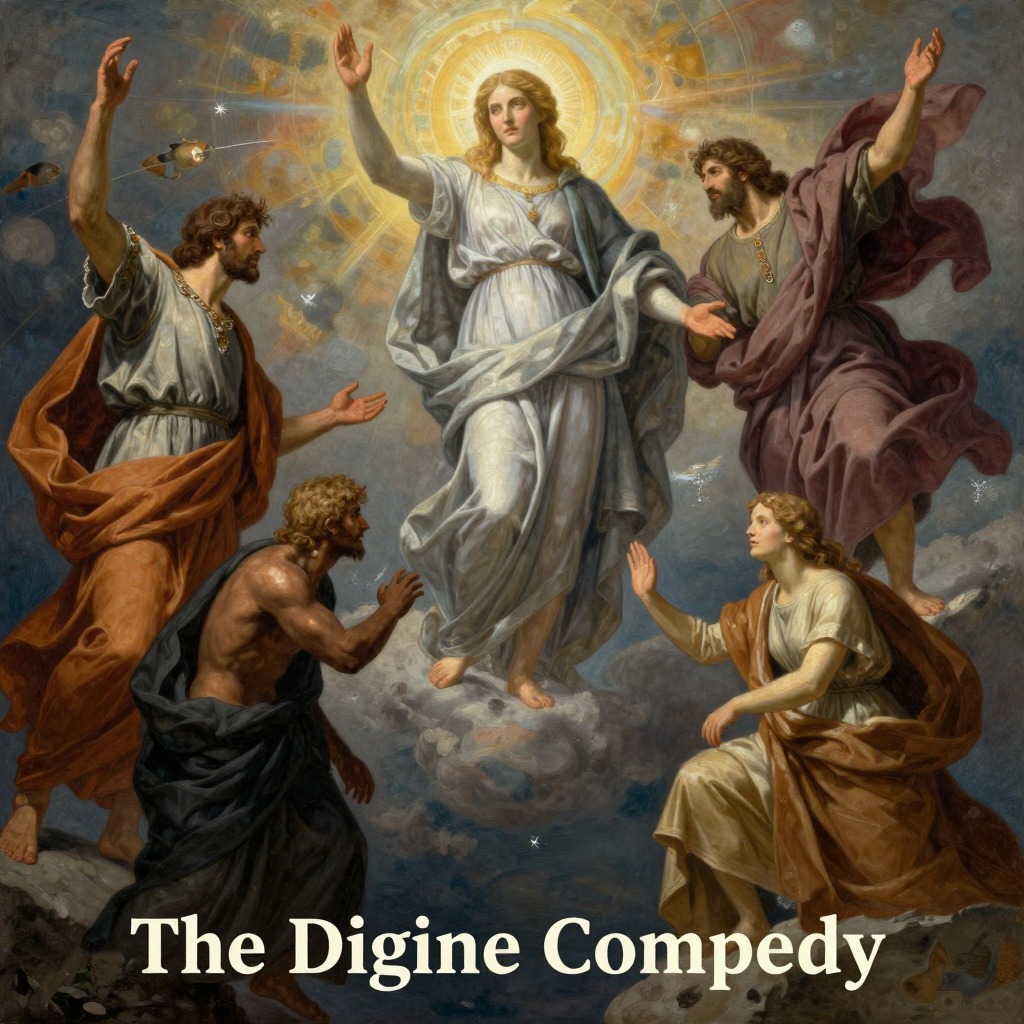
Beatrice undergoes no personal change—she is already perfected in Heaven—but her role in the poem shifts from an unseen mover to a visible judge and finally to a glorified intercessor. In the Empyrean, Dante sees her seated on a throne in the White Rose, "as she made herself a crown / Reflecting from herself the eternal rays." When he prays to her, acknowledging that she brought him from slavery to freedom, she smiles at him from that immense distance and then turns "unto the eternal fountain." She does not accompany him to the final vision; St. Bernard takes her place, and she joins the ranks of the blessed who clasp their hands in support of Bernard's prayer to the Virgin. Her last act is to look upon the Eternal Light, her eyes "beloved and revered of God." She thus completes her work: she has led Dante from the dark forest through Hell and Purgatory to the threshold of the Beatific Vision, and there she yields to a higher guide.
Narrative Role and Evaluation
Beatrice is the theological centre of the Comedy, embodying revealed truth, grace, and the love that orders the universe. Her name means "she who makes blessed," and the poem fulfills that etymology: she is the means by which Dante is made worthy of salvation. She also serves as a foil to the damned souls of the Inferno—where Francesca is swept away by love without reason, Beatrice is love guided by divine will. Her reproach of Dante in the Earthly Paradise is the poem's most intense scene of personal confrontation, and her discourses in Paradise constitute the work's most sustained theological teaching. As a character, she is both a real woman from Dante's past and an allegorical figure of theology; the poem never allows one aspect to cancel the other. Her final smile, which Dante cannot describe, marks the limit of his poetic power and the threshold of the ineffable.