Bernard and Mary
The Divine ComedyBernard of Clairvaux and the Virgin Mary constitute the final and most exalted human-divine relationship in Dante Alighieri's journey through the three realms of the afterlife. After Beatrice has led Dante through the nine heavens of Paradise, she withdraws to her throne in the Empyrean, and Bernard, the twelfth-century Cistercian abbot and mystic, takes over as the poet's guide for the ultimate stage of his vision. Their relationship is defined by Bernard's complete devotion to Mary and his role as the one who directs Dante's prayer and gaze toward her, so that she may intercede for the grace needed to behold God directly.
Bernard's Role as the Final Guide
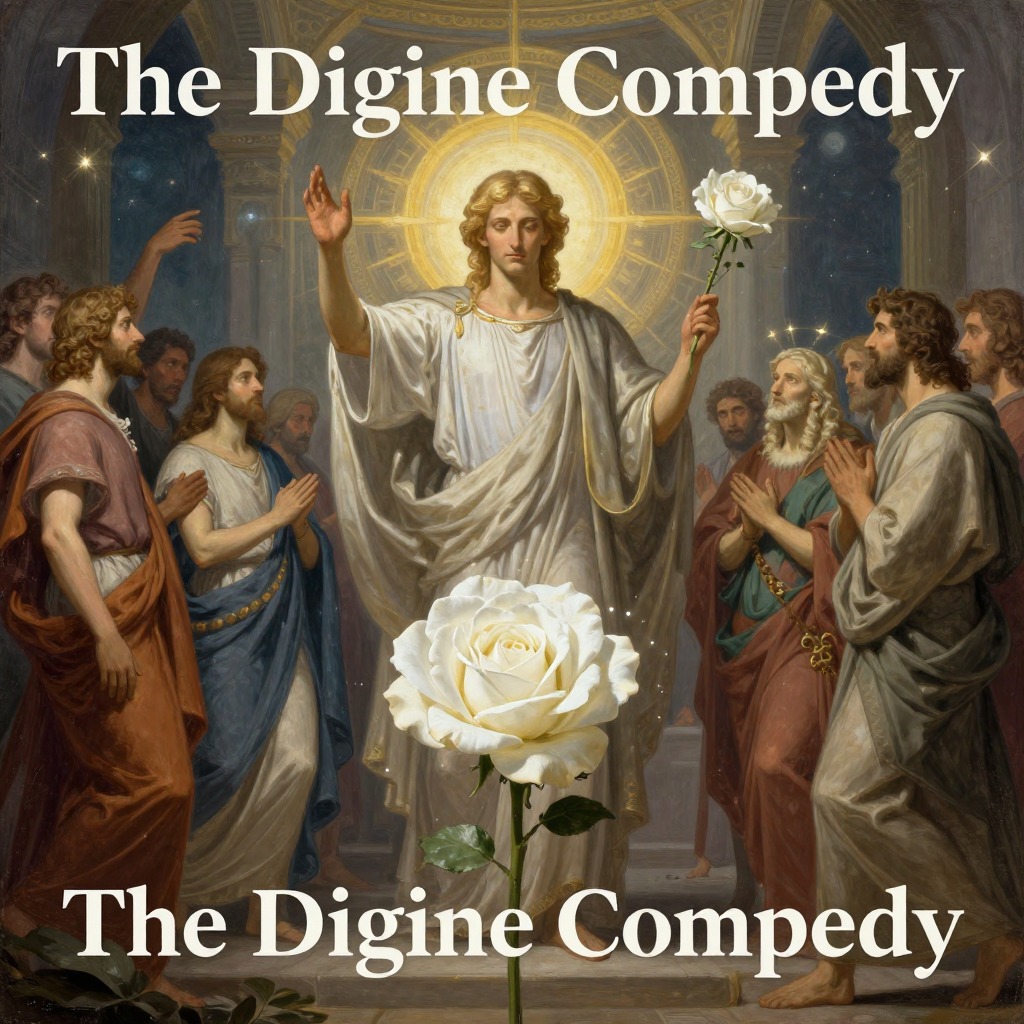
Bernard appears to Dante in the Empyrean, the tenth heaven of pure light, after Beatrice has returned to her place among the blessed. The poet, having just seen Beatrice enthroned in the White Rose of Paradise, turns to question her but finds instead an old man "habited like the glorious people" , whose eyes and cheeks overflow with "joy benign" and whose attitude is that of "a tender father" . This is Bernard, sent by Beatrice herself to complete Dante's journey. Bernard immediately instructs Dante to "fly with thine eyes all round about this garden" of the blessed, explaining that seeing it will discipline his sight to mount further along the divine ray . He then identifies himself as "her faithful Bernard" , declaring that he burns wholly with love for the Queen of Heaven and that she will grant every grace. Bernard's role is thus one of pure mediation: he does not replace Beatrice but rather channels Dante's final approach to God through the intercession of Mary.
The Prayer to the Virgin
Bernard's most significant action is the prayer he offers to the Virgin Mary on Dante's behalf, a prayer that constitutes the final petition of the entire Commedia. He begins by addressing Mary as "Thou Virgin Mother, daughter of thy Son, / Humble and high beyond all other creature, / The limit fixed of the eternal counsel" , a paradox that encapsulates her unique position as both mother and daughter of God. Bernard praises her as the one who gave such nobility to human nature that its Creator did not disdain to become its creature, and as the "living fountain-head of hope" for mortals below . He declares that she is so great and so prevailing that anyone who wishes grace but does not run to her "his aspirations without wings would fly" . Bernard then makes his specific request: that Dante, who has seen the spiritual lives from the lowest depth of the universe to this height, may receive the power to uplift his eyes to the "uttermost salvation" . He adds his own prayer, saying he never burned for his own seeing as he does for Dante's, and asks Mary to scatter every cloud of mortality from the poet's vision so that "the Chief Pleasure" may be displayed to him . Finally, Bernard prays that Mary preserve Dante's affections sound after so great a vision, and he calls upon Beatrice and all the blessed to second his prayers .
Mary's Response and the Vision of God
The Virgin Mary's response to Bernard's prayer is immediate and wordless. The eyes "beloved and revered of God" fasten upon Bernard as he speaks, showing how grateful to her are devout prayers, and then they turn to the Eternal Light . This turning is the signal that the prayer has been granted. Bernard, seeing that Dante is now ready, beckons to him and smiles, urging him to look upward . Dante, already of his own accord inclined to do so, finds his sight becoming purified and entering more and more into the ray of the High Light . The prayer thus directly enables the Beatific Vision, the final contemplation of God as three circles of light, in which Dante glimpses the mystery of the Incarnation and the unity of all things in divine love. Bernard's intercession, channeled through Mary, is the necessary grace that allows a mortal to endure and comprehend the infinite.
The Thematic Significance of the Relationship
The relationship between Bernard and Mary embodies the Commedia's deepest theological structure: salvation is achieved not by individual merit alone but through a chain of intercessory grace that begins with divine love and descends through the blessed. Bernard, the contemplative who in life "by contemplation tasted of that peace" , is the perfect figure to guide Dante in the final stage because his entire existence was oriented toward Mary and through her toward Christ. Mary, as the "noonday torch of charity" and the one in whom "compassion is, in thee is pity, / In thee magnificence" , is the ultimate human mediator, the one who can obtain any grace. Bernard's prayer does not replace Dante's own desire but perfects it, showing that the highest human aspiration requires the support of the communion of saints. The relationship thus completes the poem's movement from the solitary terror of the Dark Forest, through the guidance of Virgil and Beatrice, to the communal and intercessory love of the Empyrean, where Bernard and Mary together lead the poet to the love that moves the sun and the other stars.