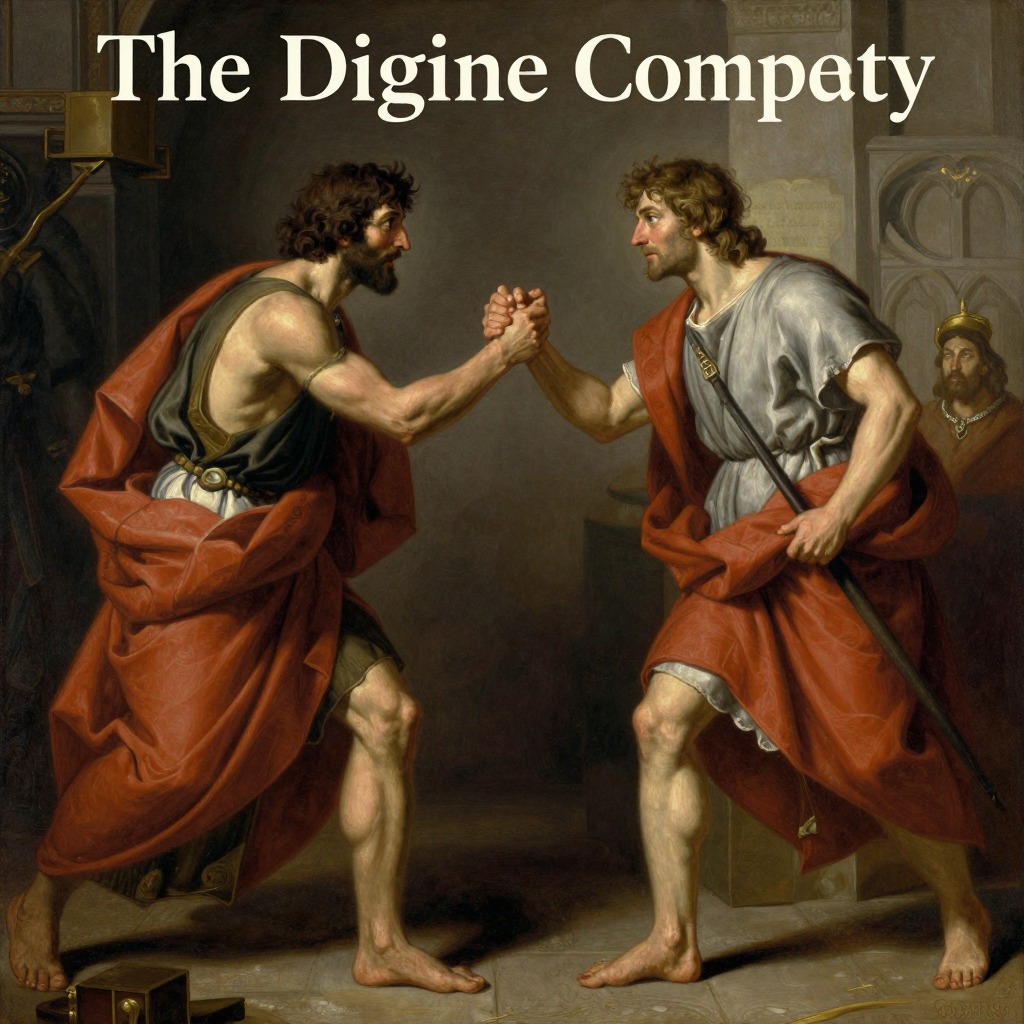
Cavalcante de' Cavalcanti
The Divine ComedyCavalcante de' Cavalcanti is a Florentine nobleman and Epicurean heretic whom Dante encounters in the sixth circle of Hell, where he is condemned for denying the soul's immortality. His brief but devastating appearance in Inferno Canto X is defined by a single, agonizing question—whether his son Guido is still alive—and by the revelation that the damned can see the distant future but are blind to the present. Cavalcante's desperate love for his son, his misinterpretation of Dante's reply, and his sudden collapse back into the tomb make him one of the most poignant figures in the Inferno, a father whose intellectual pride is shattered by a grief that no philosophical system can console.
Identity and Background
Cavalcante de' Cavalcanti was a prominent Florentine of the thirteenth century, a member of the Guelph aristocracy and the father of the celebrated poet Guido Cavalcanti, who was Dante's "first friend" and a leading figure in the Dolce Stil Novo movement. In the Inferno, Cavalcante is placed among the heretics in the sixth circle, specifically with the followers of Epicurus, "who with the body mortal make the soul" (Inferno X.14-15). His punishment is to lie in a flaming tomb whose cover will remain open until the Last Judgment, when the bodies of the damned will be reunited with their souls and the torment will become complete. The tomb itself is part of a vast cemetery of similar sepulchres, scattered with flames that heat them "so intensely, that iron more so asks not any art" (Inferno IX.118-119).
The Encounter in the Sixth Circle
Dante and Virgil are walking along a narrow path between the torments and the city wall when a voice suddenly issues from one of the tombs. It is Farinata degli Uberti, who has risen erect and who engages Dante in a political dialogue about their respective ancestors and the battles of Florence. While they are speaking, Cavalcante, who shares the same tomb with Farinata, rises up on his knees, his body visible only from the chin down. He gazes around "as if solicitude he had to see if some one else were with me" (Inferno X.110-111)—that is, he is looking for his son Guido, whom he expects to accompany Dante on this journey through the afterlife. When he realizes that no one else is present, he weeps and asks: "If through this blind Prison thou goest by loftiness of genius, Where is my son? and why is he not with thee?" (Inferno X.115-117).
The Fatal Misunderstanding
Dante replies: "I come not of myself; He who is waiting yonder leads me here, Whom in disdain perhaps your Guido had" (Inferno X.118-120). The crucial word is "had" (ebbe in the original Italian)—the past tense. Dante means that Guido once held Virgil in disdain, but Cavalcante, hearing the past tense, interprets it to mean that his son is dead. He cries out: "How Saidst thou,—he had? Is he not still alive? Does not the sweet light strike upon his eyes?" (Inferno X.124-125). When Dante hesitates before answering, Cavalcante takes the delay as confirmation of his worst fear. He falls supine back into the tomb, "and forth appeared no more" (Inferno X.128). The moment is devastating: a father's love, which should have been a source of comfort, becomes the instrument of his final despair. Farinata, by contrast, does not change his aspect at all, continuing his political discourse as if nothing had happened.
The Knowledge of the Damned
Cavalcante's misunderstanding is rooted in the peculiar epistemology of Hell. As Farinata explains to Dante, the damned can see future events—"the things that distant are from us" (Inferno X.133)—but they have no knowledge of the present. When events draw near or are actually happening, their intellect is wholly blind, and "if none brings it to us, Not anything know we of your human state" (Inferno X.136-137). This is why Cavalcante does not know whether his son is alive or dead; he can only infer from Dante's words. The irony is that Guido Cavalcanti was indeed still alive in 1300, the fictional date of the poem, and would die later that same year. Dante, who knew this, was thinking of the error he had just made when he answered, and he later asks Farinata to tell "that fallen one" that his son is still among the living (Inferno X.141-143).
Thematic Significance
Cavalcante's appearance is a study in the limits of human reason and the pain of incomplete knowledge. As an Epicurean, he denied the immortality of the soul; now, in Hell, he is confronted with the reality of his own eternal existence, yet he remains trapped in a mode of thinking that cannot grasp the present moment. His love for his son—a natural and even noble affection—becomes the source of his greatest torment, because it is a love that can no longer reach its object. The scene also dramatizes the tension between intellectual pride and emotional vulnerability: Cavalcante, who presumably spent his life in philosophical contemplation, is undone by a single, unphilosophical question about his child. In the larger structure of the Inferno, he serves as a counterpoint to Farinata's political obsessions, showing that even the most intimate human bonds are subject to the iron laws of divine justice.