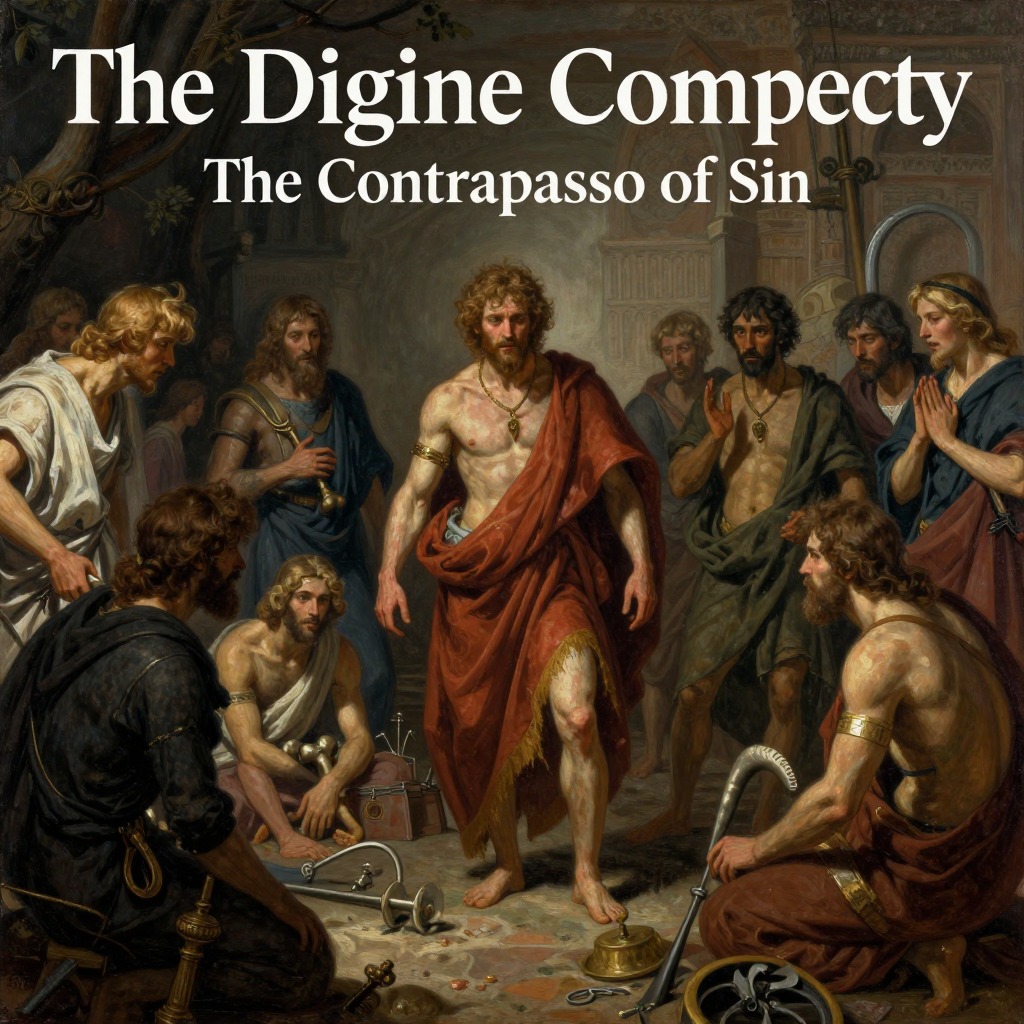
Centaurs
The Divine ComedyThe Centaurs are the monstrous guardians of the First Round of the Seventh Circle of Hell, where the Violent against their Neighbors are punished in the river of boiling blood. Armed with bows and arrows, they patrol the moat and shoot any sinner who emerges from the blood beyond the depth allotted to his crime. Their leader is Chiron, and among their number are Nessus and Pholus; they serve as both wardens and, in the case of Nessus, as guides for Dante and Virgil through this region of the Inferno.
Identity and Origin
The Centaurs are hybrid creatures, half-human and half-horse, drawn from classical mythology. In the Inferno, they are presented as a squadron of armed guardians, running in file along the embankment of the river of blood, "as in the world they used the chase to follow" . Their leader is Chiron, the great Centaur who raised Achilles . Other named members include Nessus, who perished for the love of Deianira and took his own vengeance (E01753–E01754), and Pholus, who was known for his wrath . The Centaurs are armed with bows and arrows, and they patrol the moat in vast numbers—"thousands and thousands"—shooting at any soul that rises from the blood beyond the measure of his sin (E01758–E01760).
Role as Guardians of the Violent
The Centaurs serve as the wardens of the First Round of the Seventh Circle, where the river of blood, Phlegethon, boils with the souls of tyrants and murderers. When Dante and Virgil descend the broken cliff to this level, three Centaurs detach themselves from the squadron and challenge the travelers, with one crying out: "Unto what torment / Come ye, who down the hillside are descending? / Tell us from there; if not, I draw the bow" (E01746–E01748). Virgil rebukes the hasty Centaur, insisting that they will answer only to Chiron (E01749–E01751). Chiron himself, upon seeing Dante, notes that the pilgrim moves the ground beneath his feet—a sign that he is alive, not a shade—and asks Virgil to explain (E01765–E01767). Virgil explains that Dante is alive and that their journey is ordained by Heaven, and he requests a guide to carry Dante across the ford (E01770–E01781). Chiron then assigns Nessus to guide them and to warn aside any other Centaur band they might encounter (E01782–E01784).
Guidance and the Geography of Punishment
Nessus leads Dante and Virgil along the brink of the boiling blood, pointing out the sinners immersed at various depths according to their guilt. He identifies tyrants such as Alexander the Great, the fierce Dionysius of Sicily, Ezzelino III da Romano, and Obizzo d'Este, who was slain by his stepson (E01788–E01797). As they proceed, the blood grows shallower, first covering the sinners to the throat, then to the chest, and finally only to the feet (E01801–E01810). Nessus explains that the river diminishes on this side until it reunites where tyranny is punished, and he names further figures: Attila the scourge of the earth, Pyrrhus, Sextus Tarquinius, and the highway robbers Rinier da Corneto and Rinier Pazzo (E01812–E01823). After guiding them to the ford, Nessus turns back and recrosses the river .
Narrative Significance
The Centaurs embody the principle of contrapasso in the Inferno: as creatures of violent and untamed nature, they are fitting punishers of those who committed violence against their neighbors. Their hybrid form—part human, part beast—mirrors the bestiality of the sins they oversee. The episode also establishes Virgil's authority and the divine sanction of the journey, as the Centaurs, like other infernal guardians, ultimately yield to the will of Heaven. The detailed geography of the boiling blood, with its graduated depths, reinforces the moral order of Dante's Hell, where the severity of punishment is precisely calibrated to the gravity of the sin.