Charles Martel
The Divine ComedyCharles Martel appears in the Heaven of Venus, the third sphere of Paradise, as a luminous spirit who speaks with Dante about the nature of human diversity and the misdirection of talents. Though his time on earth was short, his presence in the poem carries substantial thematic weight, linking the cosmic order of the heavens to the political disorder of Italy and offering a poignant reflection on how inherited power can go awry when individual aptitudes are ignored.
Identity and Background
Charles Martel was the son of Charles II of Anjou, King of Naples, and the heir to a vast dominion that included Provence and parts of Italy. In the poem, he identifies himself by describing the lands that awaited his rule: the left bank of the Rhone where it mingles with the Sorgue, and the horn of Italy that includes Bari, Gaeta, and Catona, from the Tronto to the Verde. He also claims the crown of a realm watered by the Danube after it leaves Germany, and the beautiful island of Trinacria (Sicily), which lies between Pachino and Peloro. This geography establishes him as a prince of great potential, whose early death—he died in 1295 at the age of twenty-four—prevented him from realizing his political destiny. He tells Dante that had he lived longer, much evil would have been avoided, and that Dante loved him well and with good reason.
Life and Plot Trajectory
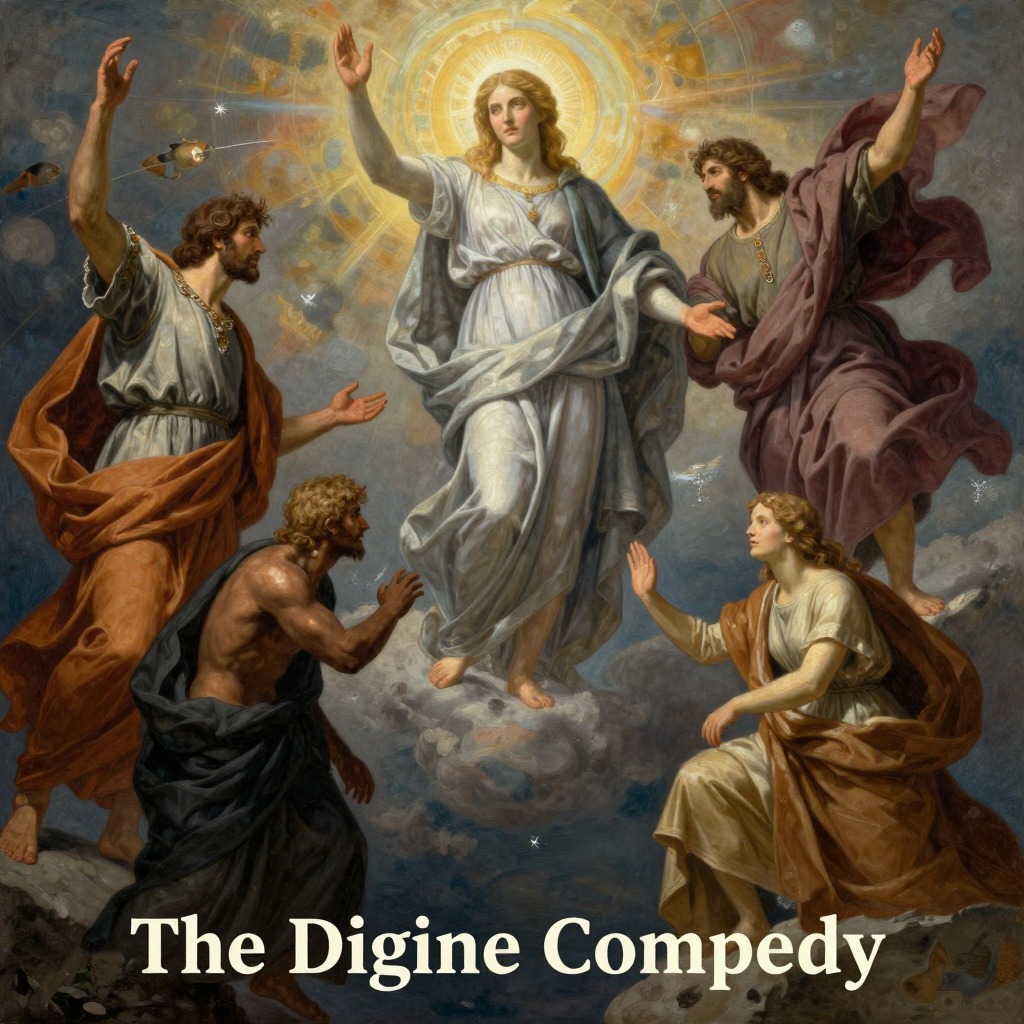
Charles Martel appears in Canto VIII of the Paradiso, one of the first souls Dante encounters after ascending from the Heaven of Mercury. He is part of a circle of lights that move in a gyre, singing hosannas, and he approaches Dante with a joyful willingness to converse. His speech is marked by a warm, personal tone, as he recalls Dante's affection for him and expresses regret that he could not have shown Dante more of his love while alive. The encounter is brief but intense, and Charles's words carry a prophetic weight that extends beyond his own story into the political future of Italy and his family.
Key Actions and Objectives
Charles Martel's primary action in the poem is to engage Dante in a philosophical dialogue about the diversity of human natures and the necessity of different social roles. When Dante asks how sweet seed can produce bitter fruit—a question prompted by the political corruption he sees in the world—Charles responds with a detailed explanation of how Providence works through the celestial spheres. He argues that nature, like a signet stamping wax, produces different individuals for different purposes: one is born a Solon, another a Xerxes, another a Melchisedec, and another a Daedalus. The problem arises when human society forces people into roles that do not match their natural inclinations, as when a man born for the sword is made a monk, or a man born for preaching is made a king. This, he implies, is the root of much political and social evil.
Relationships and Conflict
Charles Martel's relationship with Dante is one of mutual affection and intellectual respect. He addresses Dante with familiarity and warmth, and Dante responds with reverence, calling him "my Lord." The conflict in their exchange is not personal but structural: Charles laments the misdirection of talents that results from human folly, and he foresees the troubles that will befall his own family. He speaks of his brother Robert, who inherited the throne of Naples, and warns that the greedy poverty of Catalonia will lead to further corruption unless the kingdom is governed wisely. He also alludes to the Sicilian Vespers, the uprising that drove the Angevins from Sicily, as a consequence of evil lordship. The tension between what Charles might have accomplished and what actually happened gives his words a tragic undertone.
Change and Ending
Charles Martel does not undergo a personal transformation within the poem, as he is already a perfected soul in Paradise. However, his discourse marks a shift in Dante's understanding of the relationship between divine order and human society. After explaining the necessity of diverse natures, Charles concludes with a corollary: if the world below would follow the foundation laid by nature, it would have good people, but instead it wrenches individuals from their proper paths, causing the footsteps of humanity to wander from the road. His speech ends with a return to the celestial dance, as he rejoins the other lights in their eternal song. He leaves Dante with a clearer vision of how Providence operates through the heavens, even when human choices produce bitter fruit.
Narrative Role and Evaluation
Charles Martel serves as a crucial voice in Dante's exploration of political and social order. His appearance in the Heaven of Venus, traditionally associated with love, underscores the theme of divine love as the organizing principle of the universe. His explanation of diverse natures anticipates later discussions in the Paradiso about predestination, free will, and the justice of God. As a historical figure who died young, he embodies the pathos of unfulfilled potential, but his blessed state in Paradise affirms that his soul has found its true home. His words also function as a critique of the political corruption of his time, particularly the misrule of the Angevin dynasty in Italy. Through Charles Martel, Dante argues that social harmony depends on recognizing and honoring the natural diversity of human talents, a lesson that resonates throughout the poem's political vision.