Contrapasso
The Divine ComedyContrapasso, the law of symbolic retribution, is the organizing moral and poetic principle of Dante's Divine Comedy. In the Inferno, it dictates that the punishment of each damned soul corresponds directly to the nature of its sin, often through a literal enactment of the sin's inner logic or a reversal of its earthly pleasure. In Purgatory, the same principle operates as a process of purification, where the penitent soul undergoes a corrective discipline that mirrors the distortion of love that caused its sin. In Paradise, the principle is inverted: the blessed soul's degree of beatitude reflects the measure of its love and virtue. Contrapasso thus transforms the entire afterlife into a system of divine justice that is at once perfectly rational and profoundly poetic.
The Inferno: Punishment as the Mirror of Sin
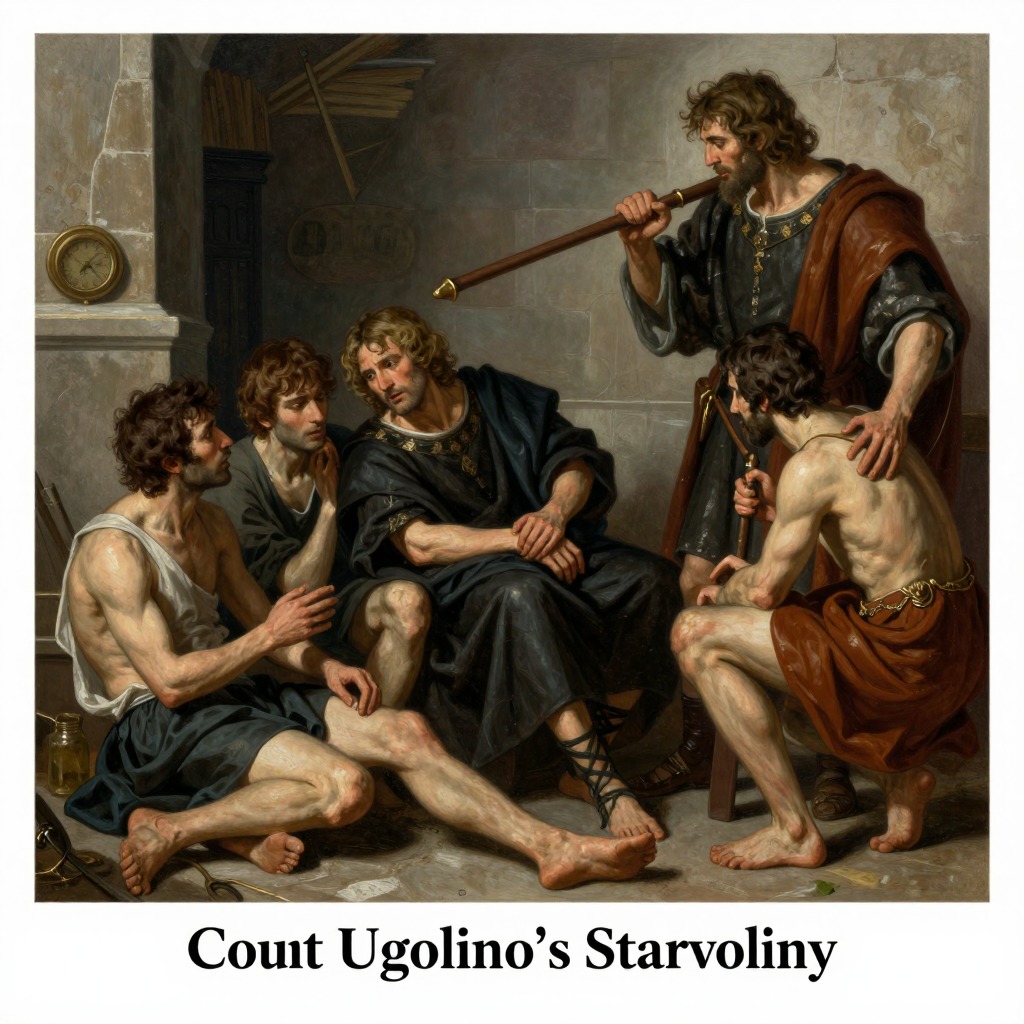
In the Inferno, contrapasso is most vividly displayed as a literal, often grotesque, correspondence between sin and suffering. Virgil explains the underlying moral taxonomy to Dante in Canto XI, stating that "of every malice that wins hate in Heaven, injury is the end; and all such end either by force or fraud afflicteth others" (E01591–E01593). Because fraud is uniquely human, it displeases God more and is punished in the lower circles (E01594–E01596). The punishments themselves are symbolic enactments of the sin. The lustful, who surrendered reason to appetite, are eternally swept about by a tempest, mirroring the uncontrollable passion that drove them in life. The gluttonous, who abused food and drink, lie in a foul slush under a perpetual rain of hail, snow, and filthy water, their bodies torn by Cerberus. The avaricious and prodigal, who misdirected their energies toward material goods, are locked in an endless, futile struggle, rolling great weights against each other. The wrathful tear each other apart in the muddy Styx, while the sullen, who refused to rejoice in the light of God, are submerged in the same mire, their gurgling hymns a parody of praise. The violent against God, like Capaneus, lie on a burning plain under a rain of fire, their defiance only intensifying their torment. The fraudulent, who used their intellect to deceive, are enclosed in flames that conceal their identities, a fitting punishment for those who abused the light of reason. The ultimate expression of contrapasso in Hell is found in the ninth circle, where traitors are frozen in the ice of Cocytus, their cold hearts now eternally fixed in a landscape of absolute isolation and immobility. The most famous example is Count Ugolino, who, having been starved to death with his sons by Archbishop Ruggieri, now eternally gnaws on Ruggieri's skull, a cannibalistic inversion of the betrayal that led to his own starvation . As Bertrand de Born, who sowed discord between a father and son, declares while carrying his severed head like a lantern, "Thus is observed in me the counterpoise" .
Purgatory: Purification through Corrective Discipline
On Mount Purgatory, contrapasso operates not as eternal punishment but as a temporary, curative process. The souls here are not damned but are being purified of the disordered love that remains from their earthly lives. Virgil's discourse on love in Canto XVII establishes the framework: all sin arises from love that is directed toward evil, or that is too weak or too strong toward the true good (E07363–E07368). The proud, who exalted themselves above others, are bent under massive stones, forced to see the humility they lacked. The envious have their eyes sewn shut with iron wire, a physical correction for the sin of looking upon others' good fortune with malice. The wrathful are enveloped in a bitter, blinding smoke, a fitting environment for those who let anger cloud their reason. The slothful are compelled to run with eager haste, making up for the love they failed to act upon. The avaricious and prodigal lie prostrate on the ground, their faces pressed to the earth, a direct reversal of their earthly fixation on material wealth. The gluttonous are tormented by the sight and smell of a fruit tree and a stream of water that they cannot reach, their desire for food and drink now a source of purifying hunger. The lustful walk through a wall of fire, burning away the impure desires of the flesh. In each case, the punishment is not arbitrary but is a precise remedy for the specific distortion of love, designed to restore the soul to its original, healthy state.
Paradise: The Beatitude of Rightly Ordered Love
In Paradise, the principle of contrapasso is inverted. The blessed souls are not punished but are rewarded according to the measure of their love and virtue. They appear in different heavens not because they are confined there, but to signify the degree of their beatitude. Piccarda explains this to Dante in the Heaven of the Moon: "Brother, our will is quieted by virtue of charity, that makes us wish alone for what we have, nor gives us thirst for more" (E10122–E10124). The souls are perfectly content with their allotted place, for their will is entirely conformed to God's. The hierarchy of Paradise is thus a direct reflection of the soul's capacity for divine love, a positive contrapasso where the reward is the full and perfect satisfaction of the rightly ordered desire. The entire system of the Comedy, from the depths of Hell to the heights of the Empyrean, is therefore a single, coherent expression of contrapasso: the soul's eternal state is the inevitable and just consequence of the choices it made in life, a truth that Dante's journey makes visible in every circle, terrace, and sphere.