Dark Forest
The Divine ComedyThe Dark Forest is the opening location of Dante Alighieri's journey in the Divine Comedy, a place of spiritual confusion and peril that symbolizes the poet's loss of the true way and sets the entire narrative in motion. It is the first setting of the poem, the point from which all action proceeds, and the site of the initial crisis that precipitates the entire journey through Hell, Purgatory, and Paradise. The forest is not merely a geographical feature but a profound allegorical landscape representing the state of sin and error from which the protagonist must be rescued.
Identity and Description
The Dark Forest is introduced in the opening lines of the Inferno. Dante states, "Midway upon the journey of our life I found myself within a forest dark, For the straightforward pathway had been lost" (E00209-E00211). The forest is described as "savage, rough, and stern" , and its memory alone renews fear. It is so bitter that death is little more . The poet cannot well repeat how he entered it, so full was he of slumber at the moment he had abandoned the true way (E00218-E00220). The forest is thus a place of disorientation, spiritual darkness, and existential terror, contrasting sharply with the light and order of the divine path.
The Encounter with the Three Beasts
Within the Dark Forest, Dante encounters three beasts that block his ascent to a sunlit hill. After reaching a mountain's foot and looking up to see its shoulders vested with the planet's rays (E00224-E00226), he attempts to climb. However, a panther, light and swift, with a spotted skin, appears and impedes his way, causing him to turn back many times (E00240-E00244). The time is the beginning of morning, and the sun is mounting with the stars that were with it at the first creation, giving him good hope from the panther's variegated skin, the hour, and the delicious season (E00245-E00251). But this hope is not enough, for a lion appears, coming against him with head uplifted and ravenous hunger, so that the air seems afraid (E00253-E00256). Finally, a she-wolf, laden with all hungerings in her meagreness, brings upon him so much heaviness that he relinquishes the hope of the height (E00257-E00262). The she-wolf thrusts him back to where the sun is silent . This triple threat forces Dante to retreat into the lowland, where he meets Virgil.
The Meeting with Virgil and the Way Out
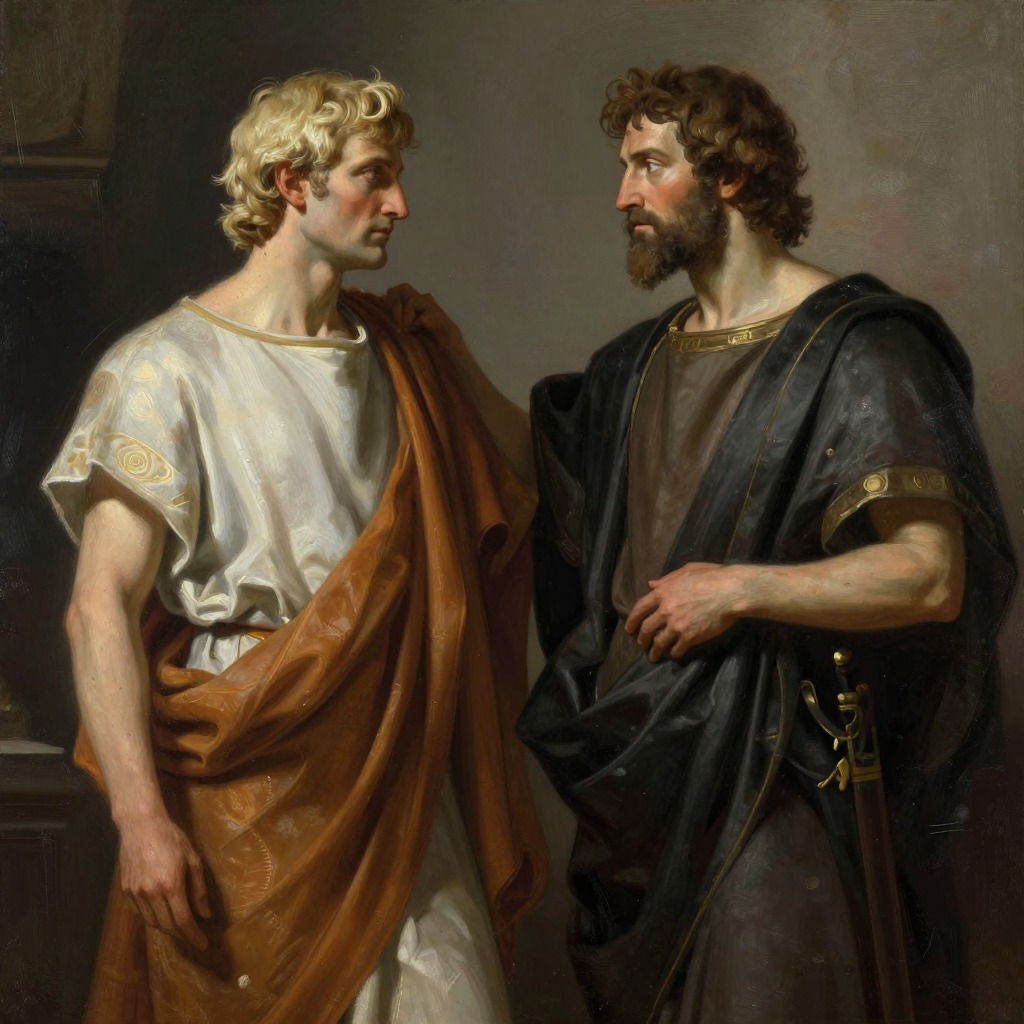
While rushing downward to the lowland, Dante sees a figure who seems hoarse from long-continued silence (E00270-E00271). He cries out for pity, and the figure reveals himself as Virgil, the poet of the Aeneid (E00275-E00283). Virgil explains that the she-wolf suffers no one to pass her way and destroys him, but that a Greyhound will come to make her perish (E00302-E00310). Virgil then offers to guide Dante through the eternal place, leading him through Hell and Purgatory, and finally to a soul more worthy to lead him to Paradise (E00320-E00331). Dante entreats Virgil to lead him, and Virgil moves on, with Dante following behind (E00338-E00344). The Dark Forest thus serves as the threshold between Dante's ordinary life and the extraordinary journey, the place where the call to adventure is issued and the mentor appears.
Narrative and Thematic Significance
The Dark Forest functions as the archetypal "ordinary world" of the hero's journey, but it is already a world of crisis and error. It represents the state of sin, confusion, and spiritual death from which Dante must be rescued. The three beasts are traditionally interpreted as symbols of lust (panther), pride (lion), and avarice (she-wolf), the sins that prevent the soul from ascending to God. The forest's darkness contrasts with the light of the sun on the mountain, which represents divine illumination and the path of righteousness. The entire poem is framed as a response to the crisis in the Dark Forest: Dante's journey is a process of purification and enlightenment that begins with the recognition of being lost. The forest is never revisited after the first canto, but its memory haunts the narrative, serving as the baseline of despair from which the pilgrim must rise. It is the starting point of the "straightforward pathway" that has been lost, and the entire Comedy is the story of finding it again.