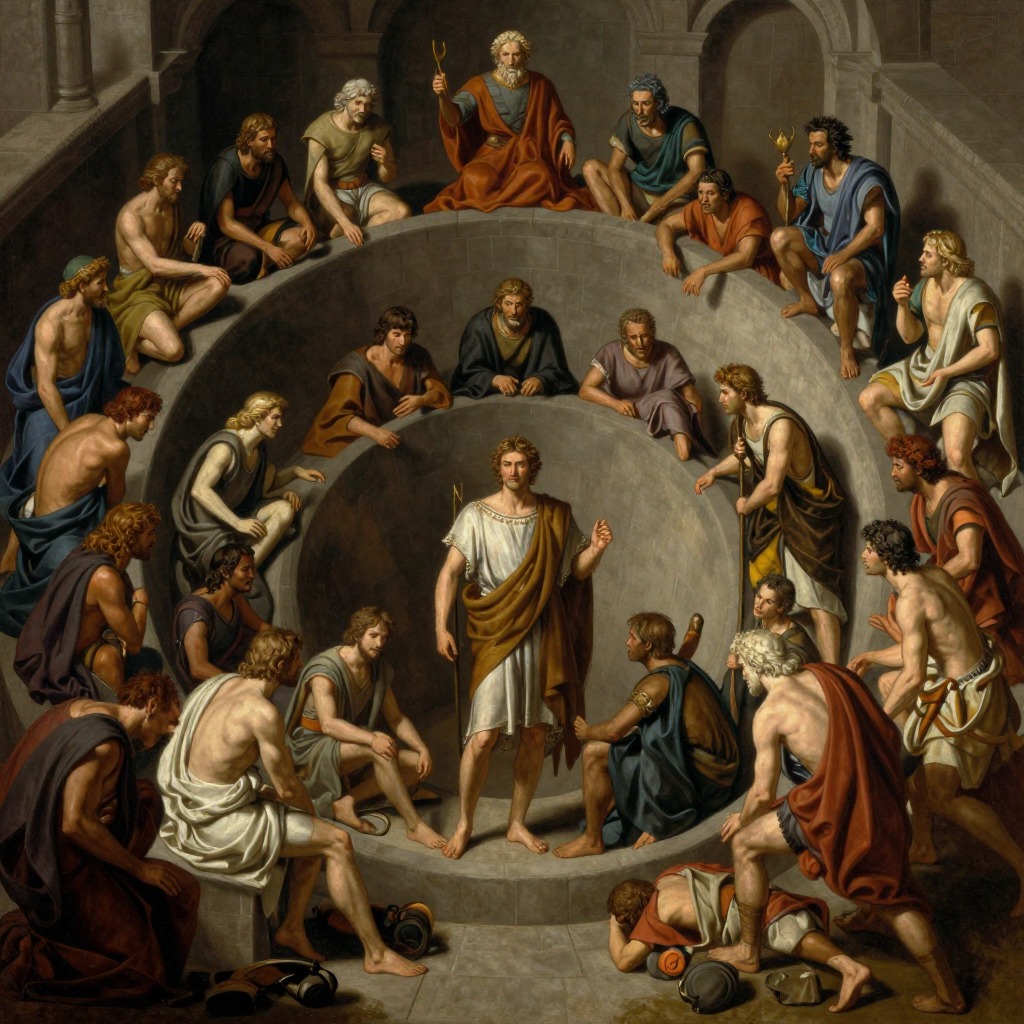
Dido
The Divine ComedyDido, the legendary queen of Carthage, appears in Dante's Divine Comedy as a figure emblematic of carnal sin, her story of love and suicide serving as a cautionary example within the second circle of Hell. Her presence in the poem is twofold: she is named among the lustful in the Inferno, and her story is later invoked in Purgatory as a contrast to the virtue of chastity and the proper ordering of love. Through these references, Dante uses Dido to explore the destructive power of unchecked desire and the necessity of aligning human love with divine will.
Identity and Background
Dido, also known as Elissa, was the Phoenician queen who founded Carthage. According to Virgil's Aeneid, after the death of her husband Sychaeus, she fled Tyre and established a new kingdom in North Africa. When the Trojan hero Aeneas arrived on her shores, Dido fell deeply in love with him, a passion that ultimately led to her suicide when he abandoned her to fulfill his destiny in Italy. In the Comedy, Dante draws on this classical narrative, presenting Dido as a figure whose love, though powerful, was ultimately misdirected and destructive.
Role in the Inferno
In the second circle of Hell, where the lustful are punished, Virgil points out Dido among the souls of those who "subjected reason to desire." She is described as "she who killed herself for love, and broke faith with the ashes of Sichaeus" . This places her among the wanton, condemned to be eternally swept by the infernal hurricane, a punishment that mirrors the restless, uncontrollable nature of their passion. Dido's inclusion in this circle underscores the medieval Christian view that suicide, even for love, is a sin, and that her violation of her vow to her deceased husband compounds her guilt.
Contrast in Purgatory
In Purgatory, Dido's story is invoked in a different context. On the seventh terrace, where the lustful are purified, the souls shout examples of chastity and of punished lust. Among the latter, they cry out: "Into the cow Pasiphae enters, so that the bull unto her lust may run!" (E07363-E07368). While Dido is not directly named here, the reference to Pasiphae's bestial lust serves as a parallel to the kind of uncontrolled desire that Dido represents. More directly, in the same canto, the souls of the sodomites and the lustful call out "Sodom and Gomorrah!" and recall the story of Pasiphae, reinforcing the theme of unnatural or excessive love. Dido's story, though not explicitly recounted, is implicitly present as a warning against the kind of love that leads to damnation.
Thematic Significance
Dido's presence in the Comedy serves to illustrate the medieval Christian understanding of love as a force that must be ordered toward God. Her tragic story, as told by Virgil, is a powerful example of how love, when it becomes an end in itself rather than a means to a higher good, can lead to spiritual ruin. In the Inferno, she is a warning; in Purgatory, the contrast between her fate and the purification of the lustful souls highlights the possibility of redemption through repentance and the proper ordering of desire. Dante's use of Dido thus reinforces the poem's central theme: that true love is found not in the pursuit of earthly pleasure, but in the love of God, which alone brings peace and fulfillment.