Earthly Paradise
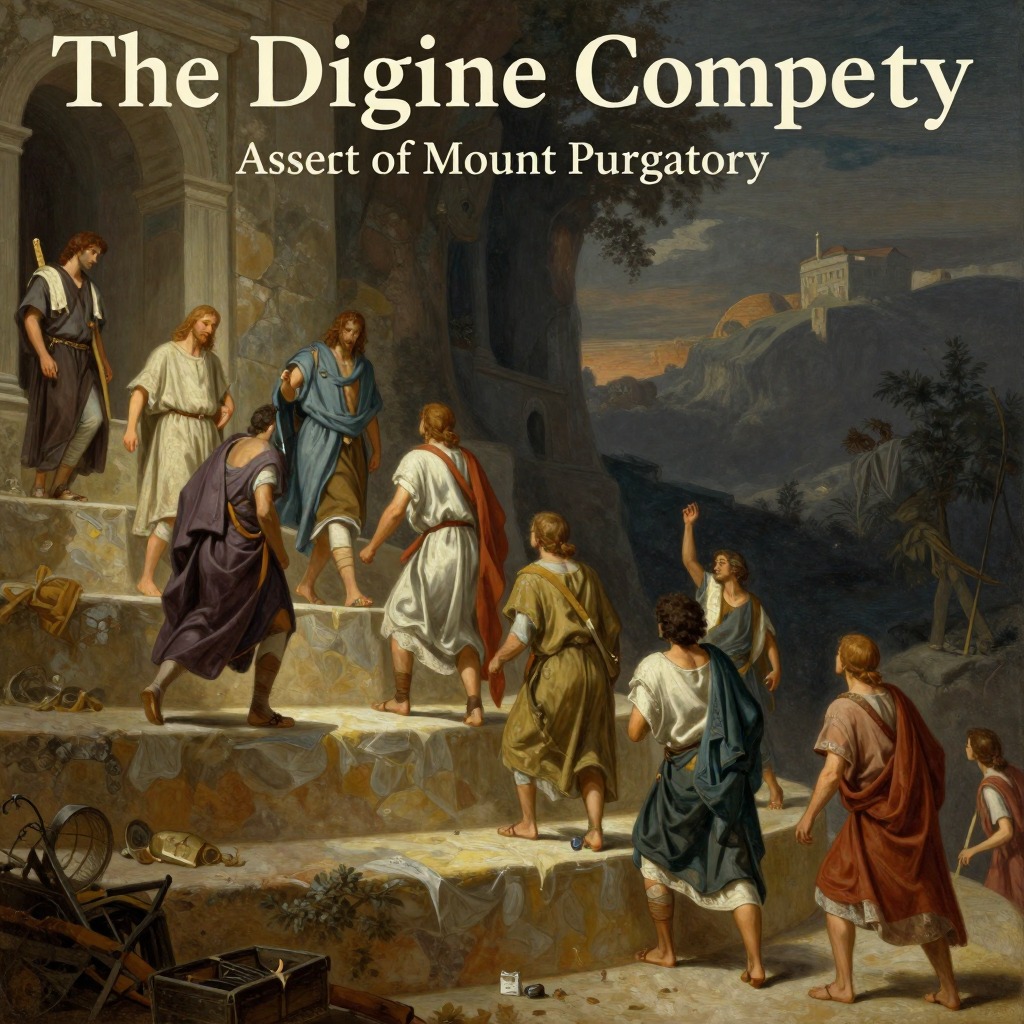
The Divine ComedyThe Earthly Paradise, also called the Terrestrial Paradise or the Garden of Eden, crowns the summit of Mount Purgatory and serves as the threshold between the temporal world of purgation and the eternal realm of Heaven. It is the place where humanity once lived in innocence before the Fall, and where Dante, having completed his ascent through the seven terraces of Purgatory, undergoes his final purification and is reunited with Beatrice. The Earthly Paradise is not merely a setting but a theological and narrative crux: it is the site where the penitent soul, fully cleansed, recovers its original state of grace and prepares for the beatific vision.
Geography and Nature of the Earthly Paradise
The Earthly Paradise is a "heavenly forest, dense and living-green" that "tempered to the eyes the new-born day" (E08857–E08859). It occupies the flat summit of Mount Purgatory, a plateau that rises above the seven terraces of purgation. The air is a "softly-breathing air, that no mutation / Had in itself," a gentle breeze that never varies (E08863–E08864). This wind, caused by the rotation of the Primum Mobile, strikes the dense forest and makes it sound, and the plants, impregnated with virtue, scatter seeds that take root in the earth below without any visible seed (E08953–E08973). The forest is filled with birds that sing "with full ravishment the hours of prime" (E08872–E08873), and the branches bow "toward that side / Where its first shadow casts the Holy Mountain" (E08866–E08868). The ground breathes fragrance , and the river that flows through it is "brown, brown current / Under the shade perpetual, that never / Ray of the sun lets in, nor of the moon" (E08887–E08889). This river, the Lethe, is one of two streams that spring from a single fountain; the other is the Eunoe (E08980–E08988). The Lethe removes all memory of sin, while the Eunoe restores the memory of every good deed (E08983–E08985). The Earthly Paradise is thus a place of perfect equilibrium, where nature is benign and self-renewing, untouched by the disturbances of the fallen world.
The Garden of Innocence and the Golden Age
The Earthly Paradise is explicitly identified with the Garden of Eden, the place where God "Created man good, and this goodly place / Gave him as hansel of eternal peace" (E08947–E08949). Humanity's first parents, Adam and Eve, lived here in innocence until the Fall, which "to weeping and to toil / He changed his innocent laughter and sweet play" (E08951–E08952). The poet Matilda, who appears as a lady gathering flowers on the far bank of the Lethe, explains that the ancient poets who "have feigned in song / The Age of Gold and its felicity" dreamed of this place (E08995–E08997). She says, "Here was the human race in innocence; / Here evermore was Spring, and every fruit; / This is the nectar of which each one speaks" (E08998–E09000). The Earthly Paradise is thus the archetype of the Golden Age, a state of perfect harmony between humanity and nature that was lost through sin and can only be regained through the purgatorial journey.
Dante's Arrival and the Encounter with Matilda
Dante enters the Earthly Paradise after passing through the wall of fire and climbing the final stairway. He is eager to explore the "heavenly forest" and leaves the bank, taking "the level country slowly, slowly / Over the soil that everywhere breathes fragrance" (E08860–E08862). He soon encounters a stream, the Lethe, which blocks his path. On the far bank, he sees a lady "all alone, who went along / Singing and culling floweret after floweret, / With which her pathway was all painted over" (E08896–E08898). This is Matilda, who explains the nature of the place. She tells Dante that the water of the Lethe springs from a fountain that "by the will of God as much regains / As it discharges, open on two sides" (E08981–E08982). She also explains that the forest's sound and the river's origin are caused by the motion of the heavens, not by earthly weather (E08959–E08973). Matilda serves as Dante's guide through the Earthly Paradise, leading him to the pageant of the Church and eventually to the waters of Lethe and Eunoe.
The Pageant of the Church and the Appearance of Beatrice
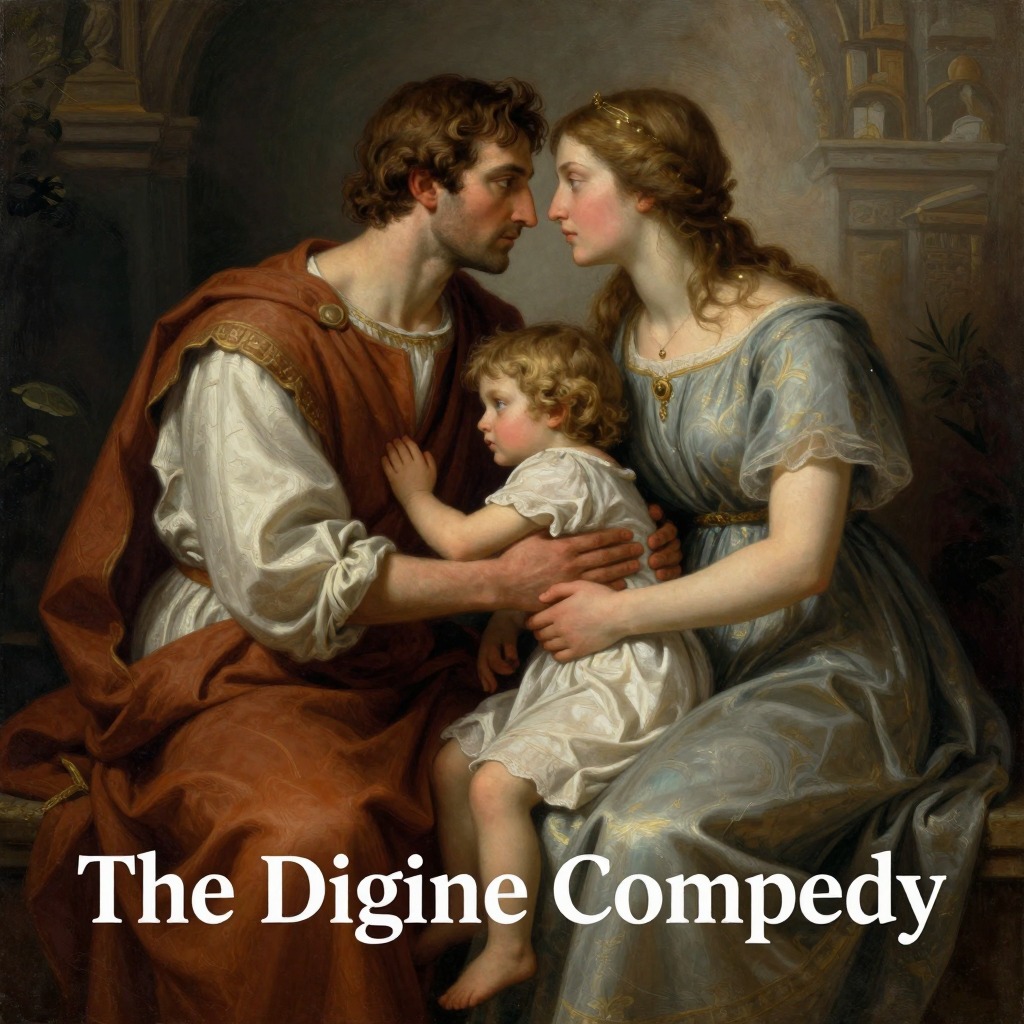
As Dante walks along the bank of the Lethe, a sudden light and a delicious melody fill the forest (E09021–E09028). A procession appears: seven golden candlesticks, followed by twenty-four elders crowned with flower-de-luce, four living creatures (the Evangelists), a triumphal chariot drawn by a Griffin (symbolizing Christ), and a company of maidens representing the theological and cardinal virtues (E09048–E09137). The procession halts, and Beatrice descends from the chariot, veiled in white with an olive crown, a green mantle, and a robe of living flame (E09191–E09193). She addresses Dante sternly, rebuking him for his sins and demanding confession (E09233–E09305). Dante, overwhelmed with shame and grief, confesses his infidelity to her memory (E09340–E09342). Beatrice then orders him to drink from the Lethe, which he does, and the river washes away all memory of his sins (E09403–E09408). After this purification, he is led by the four cardinal virtues to behold Beatrice's unveiled face, which is now radiant with divine beauty (E09421–E09444).
The Allegorical Drama of the Chariot and the Tree of Knowledge
After the confession, the procession moves to the Tree of Knowledge, which is despoiled of leaves and blossoms (E09490–E09491). The Griffin ties the chariot to the tree, and the tree is miraculously renewed, blossoming with a color "less than of rose and more than violet" (E09510–E09511). Dante then falls asleep and wakes to find Beatrice seated beneath the tree, guarding the chariot (E09546–E09548). She commands him to watch and record what he sees. A series of allegorical events unfold: an eagle descends and strikes the chariot, a fox leaps into it, the eagle returns and leaves its feathers, a dragon emerges from the earth and drags away part of the chariot, and the chariot itself transforms into a monstrous beast with seven heads (E09561–E09599). A harlot and a giant appear, and the giant beats the harlot and drags the chariot away into the forest (E09600–E09612). This complex allegory represents the corruption of the Church, the Donation of Constantine, the persecution of the faithful, and the eventual purification of the Church through divine judgment.
The Rivers Lethe and Eunoe and the Final Purification
After the allegorical drama, Beatrice delivers a prophecy of a coming deliverer, a "Five-hundred, Ten, and Five" who will slay the harlot and the giant (E09656–E09658). She then commands Matilda to lead Dante to the river Eunoe, the second stream that springs from the same fountain as the Lethe (E09740–E09742). Dante drinks from the Eunoe, and the water restores the memory of his good deeds, completing his purification (E09755–E09758). He emerges "regenerate, in the manner of new trees / That are renewed with a new foliage, / Pure and disposed to mount unto the stars" (E09756–E09758). The Earthly Paradise thus serves as the final stage of Dante's purgation, where he is fully cleansed of sin and its effects, and made ready for the ascent through the spheres of Paradise.
Thematic Significance
The Earthly Paradise is the culmination of the Purgatorio and the hinge between the temporal and eternal realms. It represents the recovery of humanity's original state of innocence, a return to the Garden of Eden that was lost through the Fall. It is a place of perfect natural harmony, where the disturbances of the fallen world—weather, decay, sin—are absent. The Earthly Paradise is also the site of Dante's reunion with Beatrice, which is both a personal and an allegorical event: it signifies the soul's reconciliation with divine love and wisdom after the long journey of purification. The allegorical pageant of the Church and the Tree of Knowledge underscores the theme of the Church's corruption and the promise of its eventual renewal. Finally, the rivers Lethe and Eunoe embody the twin processes of forgetting sin and remembering good, which together constitute the soul's complete restoration. The Earthly Paradise is thus not an end in itself but a threshold: it prepares Dante for the vision of God, which he will attain in the Empyrean.