Emperor Trajan
The Divine ComedyEmperor Trajan appears in Dante Alighieri's Divine Comedy as a figure of exemplary justice and humility, his story carved into the marble of Purgatory's First Terrace as a lesson in the virtue that counters pride, and his soul later placed among the blessed in the Heaven of Jupiter as a testament to the mysterious workings of divine grace. His presence in the poem bridges the classical and Christian worlds, embodying the ideal of the just ruler whose actions, though performed in a pagan context, earned him salvation through a faith that anticipated Christ.
The Sculpture of Humility on the First Terrace
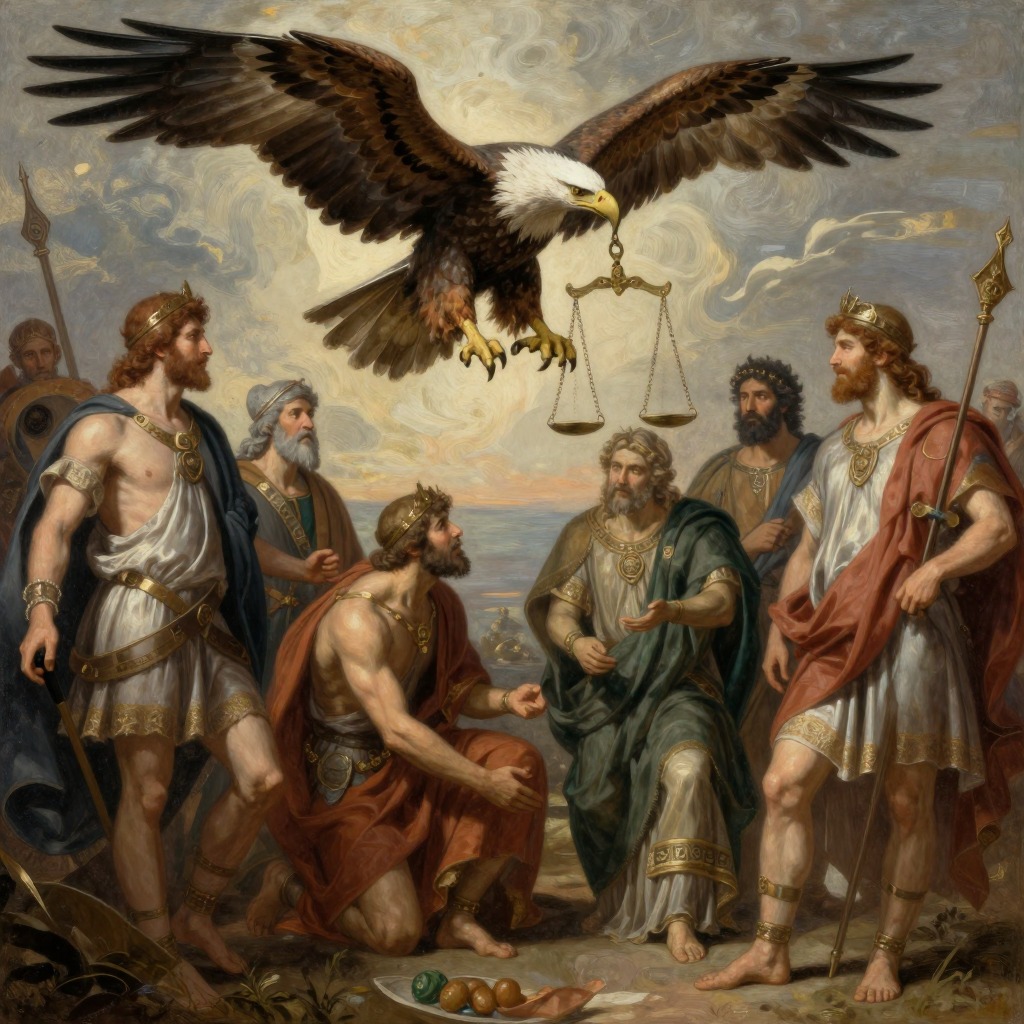
On the First Terrace of Mount Purgatory, where the proud purge their sin, the white marble wall is adorned with sculptures of humility that surpass the work of any human artist, including Polycletus, and even Nature herself. Among these carvings, Dante beholds the story of Emperor Trajan, whose "great beneficence" moved Pope Gregory the Great to his "great victory"—a reference to the legend that Gregory's prayers secured Trajan's salvation. The sculpture depicts a poor widow at Trajan's bridle, weeping and grieving for her dead son, crying out, "Give me vengeance, Lord, for my dead son, for whom my heart is breaking." Trajan responds with patience, asking her to wait until he returns, but she presses him, fearing he may not come back. He assures her that whoever holds his place will grant her justice, yet she insists that the good deeds of others cannot compensate for his own neglect. Moved, Trajan declares, "Now comfort thee, for it behoves me that I discharge my duty ere I move; Justice so wills, and pity doth retain me." This scene, described as a "visible language" created by God himself, captures the emperor's willingness to delay his imperial progress to fulfill the demands of justice and compassion, a moment of profound humility that Dante finds deeply moving.
The Discourse on Justice and the Two Suns
Trajan's example is invoked again in the broader political discourse of the Purgatorio, where the poet Marco Lombardo laments the corruption of the world and traces its cause to the confusion of spiritual and temporal authority. Marco recalls a time when Rome, which "reformed the world," was accustomed to having "two suns"—the Pope and the Emperor—each illuminating one of the two paths, "of God and of the world." This harmony has been shattered, Marco argues, because "one has the other quenched, and to the crosier the sword is joined," a union that corrupts both powers. The ideal of the just emperor, exemplified by Trajan, stands in stark contrast to the contemporary rulers who have abandoned their duty, leaving Italy prey to factionalism and tyranny. Trajan's justice, as depicted in the sculpture, represents the proper exercise of temporal power in service of God's order, a model that Dante holds up against the failings of his own age.
The Salvation of Trajan in the Heaven of Jupiter
In the Heaven of Jupiter, the sixth sphere of Paradise, Dante encounters the Celestial Eagle, a constellation of blessed souls that forms the shape of an imperial eagle, the symbol of justice. The Eagle speaks with a single voice composed of many, and among the five lights that form its eyebrow, the fifth is the soul of the Trojan Ripheus, a pagan who, like Trajan, was saved through faith. The Eagle explains that both Trajan and Ripheus, though Gentiles, were Christians in the steadfast faith of feet that were to suffer and had suffered. Trajan's salvation came about when, after his death, his soul was in Hell, but through the fervent prayers of Pope Gregory, inspired by "living hope," he was briefly returned to his body. In that second life, he believed in Christ and kindled such genuine love that at his second death he was deemed worthy of Paradise. The Eagle emphasizes that this was a reward for "living hope, that placed its efficacy in prayers to God made to resuscitate him, so that 'twere possible to move his will." Trajan's presence among the blessed thus illustrates the power of intercessory prayer and the inscrutable depths of divine predestination, a mystery that the Eagle urges mortals not to presume to judge. His story, first foreshadowed in the sculpture on Purgatory's terrace, finds its ultimate fulfillment in the celestial court, where the emperor who once paused for a widow's plea now enjoys the eternal vision of God.