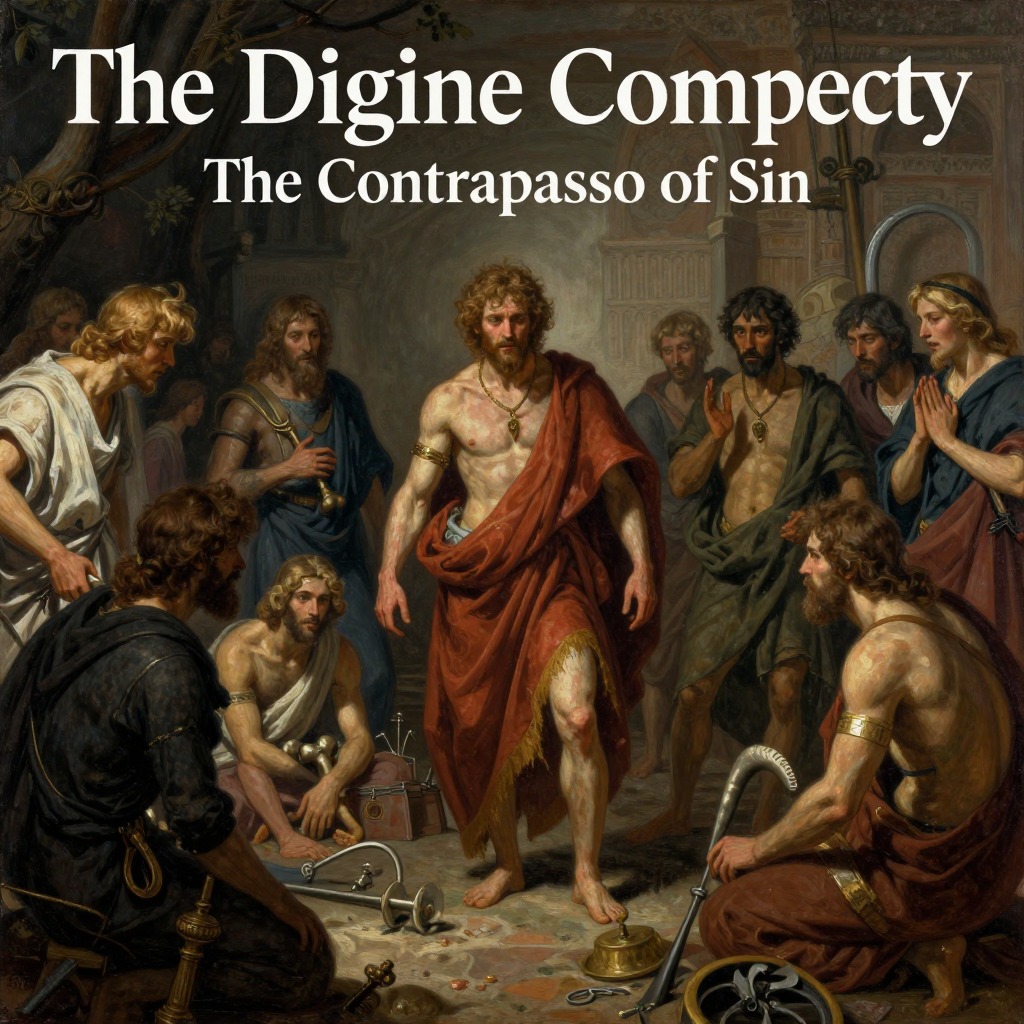
Fourth Circle
The Divine ComedyThe Fourth Circle of Hell is the domain of the avaricious and the prodigal, those who in life directed their intellect and will toward the disordered acquisition or reckless dissipation of material wealth. Located in the Inferno after the gluttonous of the Third Circle and before the wrathful and sullen of the Styx, this circle is the first of the lower regions where the sin of incontinence—specifically, the incontinence of the desire for goods—is punished. It is a place of perpetual, futile motion, where the damned are locked in an eternal, symmetrical combat that mirrors the spiritual deformity of their earthly lives. The circle's guardian is Plutus, the classical god of wealth, whose grotesque, bloated appearance and unintelligible cry of "Pape Satan, Pape Satan, Aleppe!" signal the demonic nature of the sin punished here. Virgil, the "benignant Sage, who all things knew," silences the monster by invoking the divine will that sanctions their journey, and Plutus collapses "as the sails inflated by the wind / Involved together fall when snaps the mast." This episode establishes the Fourth Circle as a place where divine justice, not demonic caprice, governs the punishment.
Structure and Punishment
The Fourth Circle is a vast, circular chasm where the damned are divided into two opposing processions. On one side, the avaricious—those who hoarded wealth—roll great weights forward with the full force of their chests, crying out "Why keepest?" On the other side, the prodigal—those who squandered their resources—roll their own weights in the opposite direction, shouting "Why squanderest thou?" When the two mobs meet, they clash together, then each turns back and rolls retrograde to the opposite point of the circle, where they wheel about and begin the joust anew. This endless, violent roundelay is described by Dante as a dance: "As doth the billow there upon Charybdis, / That breaks itself on that which it encounters, / So here the folk must dance their roundelay." The punishment is a precise contrapasso: those who in life were consumed by a disordered love of money, either by grasping or by wasting it, are now eternally consumed by the physical labor of moving dead weight, their souls reduced to the mechanical, purposeless motion that their avarice or prodigality made of their lives. Virgil points out that among the avaricious are many "clerks," including popes and cardinals, identifiable by their shaven crowns, "in whom doth Avarice practise its excess." The poet Dante, recognizing that he himself might know some of these souls, is told by Virgil that their sin has made them so sordid that they are now "unto all discernment dim," their identities lost in the anonymous, grinding labor of their punishment.
Virgil's Discourse on Fortune
Standing within the Fourth Circle, Dante asks Virgil to explain the nature of Fortune, the force that distributes worldly goods. Virgil responds with a theological and philosophical discourse that elevates Fortune from a capricious pagan goddess to a minister of divine Providence. He explains that God, "whose omniscience everything transcends," created the heavens and their guiding intelligences, and in like manner ordained a "general ministress and guide" for the "mundane splendours" of earthly wealth. This minister, Fortune, "changes at times the empty treasures / From race to race, from one blood to another, / Beyond resistance of all human wisdom." Her judgments are hidden, "as in the grass a serpent," and her permutations have no truce; she is precipitate by necessity. Virgil rebukes those who curse her, calling her "blissful" and "gladsome" among the primal creatures, turning her sphere and rejoicing in her work. This discourse reframes the suffering of the avaricious and prodigal: their torment is not merely a punishment for their sin but a consequence of their failure to understand that wealth is a transient, divinely administered gift, not an end in itself. The Fourth Circle thus becomes a classroom where the pilgrim learns the first great lesson about the proper relationship between the soul and material goods, a lesson that will be deepened in the purgation of avarice on the Fifth Terrace of Mount Purgatory.
Narrative and Thematic Significance
The Fourth Circle serves as a crucial turning point in Dante's descent. It is the last circle of incontinence before the pilgrim enters the lower circles of violence and fraud, and it is here that Virgil delivers the first extended theological lecture of the poem, establishing the pattern of moral instruction that will characterize the rest of the journey. The circle's symmetrical, futile conflict also introduces a key structural principle of the Inferno: the damned are often divided into opposing groups that mirror the two poles of a single vice, a pattern that recurs in the circles of the avaricious and prodigal in Purgatory. Thematically, the Fourth Circle addresses the sin of avarice, which Dante, through the character of Ciacco in the previous circle, had already identified as one of the three sparks that enkindle the hearts of his fellow Florentines. The punishment of the avaricious and prodigal, locked in their eternal, pointless struggle, is a vivid image of the spiritual emptiness that results from a life devoted to the accumulation or dissipation of wealth. The circle's lesson is reinforced by the presence of the shaven-headed clerics, a pointed critique of the Church's corruption by worldly riches, a theme that will recur throughout the poem, most notably in the denunciation of simony in the Third Bolgia of Malebolge.