Grace
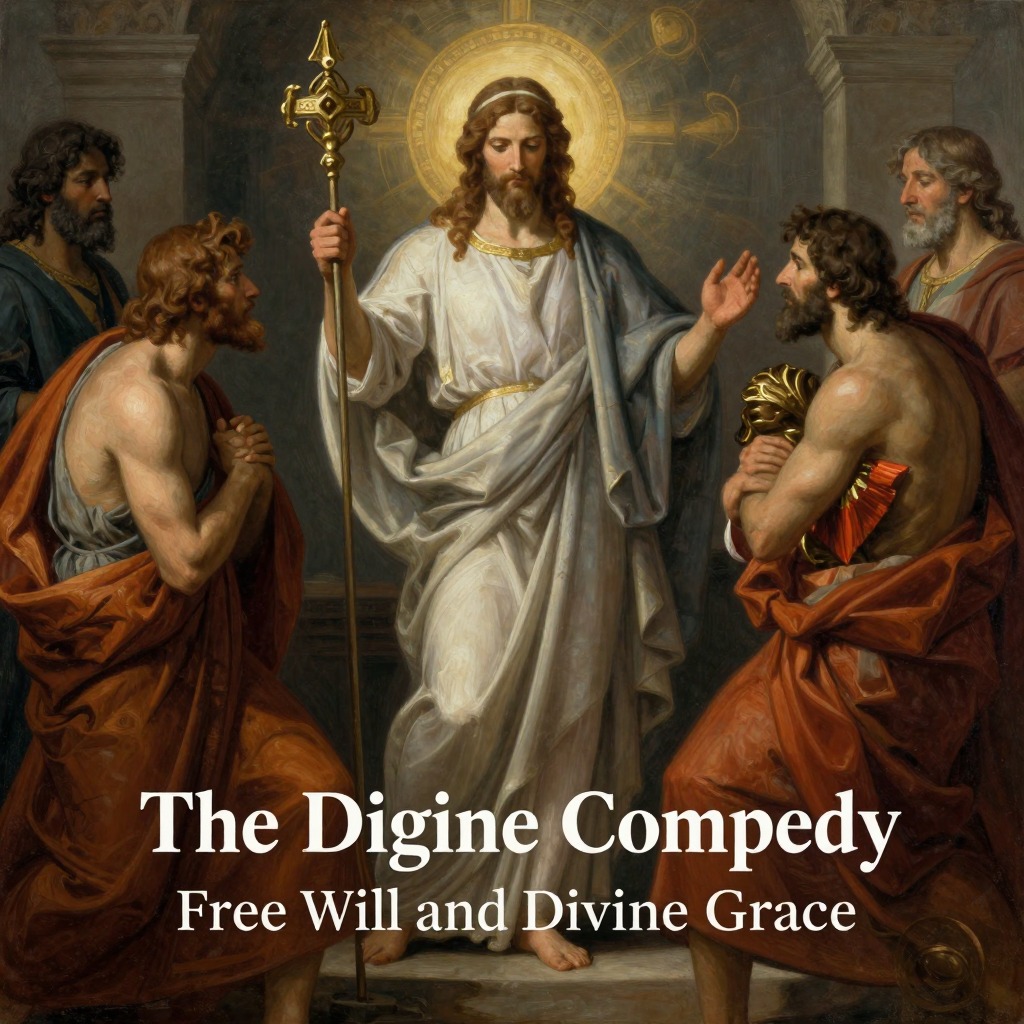
The Divine ComedyGrace is the unmerited divine assistance that makes possible Dante Alighieri's journey through the afterlife and, ultimately, his salvation. In the theological architecture of the Divine Comedy, grace is not a reward for human virtue but a free gift from God, set in motion by the compassion of heavenly figures and administered through a chain of intercessors. It is the force that rescues Dante from the Dark Forest, sustains him through Hell and Purgatory, and finally elevates him to the vision of God. Without grace, the poem's entire plot—a living man's tour of the three realms—would be impossible; with it, the poem becomes a demonstration of how divine love reclaims a soul that had lost its way.
The Heavenly Origin and the Chain of Intercession
Grace descends from the highest Heaven through a deliberate chain of intercessors. In Inferno II, Beatrice tells Virgil that "a gentle Lady is in Heaven, who grieves / At this impediment, to which I send thee, / So that stern judgment there above is broken" (E00439–E00441). This unnamed Lady—traditionally identified as the Virgin Mary—beseeches Saint Lucia, who in turn hastens to Beatrice, sitting with the ancient Rachel, and rebukes her: "Why succourest thou not him, who loved thee so, / For thee he issued from the vulgar herd? / Dost thou not hear the pity of his plaint?" (E00448–E00452). Beatrice, moved by this appeal, descends to Limbo to enlist Virgil as Dante's guide. The entire rescue operation is thus initiated by grace, not by any act of Dante's own. Virgil later confirms this to Cato of Utica on the shores of Purgatory: "I came not of myself; / A Lady from Heaven descended, at whose prayers / I aided this one with my company" (E05015–E05017). Grace is therefore a cascade of heavenly compassion that overrides the normal order of justice.
Grace and Human Potential: Beatrice's Account of Dante's Fall
The most extended theological treatment of grace in the poem occurs in Purgatorio XXX, when Beatrice, having appeared to Dante in the Earthly Paradise, explains why he needed so extreme a remedy. She tells the angels that Dante, in his new life, had been "Potentially, that every righteous habit / Would have made admirable proof in him" (E09275–E09277). This potential was itself a gift of grace: "Not only by the work of those great wheels, / That destine every seed unto some end, / According as the stars are in conjunction, / But by the largess of celestial graces, / Which have such lofty vapours for their rain / That near to them our sight approaches not" (E09269–E09274). Yet Dante, despite this endowment, turned away. Beatrice recalls that she sustained him with her look and led him in the right way while she was alive, but "As soon as ever of my second age / I was upon the threshold and changed life, / Himself from me he took and gave to others" (E09284–E09286). After her death, when her beauty and virtue increased, he found her "less dear and less delightful" and pursued "the false images of good, / That never any promises fulfil" (E09291–E09292). Neither prayer nor inspiration—"by means of which in dreams and otherwise / I called him back" (E09294–E09295)—availed. "So low he fell, that all appliances / For his salvation were already short, / Save showing him the people of perdition" (E09296–E09298). Grace, in this account, is not a one-time infusion but a sustained offer that the recipient can resist; its final, drastic form is the vision of Hell itself.
Grace and the Restoration of Free Will
Grace does not override human freedom but restores it. Virgil's discourse on love in Purgatory, though delivered before Beatrice's appearance, prepares this understanding: the soul is created apt to love, but the power to restrain or direct that love lies within the self. Beatrice later identifies this power as free will, which grace heals and perfects. In the Earthly Paradise, after Dante has confessed his error and been immersed in Lethe, Virgil—who has guided him through Hell and Purgatory—pronounces him free: "Free and upright and sound is thy free-will, / And error were it not to do its bidding; / Thee o'er thyself I therefore crown and mitre!" (E08853–E08855). This declaration marks the moment when grace, having purged Dante's sins and restored his will, returns him to full moral agency. The crown and mitre signify that he is now king and bishop of himself, no longer needing Virgil's guidance. Grace thus culminates not in the annihilation of the will but in its liberation.
Grace and the Necessity of the Infernal Journey
Beatrice's explanation makes clear that the journey through Hell was not a punishment but a last-resort therapy of grace. She tells the angels that she visited "the gates of death" and bore her intercessions with weeping to Virgil, who has led Dante so far. The reason for this extreme measure is that Dante's fall had rendered ordinary means—prayer, dreams, inspiration—ineffective. The vision of the damned is itself a grace, because it alone could shock him back to the right path. This logic is embedded in the poem's structure: the Inferno is not merely a spectacle of divine justice but a pedagogical instrument of grace. The damned souls serve as negative exemplars, and Dante's progressive horror and pity, corrected by Virgil, train his moral vision. Grace therefore operates through the very terrors that seem most opposed to it.
Grace and the Beatific Vision
In Paradise, grace becomes the medium of the soul's union with God. Beatrice explains that the blessed see God in proportion to the grace they have received: "The vision / Equals what grace it has above its worth" (E11669–E11670). The light that enables the soul to look on God is itself a gift: "Light which enables us to look on Him" . This light is not earned but given, and it increases the soul's capacity for love and joy. The final vision of God in Paradiso XXXIII is the consummation of grace: Dante's mind is struck by "a flash of lightning, wherein came its wish" , and his desire and will are turned "even as a wheel that equally is moved, / The Love which moves the sun and the other stars" (E14549–E14550). Grace, which began as an external intervention—a Lady in Heaven grieving, a saint rebuking, a poet guiding—has become the soul's own motion, identical with the love that sustains the universe.
Grace and the Structure of the Poem
The entire Divine Comedy can be read as a narrative of grace in action. The poem opens with Dante lost in a Dark Forest, unable to climb the sunlit hill because of the three beasts—a state of sin and spiritual helplessness that no human effort can overcome. Grace intervenes in the form of Virgil, sent by Beatrice at the request of Lucia and the Virgin. Virgil leads Dante through the recognition of sin (Hell), the purification of the soul (Purgatory), and finally to the point where Beatrice herself can take over. Beatrice's role is explicitly that of a mediator of grace: she reveals her youthful eyes to Dante and led him "with me turned in the right way" . After her death, when he strayed, she descended to Hell's gate to set in motion the journey that would save him. The poem thus demonstrates that grace is not a single event but a process, unfolding through time and requiring the cooperation of the human will at every stage. The final cantos, in which Dante passes beyond Beatrice to Saint Bernard and then to the vision of God, show that even the highest human love—Beatrice's—is only a channel of grace, not its source.