Horace
The Divine ComedyHorace, the Roman satirist and poet of the Augustan age, occupies a distinguished place in Dante's afterlife as one of the four supreme classical poets whom Dante encounters in Limbo, the first circle of Hell. He is named by Virgil as "Horace, the satirist" and forms part of the "fair school" of poetry that honors Virgil as its pre-eminent lord. Later, in Purgatory, the poet Statius speaks of Horace with affection, recalling him as a friend and fellow poet who dwells in Limbo alongside other ancient writers. Horace's presence in the poem underscores Dante's reverence for classical literary tradition and the enduring bonds of poetic fellowship that transcend even the divide between the saved and the damned.
Identity and Introduction
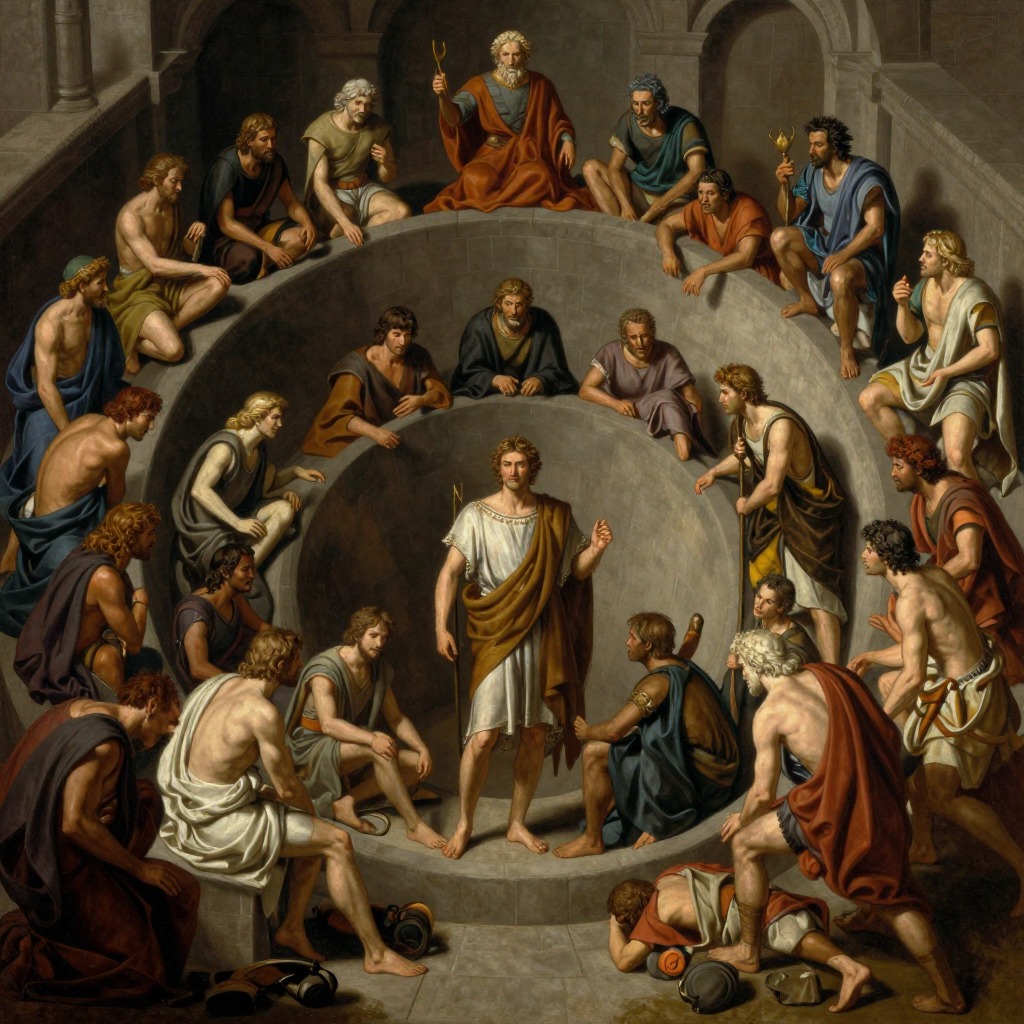
Horace is introduced in Inferno, Canto IV, when Virgil points out to Dante the four great poets who approach them in Limbo. Virgil identifies Homer as the sovereign poet, followed by "Horace, the satirist," then Ovid and Lucan. These four, together with Virgil himself, constitute the "fair school" of poetry, and they honor Virgil as the pre-eminent lord of song, who soars above the others like an eagle. Horace is thus placed among the most revered figures of classical literature, a status that Dante's poem confirms by including him in the company of Homer, the foundational epic poet, and the other major Latin poets.
Life and Plot Trajectory
Horace does not participate in the action of the Divine Comedy beyond this initial appearance in Limbo. He is one of the shades whom Dante sees in the luminous opening of the Noble Castle, where the virtuous pagans dwell in a state of sorrow without torment, hoping without fulfillment. He is not among the souls who speak or interact with Dante; his role is purely that of a revered figure from the literary past, acknowledged by Virgil and observed by Dante as part of the honored company. In Purgatory, however, Horace is mentioned again by Statius, who asks Virgil about the fate of their mutual friends, including Horace, among the poets in Limbo.
Relationships and Conflict
Horace's primary relationship in the poem is with Virgil, who names him as a fellow poet and a member of the school that honors Virgil's supremacy. Statius, in Purgatory, speaks of Horace with warmth, asking Virgil about "our friend Terentius, Caecilius, Plautus, Varro" and then including Horace among those who dwell in the first circle of the prison blind. Statius's question reveals that Horace is remembered with affection and that the poets of Limbo maintain a community of discourse, often speaking of the mountain (Parnassus) that was their nurse. There is no conflict associated with Horace; his presence is one of harmony and mutual respect among the classical poets.
Change and Ending
Horace undergoes no change within the poem. He remains in Limbo, the first circle of Hell, where the virtuous pagans are confined not by sin but by the lack of baptism and of faith in Christ. Virgil explains that these souls "sinned not" but are lost because they lived before Christianity or did not worship God in the right manner. Horace, like the others, lives in desire without hope. His fate is fixed: he will never ascend to Purgatory or Paradise, but he is not subjected to the torments of the lower circles. His ending is one of eternal suspension in a place of sorrow without torment, where the only punishment is the absence of God.
Narrative Role and Evaluation
Horace functions in the Divine Comedy as a symbol of the highest achievements of classical poetry and as a marker of Dante's own literary lineage. By including Horace among the four great poets who welcome Virgil and honor Dante by making him "the sixth among such wisdom," Dante asserts his own place within the tradition of classical epic and satire. Horace's presence also reinforces the theme of the limitations of pagan virtue: despite his greatness, he cannot be saved because he lacked faith. In Purgatory, Statius's affectionate inquiry about Horace and the other poets humanizes the classical tradition, showing that even in Limbo, the bonds of friendship and shared artistic endeavor persist. Horace thus serves as both a tribute to the enduring power of poetry and a reminder of the ultimate insufficiency of human achievement without divine grace.