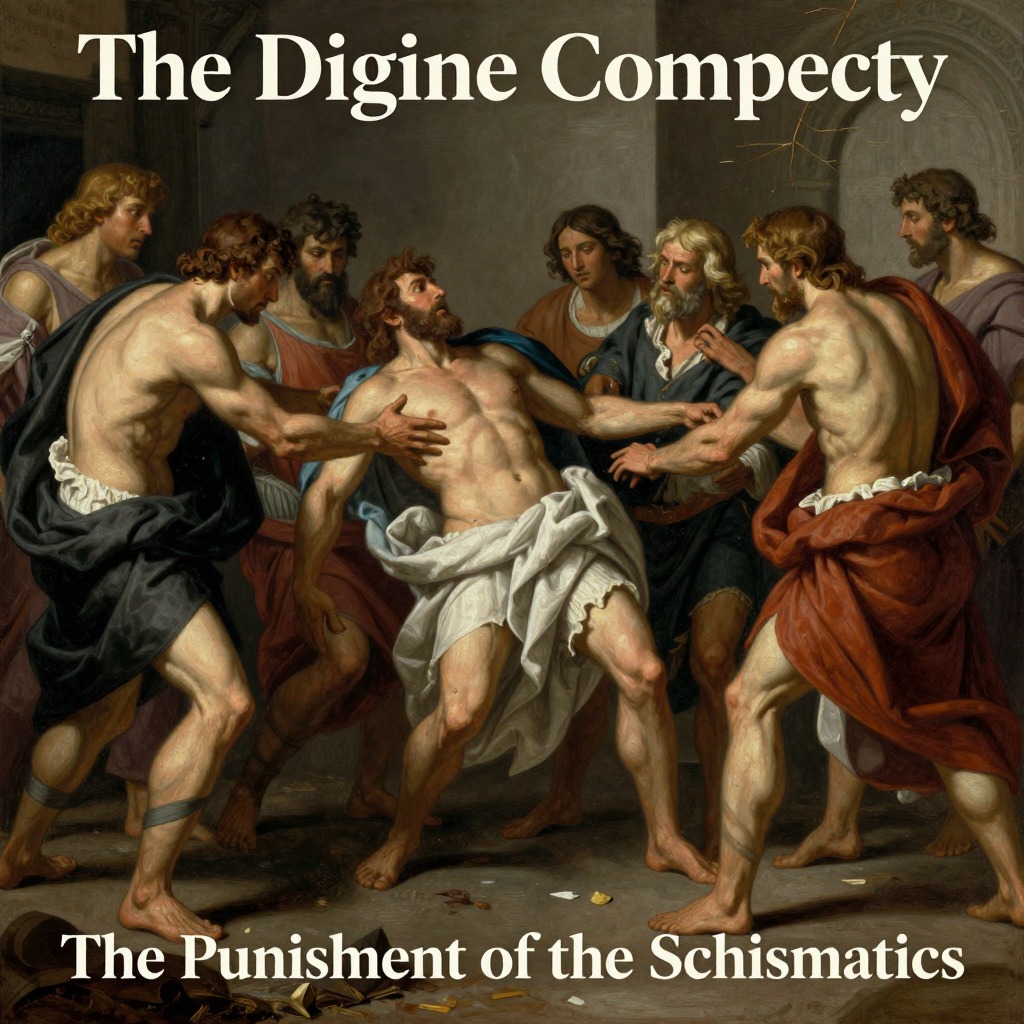
Mosca
The Divine ComedyMosca is a minor but historically significant figure in Dante's Inferno, appearing in Canto XXVIII among the Schismatics in the Ninth Bolgia of Malebolge. His single, fateful utterance—"A thing done has an end!"—made him the catalyst for the violent factionalism that tore Florence apart in the 13th century, and his eternal punishment in Hell is a direct contrapasso of his divisive counsel.
Identity and Historical Background
Mosca was a member of the Uberti family, a powerful Florentine Ghibelline clan. In the mid-13th century, when the city was riven by conflict between the Guelphs and Ghibellines, the murder of a nobleman named Buondelmonte de' Buondelmonti in 1215 is traditionally seen as the spark that ignited open warfare. According to chroniclers, when the Amidei family and their allies debated how to avenge an insult, Mosca urged them to kill Buondelmonte, arguing that "a thing done has an end"—meaning that a decisive, irreversible act would settle the matter. This advice, which Mosca himself later regretted, set off a cycle of vendettas that plunged Florence into decades of strife.
Appearance and Punishment in Hell
In the Ninth Bolgia, Dante encounters Mosca among the Sowers of Discord, a group of sinners whose bodies are horribly mutilated by a demon with a sword as they march around the circle. Mosca is described as having both his hands severed, the stumps lifted through the murky air, his face made horrible by blood. When he sees Dante, he cries out, "Thou shalt remember Mosca also, / Who said, alas! 'A thing done has an end!' / Which was an ill seed for the Tuscan people." His punishment—the loss of his hands, the instruments of action—mirrors the way his words set irreversible events in motion, and his own body is now forever divided, just as he divided Florence.
Dante's Response and Thematic Significance
Dante, who as a Florentine exile knew the bitter consequences of the city's factionalism, responds to Mosca with a curse: "And death unto thy race." This harsh reply underscores Dante's condemnation of those who, through reckless speech, sow discord and destroy the unity of the community. Mosca's fate illustrates the poem's principle of contrapasso: the sin of schism, which tears apart the body politic, is punished by the tearing apart of the sinner's own body. His brief but powerful appearance serves as a warning against the destructive power of words, a theme that resonates throughout the Comedy as Dante repeatedly condemns the factionalism that ruined his beloved Florence.
Narrative Role and Evaluation
Mosca is a flat character in Forster's sense, built around a single idea—the disastrous consequences of his advice. Yet his historical specificity and the vividness of his punishment make him a memorable emblem of political irresponsibility. Dante uses him not only to condemn a particular individual but to critique the entire culture of vendetta and factionalism that plagued Italian city-states. Mosca's story, though brief, encapsulates the Comedy's moral vision: that every action, especially one that divides a community, carries eternal consequences.