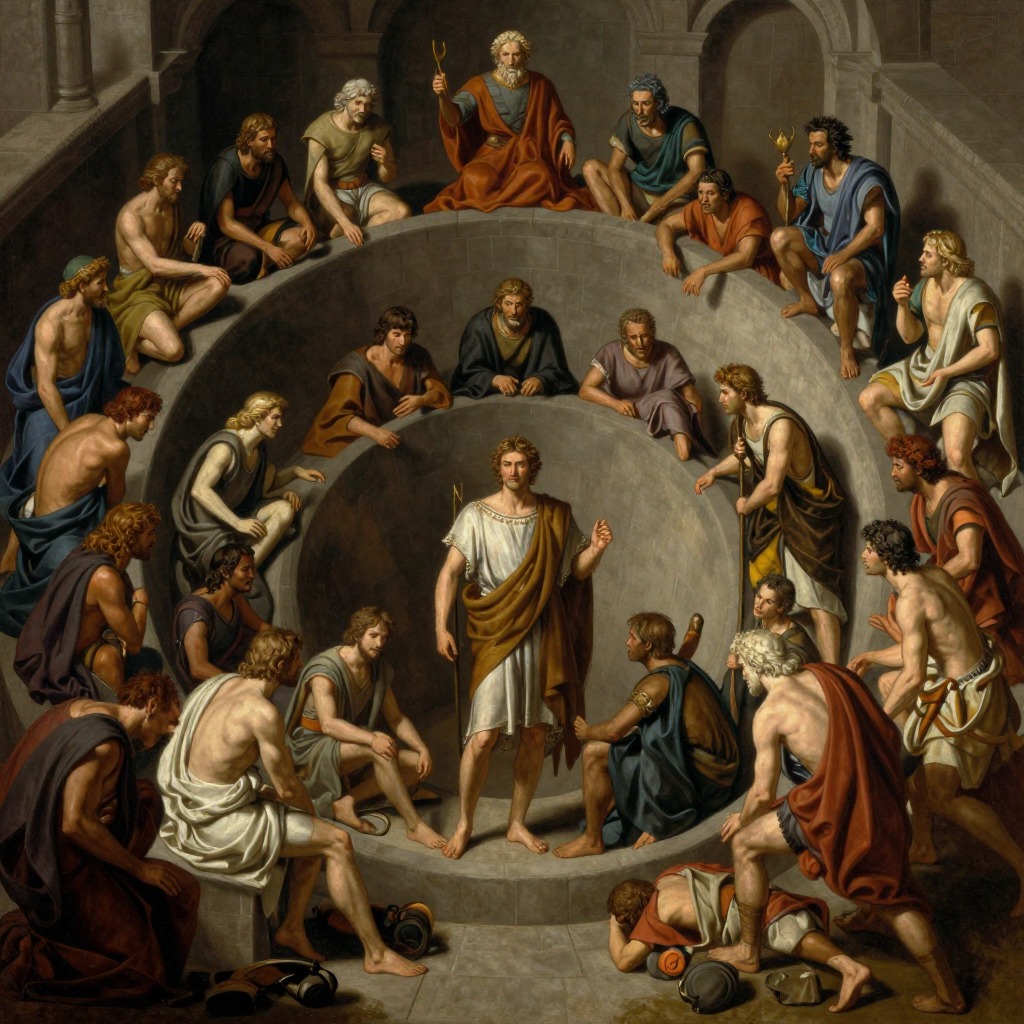
Ovid
The Divine ComedyOvid, the Roman poet Publius Ovidius Naso, occupies a singular position in Dante's literary cosmos as one of the four supreme classical poets honored in Limbo, and his Metamorphoses provides the essential mythological framework for the most astonishing transformations Dante witnesses in Hell. Dante's treatment of Ovid is both reverent and competitive: he invokes him as a peer among the greats, yet he deliberately surpasses Ovid's own tales of metamorphosis by depicting a more radical, reciprocal exchange of forms that no ancient poet had conceived.
Identity and Place Among the Poets
In the first circle of Hell, Limbo, Dante encounters the four "mighty shades" who constitute the "fair school" of poetry: Homer, Horace, Ovid, and Lucan. Virgil identifies Ovid as the third of these, following Homer and Horace, and preceding Lucan. These poets honor Virgil, and in turn they honor Dante by making him "one of their own band," so that Dante becomes the sixth among such great intellects. This placement establishes Ovid not merely as a source but as a foundational figure in the poetic tradition Dante claims as his inheritance. Later, in Purgatory, Statius—himself a poet deeply influenced by Virgil—mentions Ovid among the classical poets who dwell in Limbo, confirming Ovid's enduring presence in the literary afterlife.
Ovidian Metamorphosis and Dante's Poetic Rivalry
Dante's most direct engagement with Ovid occurs in the seventh bolgia of the eighth circle, where thieves are punished by a continuous, grotesque cycle of transformations. Dante explicitly invokes Ovid's authority only to declare that his own vision surpasses it. He commands Ovid to be silent about his tales of Cadmus (turned into a serpent) and Arethusa (changed into a fountain), because Ovid "converts" one being into another but never "transmuted" two natures "front to front" so that both forms "interchange their matter." In the bolgia, Dante witnesses a six-footed serpent fasten itself onto a sinner, Agnello Brunelleschi, and the two figures fuse into a single, monstrous hybrid—"neither two nor one"—before the serpent and the man exchange their entire forms: the serpent becomes human and the human becomes a serpent. This is a metamorphosis more radical than any in Ovid, involving a simultaneous, reciprocal transformation of two beings, not a simple one-way change. Dante further intensifies the Ovidian model by showing a second transformation in which a small, fiery serpent transfixes another sinner, Buoso degli Abati, and the two exchange their substance through smoke that issues from the wound and the mouth, resulting in the serpent taking on human shape and the man becoming a reptile. Dante explicitly boasts that Ovid and Lucan never achieved such a feat, marking his own poem as the culmination and surpassing of classical metamorphosis poetry.
Ovid as a Source of Mythological Reference
Beyond the direct competition, Ovid's Metamorphoses supplies Dante with a vast repertoire of mythological figures and narratives that populate the afterlife. In the fourth bolgia of the eighth circle, Virgil points out the soothsayer Amphiaraus, who was swallowed by the earth before the eyes of the Thebans—a story drawn from Ovid. He also identifies Tiresias, who was transformed from male to female and back again by striking two serpents, a tale Ovid recounts in detail. The figure of Manto, the daughter of Tiresias, who wandered after her father's death and eventually founded Mantua, is another Ovidian borrowing. In the tenth bolgia, the falsifiers include Myrrha, who, as Ovid tells, committed incest with her father by disguising herself, and Gianni Schicchi, who impersonated the dead Buoso Donati to forge a will—both stories of deceptive identity that Ovid narrated. The maddened figures of Athamas, who killed his son Learchus, and Hecuba, who barked like a dog after witnessing the deaths of her children, are also drawn from Ovid's Metamorphoses. These references demonstrate that Ovid's work functions as a mythological encyclopedia for Dante, providing the raw material for the punishments of fraud and falsification.
Thematic Significance: The Limits and Transcendence of Classical Art
Dante's use of Ovid ultimately serves a larger theological and poetic purpose. By invoking Ovid only to surpass him, Dante asserts that his Christian poem can achieve what pagan poetry cannot: a vision of transformation that is not merely physical but moral and spiritual. Ovid's metamorphoses are often arbitrary or punitive, driven by the whims of gods; Dante's transformations are governed by the divine justice of contrapasso, where the punishment perfectly mirrors the sin. The thieves, who in life stole and falsified identities, are condemned to lose their own forms in an endless, agonizing exchange. Dante thus transforms Ovid's literary device into a vehicle of moral and theological meaning, demonstrating that the "true" poetry of the Commedia fulfills and transcends the classical tradition. At the same time, Dante's reverence for Ovid as a fellow poet in Limbo acknowledges the enduring power of classical art, even as it is subordinated to the higher truth of Christian revelation.