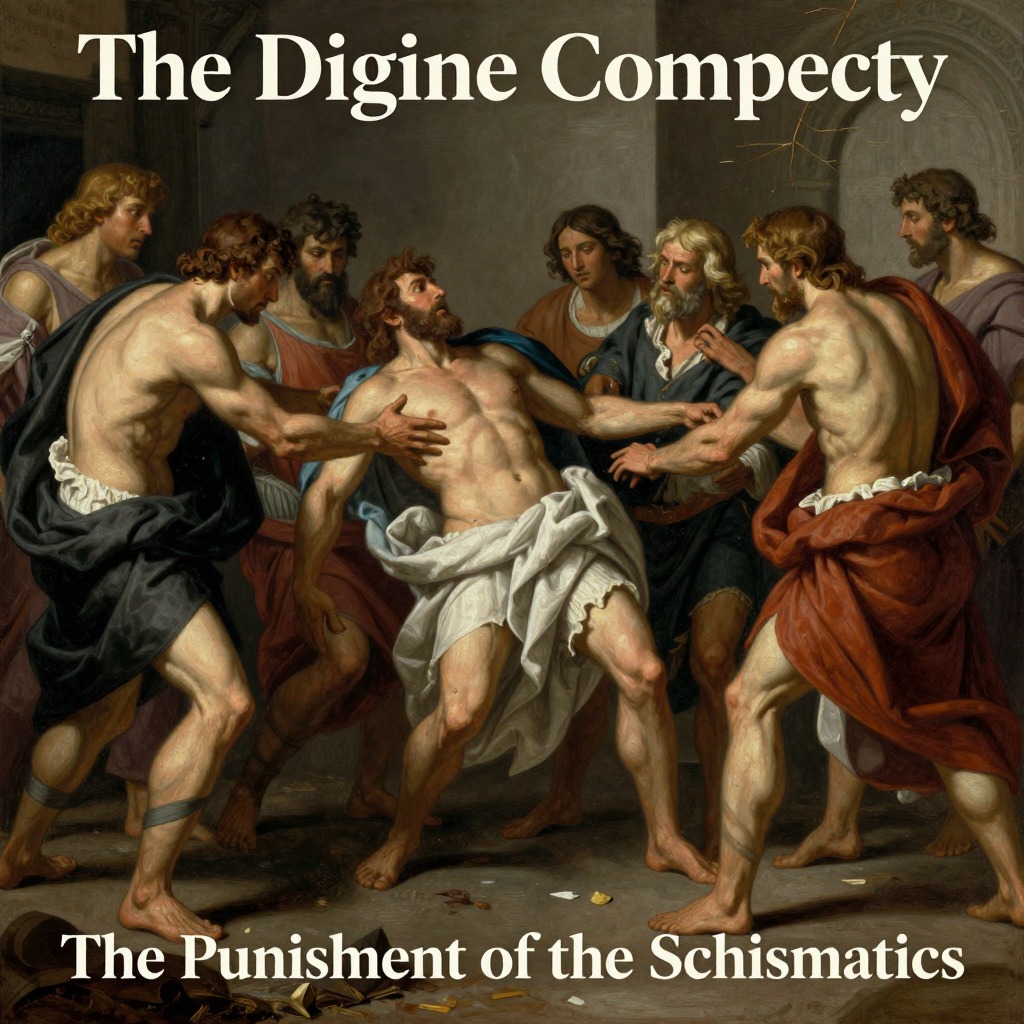
Pier da Medicina
The Divine ComedyPier da Medicina is a damned soul encountered in the Ninth Bolgia of Malebolge, the circle reserved for Schismatics and Sowers of Discord. His grotesquely mutilated body—throat pierced through, nose cut off close beneath the brows, and only a single ear remaining—visibly enacts the contrapasso by which those who divided others are themselves divided. He appears in Inferno Canto XXVIII, where he delivers a specific prophecy of political betrayal and identifies a fellow traitor, making him one of the most historically grounded and narratively functional figures in Dante's catalogue of the schismatic damned.
Identity and Mutilation
Pier da Medicina is introduced among the wounded shades of the ninth Bolgia, where a devil perpetually cleaves the sinners with a sword, their wounds closing only to be reopened as they circle the ditch. When Dante and Virgil pause, Pier da Medicina is one of those who stops to look in wonder at the living visitor. His injuries are described with clinical precision: his throat is pierced through, his nose is cut off close underneath the brows, and he has no longer but a single ear. The mutilation is not merely punitive but communicative—it is through this ruined face that he speaks, his gullet open and outwardly red in every part, forcing his words through a body that has been literally unmade by the sin of division.
Prophecy of Betrayal
Pier da Medicina recognizes Dante as a living man from the "Latian land" and, believing Dante may return to the world, entrusts him with a warning. He instructs Dante to make known to "the best two of Fano," Messer Guido and Angiolello, that they will be cast overboard from their vessel and drowned near the Cattolica by the betrayal of a tyrant. He declares that between the isles of Cyprus and Majorca, Neptune never yet beheld so great a crime—neither of pirates nor of Argolic people. The traitor, he specifies, is a one-eyed man who holds the land and will lure the victims to a parley before executing the murder. The prophecy is grimly specific, naming places and persons, and it functions as a political warning embedded within the larger structure of Dante's condemnation of treachery in Italian affairs.
Identification of Curio
After delivering his prophecy, Pier da Medicina performs a second act of exposure. He lays his hand upon the jaw of a companion and opens his mouth, revealing a figure whose tongue is asunder in his windpipe slit. This is Curio, the Roman who, being banished, urged Caesar to cross the Rubicon by affirming that the forearmed always have the advantage and that delay brings detriment. Dante's narrator recalls Curio as one who "in speaking was so bold," and his punishment—a tongue split and silenced—mirrors the divisive speech that ignited civil war. By pointing out Curio, Pier da Medicina not only names a historical figure but also reinforces the Bolgia's theme: those who used words to sever political bonds are now themselves severed, their organs of speech made monuments to their crime.
Narrative Role and Significance
Pier da Medicina serves as a witness and a prophet within the Schismatics' circle, his own ruined body a text that Dante reads and then transmits to the living. His prophecy of the Fano murders and his identification of Curio together create a dense network of historical reference, linking the cosmic justice of Hell to the specific political crimes of Dante's era. Unlike some damned souls who merely lament their fate, Pier da Medicina actively engages with Dante as a messenger, using his mutilated voice to expose treachery that remains unpunished on earth. His presence in the poem thus extends the reach of divine judgment into the world of Italian politics, where the one-eyed tyrant and the drowned noblemen await a reckoning that only the reader, armed with Dante's report, can fully comprehend.