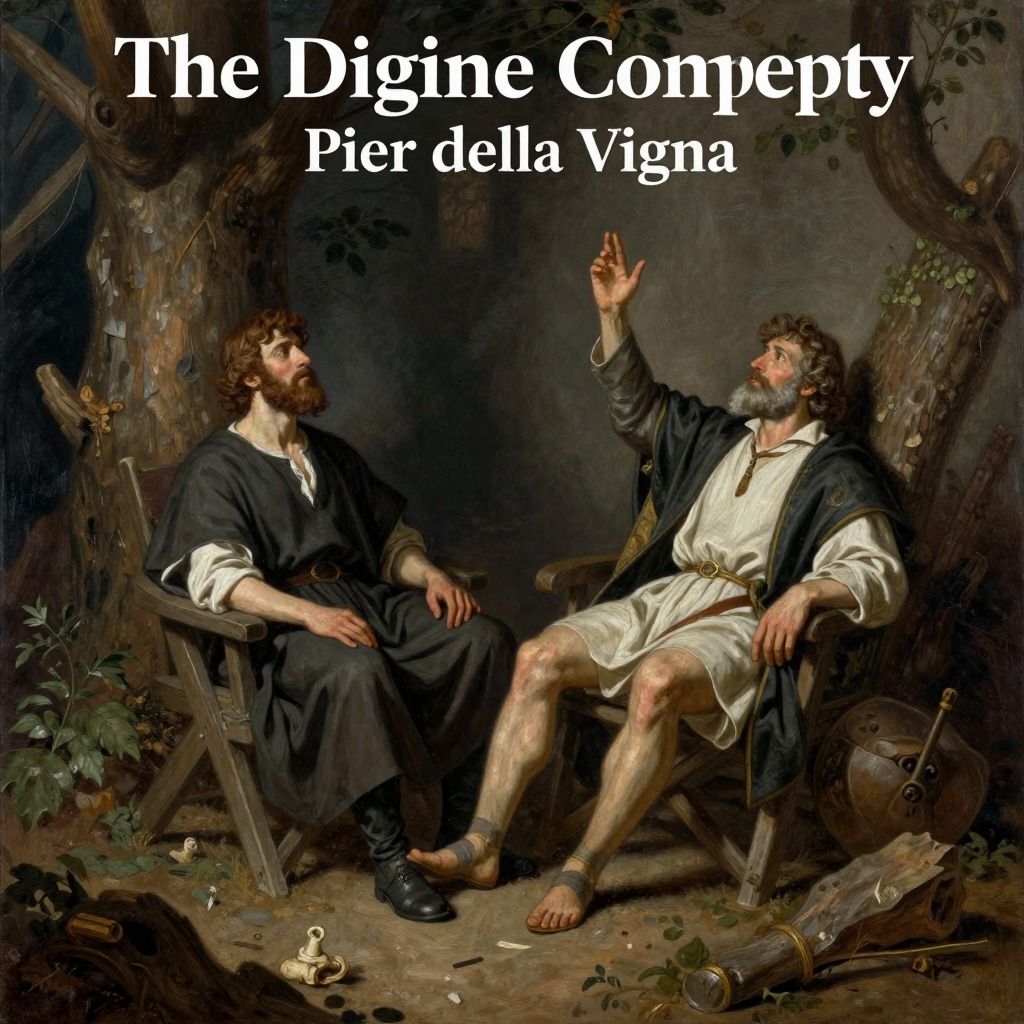
Pier della Vigna
The Divine ComedyPier della Vigna is one of the most tragic figures in Dante's Inferno, a man of immense political power and intellectual achievement who was destroyed by envy and courtly intrigue, and whose suicide condemned him to an eternity of suffering as a gnarled, bleeding tree in the Wood of Thorns. His story, told in Canto XIII, is a meditation on loyalty, injustice, and the irreversible nature of self-destruction, and it provides one of the poem's most vivid and disturbing examples of contrapasso.
Identity and Background
Pier della Vigna was a renowned statesman and scholar who served as the chief minister and private secretary to Emperor Frederick II, holding the keys to the emperor's heart and secrets. He describes himself as the one who "both keys had in keeping / Of Frederick's heart, and turned them to and fro / So softly in unlocking and in locking, / That from his secrets most men I withheld." His fidelity to his office was so great that he lost his sleep and his pulse. However, the "courtesan who never from the dwelling / Of Caesar turned aside her strumpet eyes"—that is, Envy, the universal vice of courts—inflamed the other courtiers against him. Their slander so enraged Frederick that Pier's "glad honours turned to dismal mournings."
The Suicide and Its Cause
Unable to bear the disgrace and the loss of the emperor's favor, Pier della Vigna chose to end his own life. He states that his spirit, "in disdainful exultation, / Thinking by dying to escape disdain, / Made me unjust against myself, the just." This act of self-violence, born of pride and despair, is the sin for which he is punished in the seventh circle. He swears by the roots of the tree he has become that he never broke faith with his lord, who was so worthy of honor. His plea to Dante is that his memory be comforted in the world above, for it still lies prostrate from the blow that envy dealt it.
The Contrapasso of the Suicides
Pier della Vigna explains the unique and terrible punishment of the suicides. When the exasperated soul abandons the body, it falls into the forest of the seventh circle, where it takes root and grows into a thorn tree. The Harpies feed on its leaves, causing pain and providing an outlet for the suffering. At the Last Judgment, the souls will reclaim their bodies, but they will not be reunited with them; instead, the bodies will be hung from the thorn trees of their respective shades, a final, grotesque union. This contrapasso reflects the sin: those who violently rejected their own bodies are now trapped in a vegetable form, unable to move or speak except when wounded, and their bodies will be eternally displayed as a sign of their rejection.
Encounter with Dante and Virgil
When Dante, at Virgil's urging, breaks a branch from Pier's tree, the trunk cries out in pain and bleeds. Virgil rebukes Dante for his thoughtless act, explaining that the incredible nature of the punishment led him to prompt the breaking of the branch. Pier then recounts his story, and when asked by Virgil how the soul is bound within the knots and whether any soul is ever freed, he provides the detailed explanation of the suicides' eternal fate. The encounter is marked by Dante's profound pity, which prevents him from questioning Pier further, leaving Virgil to ask the crucial questions about the mechanics of the punishment.
Thematic Significance
Pier della Vigna's story embodies several key themes of the Inferno. It illustrates the destructive power of envy and slander in the courts of the powerful, a theme that resonates throughout the poem. His suicide, an act of self-harm born from a sense of injustice, is presented as a grave sin against oneself, a violation of the natural order. The contrapasso of the bleeding tree is a powerful symbol of the soul's inability to escape its own pain and the eternal consequences of a choice made in despair. Pier's eloquence and his insistence on his own loyalty make him a deeply sympathetic figure, complicating the reader's response to damnation and underscoring the tragedy of a life cut short by the very virtues—fidelity and honor—that defined it.