Pisa
The Divine ComedyPisa is the Tuscan city on the Arno River that Dante Alighieri condemns in the Inferno as a place of exceptional cruelty, most memorably as the setting for Count Ugolino's imprisonment and starvation alongside his sons and grandsons. The city's name appears in the poem not merely as a geographical marker but as a moral indictment, with Dante calling it "thou opprobrium of the people / Of the fair land there where the 'Si' doth sound" . This denunciation places Pisa among the most sharply criticized locations in the entire Divine Comedy, a city whose sins are so grave that the poet wishes for its destruction.
The Prison of the Mew and the Starvation of Count Ugolino
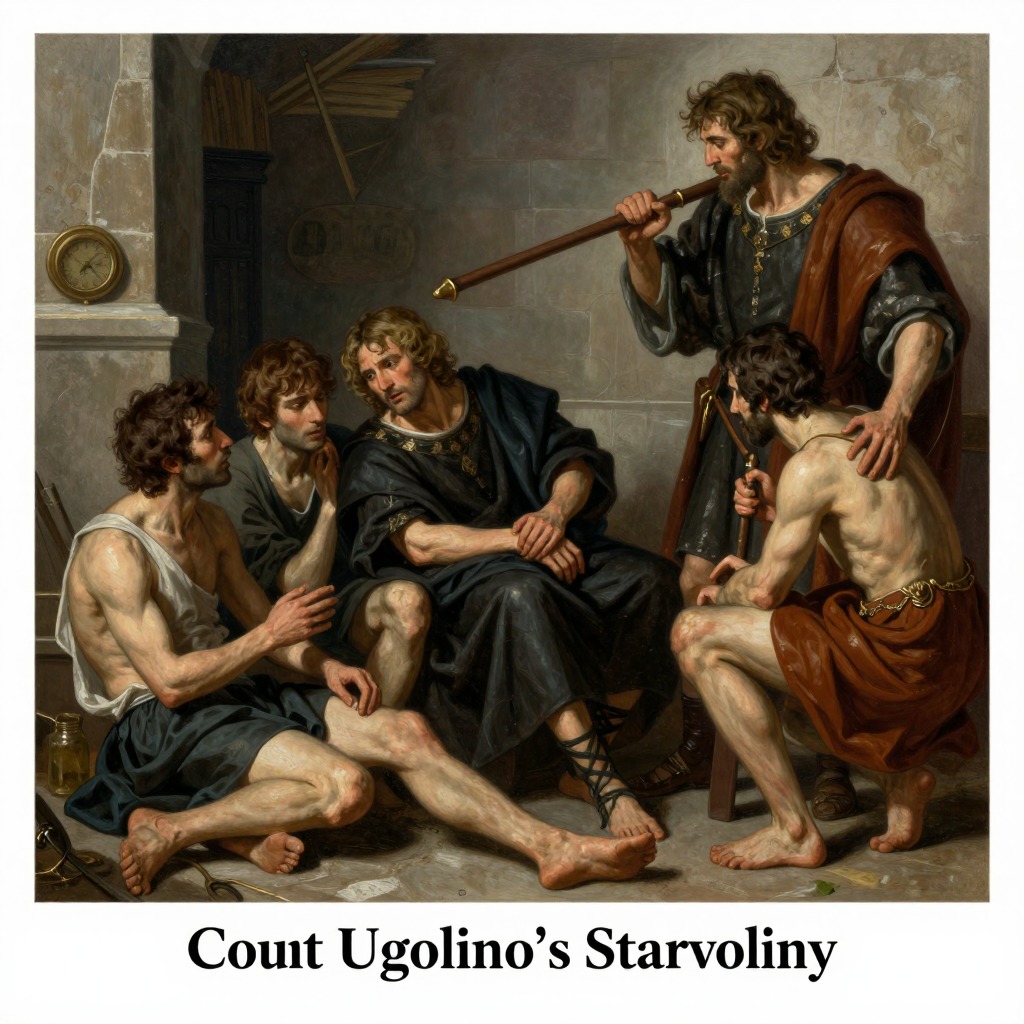
The most famous Pisan episode in the Inferno is the story of Count Ugolino, who was imprisoned with his sons and grandsons in a tower that "bears because of me the title of Famine" . The tower, called the Mew, was a narrow cell where the prisoners were locked in and slowly starved to death. Ugolino describes how he dreamed of being hunted like a wolf with his whelps on the mountain that separates Pisa from Lucca, and how the dream foretold his actual fate. After days of watching his children die one by one—Gaddo, then the others—Ugolino, already blind from hunger, groped over their bodies and called to them for three days after they were dead, until "hunger did what sorrow could not do" . This harrowing account is the most sustained and emotionally devastating narrative in the Inferno's ninth circle, and it is inextricably tied to Pisa as the place where this atrocity occurred.
Dante's Curse upon the City
Dante's response to Ugolino's story is not pity alone but a furious curse directed at Pisa itself. He calls the city "thou opprobrium of the people / Of the fair land there where the 'Si' doth sound" , invoking the Italian language's affirmative particle to mark Pisa as a stain on the entire nation. He wishes that the islands of Capraia and Gorgona would move to block the mouth of the Arno and drown every person in Pisa . The poet's rage stems from the fact that Ugolino's sons—Uguccione, Brigata, and the other two—were innocent of any crime, yet were put to death alongside their father. Dante compares Pisa to "modern Thebes" , the ancient city notorious for its cycle of familial violence and divine punishment.
Narrative and Thematic Significance
Pisa functions in the Inferno as a symbol of political treachery and familial cruelty, the worst excesses of the factional violence that tore apart thirteenth-century Italy. The city's role in Ugolino's story illustrates the contrapasso of the ninth circle, where traitors are frozen in the ice of Cocytus, and where Ugolino himself is condemned to gnaw eternally on the head of Archbishop Ruggieri, the man who betrayed him. Pisa is thus not a neutral setting but an active participant in the moral geography of Hell: a place where the worst human impulses—betrayal, greed, and the murder of the innocent—are concentrated and punished. The city's name becomes a byword for the corruption that Dante believed was destroying Italy, and its appearance in the poem serves as a warning about the consequences of political and personal treachery.