Pride
The Divine ComedyPride is the first and most severe sin purged on Mount Purgatory, punished on the First Terrace where souls bent under massive stones learn humility through the weight of their former arrogance. In Dante's moral system, pride is the root of all other sins, and its purgation is the most physically arduous, requiring the proud to crawl beneath crushing loads while contemplating carved examples of humility and pride's downfall.
The Sin and Its Place in Purgatory
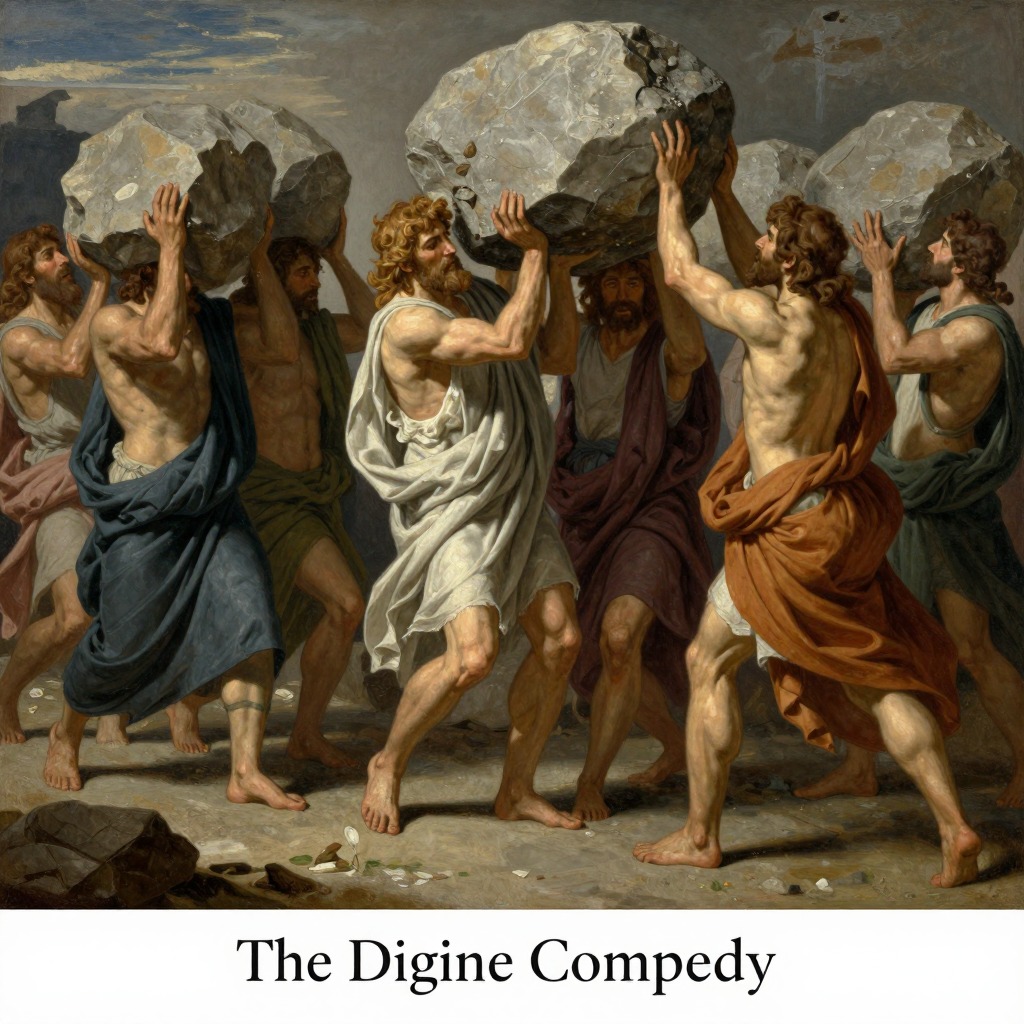
Pride occupies the First Terrace of Purgatory, the lowest and most distant from the Earthly Paradise, because it is considered the gravest of the seven deadly sins and the foundation from which all others spring. The souls here are those who in life held themselves above others, thinking more highly of themselves than they ought. Their punishment is a precise application of the law of contrapasso: as they once looked down on others with disdain, they are now forced to look down at the ground, bent double beneath enormous stones that press them into the posture of humility they refused in life. The weight each soul carries corresponds to the degree of its pride, so that "they were more or less bent down, / According as they more or less were laden" (E06468–E06469). The suffering is so intense that even the most patient among them seems to weep and say, "I can no more!" .
The Sculptures of Humility and Pride's Fall
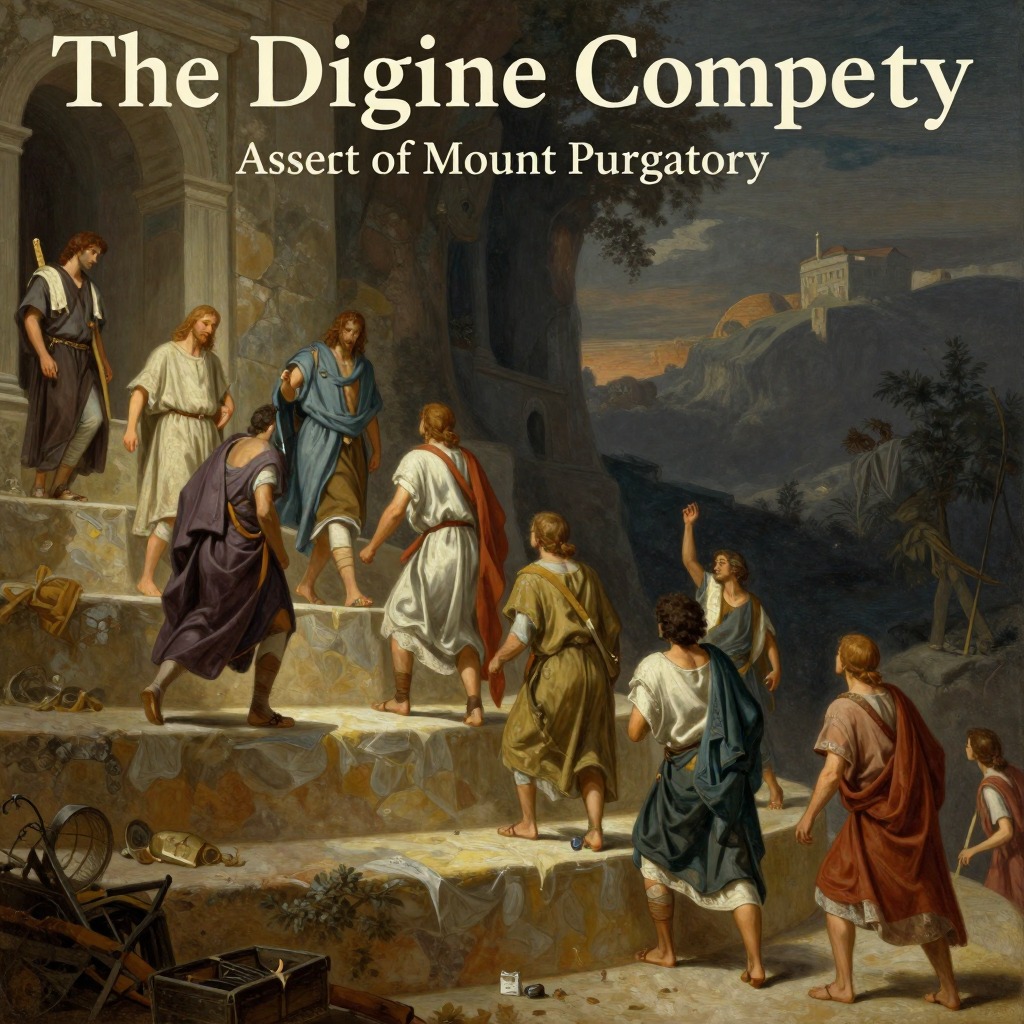
The inner wall of the First Terrace is adorned with marble sculptures of extraordinary artistry, designed to teach humility by example. These carvings are so lifelike that "Dead seemed the dead, the living seemed alive" . The first series depicts scenes of humility: the Annunciation, where the Angel Gabriel appears to Mary and she responds "Ecce ancilla Dei" ; King David dancing before the Ark of the Covenant, humbling himself before God despite the scorn of his wife Michal (E06297–E06301); and the Roman Emperor Trajan stopping to hear the plea of a poor widow, demonstrating that even the highest authority must bend to justice and mercy (E06305–E06325). The second series, carved into the pavement beneath the souls' feet, shows the downfall of the proud: Lucifer cast from heaven (E06540–E06542), the giant Nimrod bewildered at the Tower of Babel (E06549–E06551), Niobe weeping over her slain children (E06552–E06554), and King Saul falling on his own sword (E06555–E06557). These images serve as a constant reminder that pride leads to destruction, and the souls must tread upon them as they crawl, literally walking over the examples of the sin they are purging.
The Souls and Their Stories
Among the proud souls Dante encounters are several notable figures whose lives exemplify the sin. Omberto di Santafiore, a Tuscan nobleman, confesses that "The ancient blood and deeds of gallantry / Of my progenitors so arrogant made me / That, thinking not upon the common mother, / All men I held in scorn" (E06433–E06436). His pride led to his violent death, and now he bears the stone that crushes his neck, acknowledging that his arrogance harmed not only himself but all his kin. The illuminator Oderisi d'Agobbio, once the most celebrated artist of his day, now humbly admits that his fame has been surpassed by Franco Bolognese, and reflects on the vanity of earthly glory: "Your reputation is the colour of grass / Which comes and goes" (E06487–E06488). He delivers a meditation on the transience of human achievement, noting how Cimabue was eclipsed by Giotto, and how one poet surpasses another, until even the greatest are forgotten. Provenzan Salvani, once the proud lord of Siena who sought to bring the entire city under his control, is shown as an example of how even the most arrogant can be saved through a single act of radical humility: he begged publicly in the Campo of Siena to raise ransom for a friend, and this act of self-abasement shortened his time in Ante-Purgatory (E06506–E06514).
The Prayer of the Proud
The souls on the First Terrace recite the Lord's Prayer as they labor under their burdens, adapting its petitions to their condition. They pray not for themselves but for those still living on earth, saying, "This last petition verily, dear Lord, / Not for ourselves is made, who need it not, / But for their sake who have remained behind us" (E06394–E06396). This selfless intercession marks the beginning of their transformation: even as they suffer, they have begun to think of others before themselves. The prayer itself is a lesson in humility, acknowledging dependence on God for daily bread and for deliverance from temptation, and asking for the grace to forgive others as they themselves hope to be forgiven.
Virgil's Discourse on Love and the Root of Pride
As Dante and Virgil ascend from the Fourth Terrace, Virgil delivers a comprehensive discourse on love as the seed of all virtue and all sin. He explains that love, which is the fundamental motion of the soul, can err in three ways: by loving evil, by loving good too little, or by loving good too much. Pride belongs to the first category, the love of evil directed toward one's neighbor. Virgil identifies three forms of this perverted love: the proud who "by abasement of their neighbour, / Hope to excel" (E07366–E07367); the envious who fear another's rise; and the wrathful who seek revenge. Pride, then, is the desire to diminish others in order to elevate oneself, a love that turns the soul away from God and toward its own imagined superiority. This theological framework makes clear why pride is the first sin to be purged: until the soul learns to see itself as no better than others, it cannot begin to address the more subtle sins that follow.
The Ascent and the Erasure of the P's
When Dante and Virgil leave the First Terrace, an Angel wipes one of the seven P's (for peccatum, sin) from Dante's forehead, marking the remission of pride. The ascent becomes noticeably easier, and Dante remarks that he feels "as if some heavy thing / Has been uplifted from me" (E06633–E06634). Virgil explains that as each P is erased, the soul's will becomes stronger and the climb less burdensome, until at last the ascent becomes a delight rather than a labor. This physical sensation mirrors the spiritual reality: pride is the heaviest of sins, and its removal lightens the soul for the journey ahead. The proud who have completed their purgation are freed from the crushing stones and ascend to the next terrace, their eyes now lifted not in arrogance but in hope.