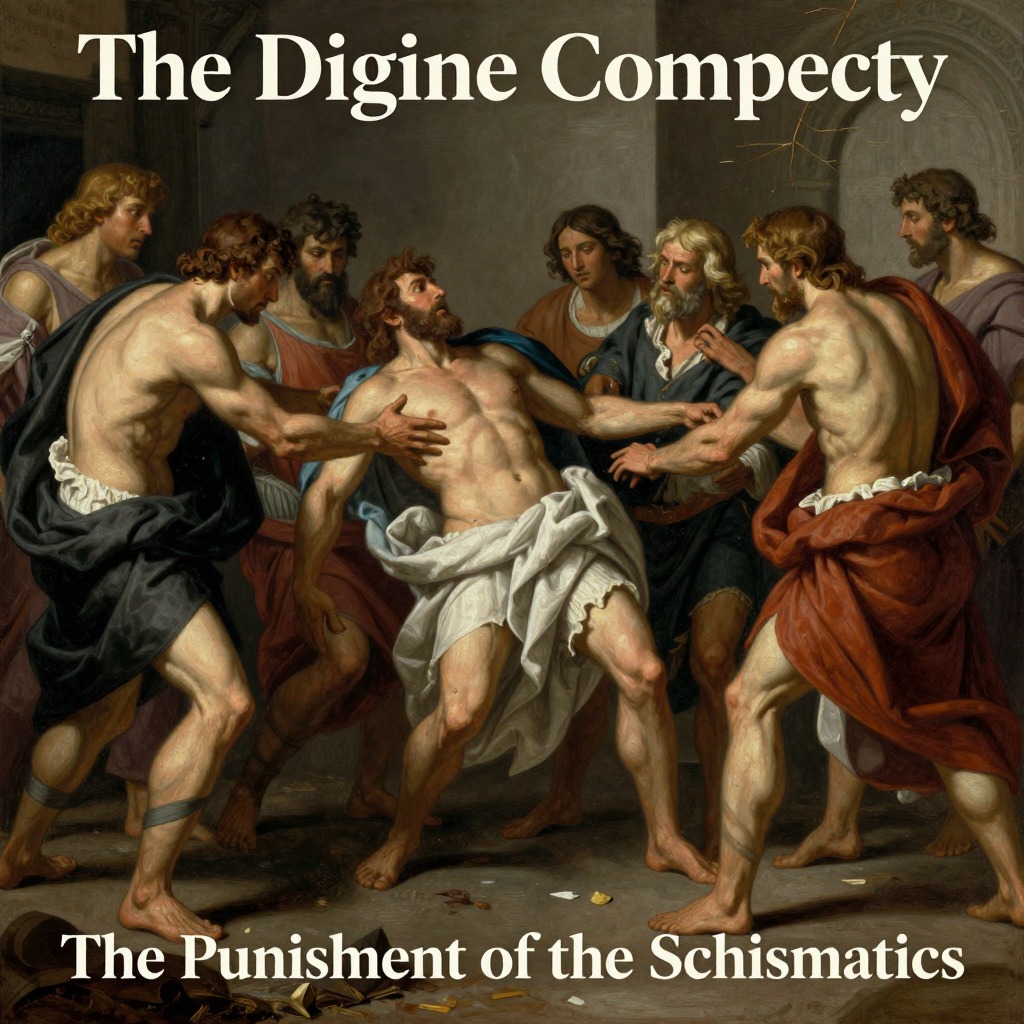
Schism
The Divine ComedySchism, in Dante's Inferno, is the sin of deliberately dividing religious or political unity, punished in the Ninth Bolgia of Malebolge by the gruesome contrapasso of being cleft from chin to groin by a demon's sword, with wounds that close only to be reopened repeatedly. The episode features historical and legendary schismatics—Mahomet, Ali, Pier da Medicina, Curio, Mosca, and Bertrand de Born—whose mutilated bodies enact the division they caused, and it culminates in the walking, lantern-like trunk of Bertrand de Born, a figure whose punishment embodies the principle that the divider of unity is himself eternally divided.
The Ninth Bolgia and the Contrapasso of Division
The Ninth Bolgia of the Eighth Circle is reserved for those who sowed discord—schismatics, heretics, and those who divided families, religions, or states. Dante describes the scene as one of such horrific mutilation that all the blood shed in the wars of southern Italy, from the Roman campaigns to the battles of Robert Guiscard, would be nothing compared to what he witnesses. The central contrapasso is a literal, physical rending: a devil stands behind the sinners, wielding a sword that cleaves them from the chin down to where the body breaks wind, splitting them open so that their entrails hang between their legs, their hearts and the "dismal sack" that makes excrement are visible. The wounds are not permanent; as the sinners complete their circuit of the dolorous road, their flesh knits together again, only for the devil to strike once more, reopening the gash. This endless cycle of splitting and healing mirrors the act of schism itself—the creation of a division that, once made, cannot be undone but must be perpetually re-inflicted.
The Schismatics: Mahomet and Ali
The first and most prominent schismatic Dante encounters is Mahomet, who presents himself by tearing open his own bosom with his hands, crying, "See now how I rend me; How mutilated, see, is Mahomet." He explains that all the souls here were "disseminators of scandal and of schism" while living, and are therefore cleft. Before him, weeping, goes Ali, cleft in the face from forelock unto chin. Mahomet, upon learning that Dante is alive and guided by Virgil, delivers a warning to Fra Dolcino, a contemporary religious leader, urging him to arm himself with provisions so that the snows of the Novarese do not defeat him—a prophecy of the fate of a real-world schismatic movement. This moment connects the eternal punishment of the Bolgia to the temporal struggles of Dante's own era, suggesting that the sin of schism is not merely a historical or theological abstraction but a living, dangerous force in the politics of the early fourteenth century.
Pier da Medicina, Curio, and Mosca
A second figure, his throat pierced through, his nose cut off, and his ear missing, identifies himself as Pier da Medicina. He asks Dante to remember him when he returns to the lovely plain that slopes from Vercelli to Marcabo, and to warn the two best men of Fano—Messer Guido and Angiolello—that they will be thrown from their vessel and drowned near the Cattolica by the betrayal of a tyrant. This tyrant, who sees with only one eye, is Malatestino da Rimini, and the prophecy underscores how schism and betrayal are intertwined: the division of political loyalties leads directly to murder. Pier then points to another figure, Curio, whose tongue has been slit in his windpipe. Curio, the Roman orator who urged Caesar to cross the Rubicon, is punished for his words that "submerged every doubt" in Caesar and precipitated civil war—a schism of the state. A third, Mosca dei Lamberti, raises his severed stumps and cries out his infamous words, "A thing done has an end!"—the advice that sparked the Guelph-Ghibelline feud in Florence. Dante adds, "And death unto thy race," and Mosca departs "like a person sad and crazed." These three figures—Pier, Curio, and Mosca—represent schism in its political and civic dimensions, showing how a single utterance can fracture a city or a nation.
Bertrand de Born: The Walking Trunk
The most astonishing and grotesque figure in the Bolgia is Bertrand de Born, who appears as a headless trunk walking among the others, carrying his own severed head by the hair like a lantern. The head speaks, saying, "Behold now the sore penalty, Thou, who dost breathing go the dead beholding; Behold if any be as great as this." Bertrand identifies himself as the one who "gave to the Young King the evil comfort," making the father and son rebellious against each other—a schism within the royal family of England. His punishment is a perfect contrapasso: "Because I parted persons so united, Parted do I now bear my brain, alas! From its beginning, which is in this trunk." The head, the seat of the intellect and will that devised the division, is severed from the body that carried out the act, and the two are forced into a perpetual, self-aware separation. Dante emphasizes the theological dimension by noting that only God knows how such a thing can be—"He knows who so ordains it"—and the image of the head speaking from its own hand becomes one of the most memorable in the Inferno, a symbol of the self-destructive nature of schism.
The Thematic Significance of Schism in the Inferno
Schism, in Dante's moral system, is a sin against the unity of the body politic and the body of Christ. The Ninth Bolgia is the penultimate circle of Malebolge, just before the final pit of the fraudulent, and its punishment is among the most visceral in the poem. The sinners are not merely punished; they are made into living emblems of their crime, their bodies literally torn apart as they tore apart communities, churches, and families. The episode also serves as a commentary on the political divisions of Dante's own time: the Guelph-Ghibelline conflict, the corruption of the papacy, and the wars between Italian city-states are all foreshadowed or directly referenced. Mahomet's warning to Fra Dolcino, Pier's prophecy of the murder at Cattolica, and Mosca's role in the Florentine feud all root the abstract sin of schism in the concrete, bloody history of the late medieval world. The contrapasso is not merely punitive but revelatory: it forces the sinner to embody the division they caused, making the invisible wound of schism visible and eternal. In this way, Dante transforms a theological concept into a spectacle of horror that is also a profound meditation on the nature of unity, community, and the consequences of breaking the bonds that hold them together.