St. Peter
The Divine ComedySt. Peter, the Prince of the Apostles and the first Bishop of Rome, holds a singular and authoritative position in the Divine Comedy. He is not merely a blessed soul in Paradise but the very gatekeeper of the Christian faith, entrusted by Christ with the keys to the kingdom. In the Paradiso, his role shifts from a distant symbol of authority to a direct, fiery interlocutor who examines Dante Alighieri on the virtue of faith and delivers a devastating indictment of the contemporary papacy, revealing the chasm between the Church's founding ideals and its present corruption.
Identity and Authority
St. Peter is identified as the foundational figure of the Church, the one to whom Christ delivered the keys. Beatrice introduces him to Dante as the "light eterne of the great man / To whom our Lord delivered up the keys / He carried down of this miraculous joy." This establishes Peter as the possessor of the authority to bind and loose, a power that grants access to the very joy of Paradise. His identity is inseparable from the keys, which are the symbol of his office and the basis for his role as the ultimate examiner of faith. He is the "great centurion" and the "Baron" of the Church, a title that emphasizes his leadership and the militant, founding nature of his apostolate.
The Examination of Faith
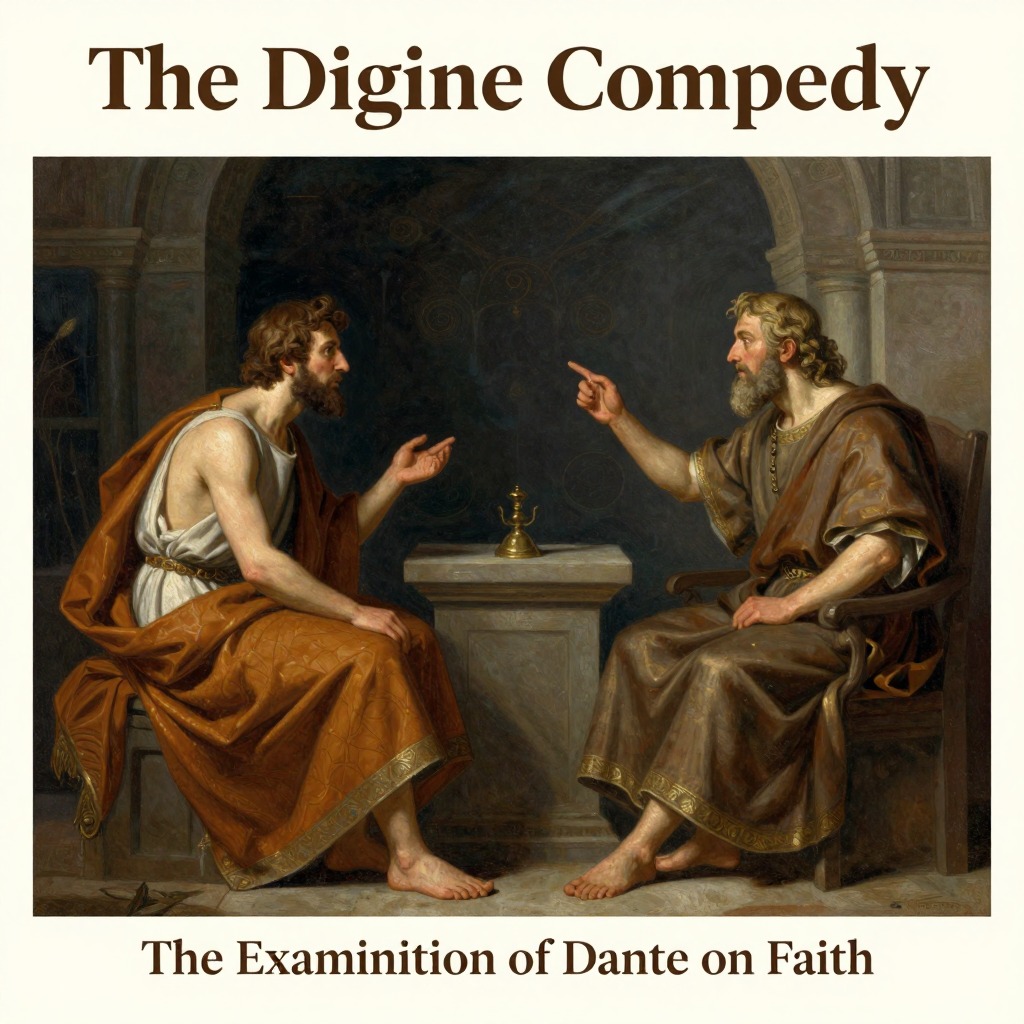
In the sphere of the Fixed Stars, St. Peter conducts a formal examination of Dante on the theological virtue of faith. The scene is structured like a scholastic disputation: Beatrice requests that Peter examine Dante, and Peter, in turn, poses a series of questions. He asks, "What is the Faith?" and Dante responds with the definition from the Epistle to the Hebrews, calling it "the substance of the things we hope for, / And evidence of those that are not seen." Peter then probes deeper, asking where Dante obtained this faith and why he holds the Scriptures to be the word of God. Dante answers by citing the miracles of the Church's spread, particularly the poverty and sacrifice of the early apostles, including Peter himself: "Because that poor and fasting thou didst enter / Into the field to sow there the good plant, / Which was a vine and has become a thorn!" This response, which contrasts the humble beginnings of the Church with its current state, pleases Peter immensely. He then asks Dante to profess his belief, which Dante does, declaring his faith in one God, the Trinity, and the Incarnation. Satisfied, Peter, singing, encircles Dante three times in a gesture of blessing and approval.
The Indictment of the Papacy
St. Peter's most dramatic and passionate moment comes not in his role as examiner but as a prophet of woe. After the examination, his appearance changes, becoming as red as Jupiter and Mars if they were birds and exchanged feathers. This transformation signals his righteous anger. He then delivers a blistering condemnation of his successor, Pope Boniface VIII, and the corrupt state of the papacy. He cries out, "He who usurps upon the earth my place, / My place, my place, which vacant has become / Before the presence of the Son of God, / Has of my cemetery made a sewer / Of blood and stench." Peter laments that the Church was never meant to be used for the acquisition of gold, recalling the blood of early martyrs like Linus, Cletus, Sixtus, Pius, Urban, and Calixtus. He explicitly states that the keys were not given to be a banner for war against the baptized or a seal for venal privileges. He sees "rapacious wolves" in the garb of shepherds and warns of the coming wrath of God, expressing hope that divine Providence will bring aid, just as it once did with Scipio at Rome. This speech establishes Peter not only as the guardian of orthodoxy but as the conscience of the Church, whose authority is directly challenged by the corruption of those who claim to follow him.
Narrative Role and Thematic Significance
St. Peter's role in the Paradiso is multi-layered. He is the ultimate authority who validates Dante's theological understanding, thereby authorizing the poet's entire visionary journey. His examination of faith serves as a model for the proper relationship between the individual believer and the institutional Church. More significantly, his fierce denunciation of the papacy is a central pillar of Dante's political and religious critique. By placing this condemnation in the mouth of the first Pope, Dante gives it an irrefutable, divine authority. Peter's words transform the abstract concept of papal corruption into a personal, anguished betrayal of the Church's founding mission. He embodies the ideal of the Church as a spiritual, suffering community, in stark contrast to the worldly, avaricious institution it had become. His presence in the Paradiso is a reminder that the highest authority in heaven is also the most severe critic of its earthly representatives, and that the true foundation of the Church is not power but faith, poverty, and sacrifice.