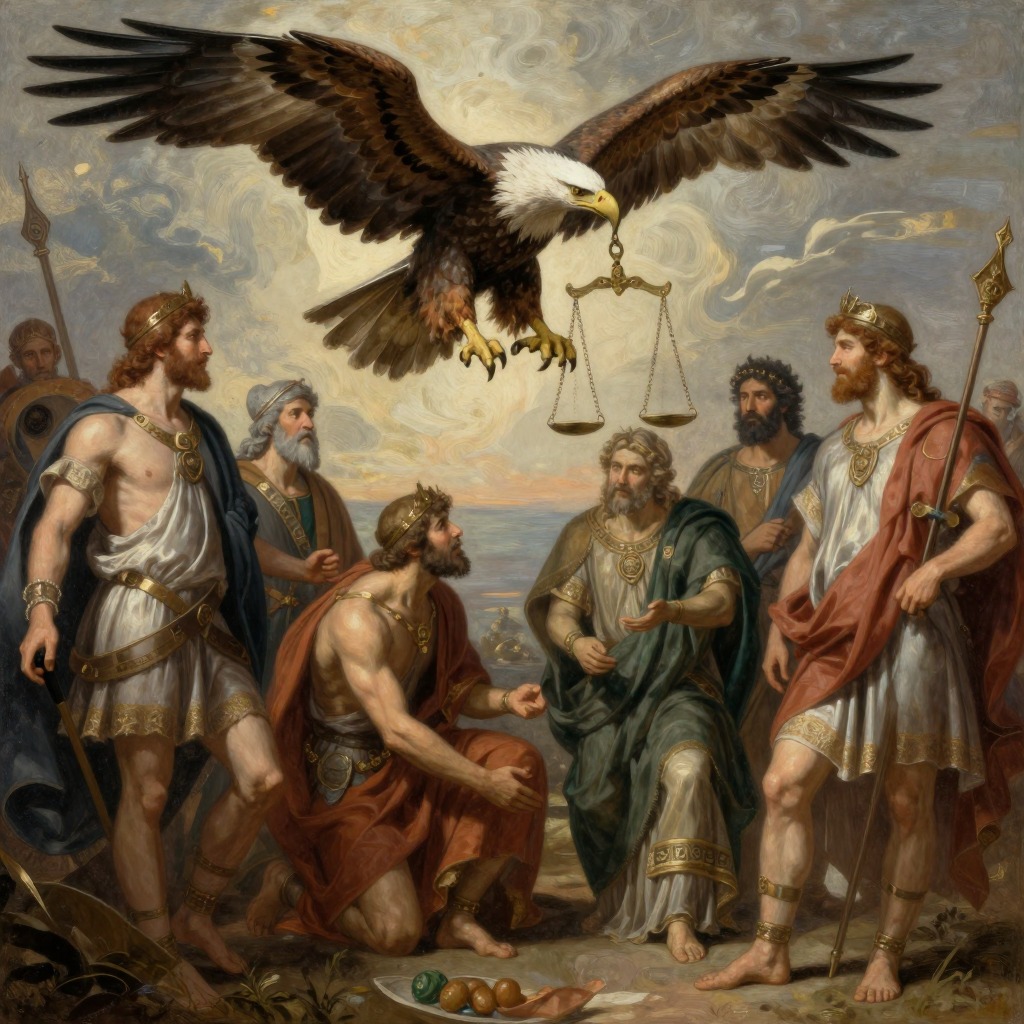
The Eagle of Jupiter
The Divine ComedyIn the sixth heaven, the sphere of Jupiter, the souls of righteous rulers and judges form themselves into a living emblem: the Eagle of Jupiter. This is no static image but a dynamic, speaking constellation of lights that articulates the poem's most sustained meditation on divine justice, the limits of human reason in judging salvation, and the corruption of earthly kingship. The Eagle appears as a figure made of individual flames, each a blessed soul, that together produce a single voice, speaking as "I" and "My" while meaning "We" and "Our" — a paradox that embodies the unity of the blessed in the divine will.
Formation and Appearance
The Eagle takes shape within the sphere of Jupiter, the "temperate star" whose white light contrasts with the red of Mars. Dante sees the souls first arrange themselves into letters, spelling out the opening words of the Book of Wisdom: "Diligite justitiam, qui judicatis terram" (Love justice, you who judge the earth). The letters form and reform until, at the M of the fifth word, other lights descend and settle, and the whole assembly resolves into the head and neck of an eagle, "delineated by that inlaid fire" (E12288–E12293). The image is not painted by any human artist; God Himself is the painter, and the virtue that gives form to the nest — the Church or the empire — is remembered from Him (E12324–E12326). The Eagle is thus a self-organizing, divinely authored symbol, not a human artifact.
The Single Voice of Many Souls
The most striking feature of the Eagle is its mode of speech. Though composed of countless individual lights, it speaks with one voice, using the first-person singular while referring to a collective identity. It begins: "Being just and merciful am I exalted here unto that glory which cannot be exceeded by desire; and upon earth I left my memory such, that the evil-minded people there commend it, but continue not the story" (E12365–E12370). This "I" is the Eagle itself, the composite sign of just rulership. The effect is of a single heat felt from many embers, a single sound issuing from many loves (E12371–E12373). The Eagle thus dramatizes the paradox of the blessed in Paradise: each soul retains its individuality, yet all are united in a common will and voice.
Discourse on Divine Justice
Dante approaches the Eagle with a long-standing doubt: how can a just God condemn to hell a virtuous man born on the banks of the Indus who has never heard of Christ, yet lives a blameless life? The Eagle answers by first establishing the limits of human vision. God, who "a compass turned on the world's outer verge," could not impress His power so fully on the universe that His Word would not remain in infinite excess (E12392–E12397). Therefore every created intellect, including that of the blessed, sees only a ray of the divine intelligence; the justice of God is like an ocean whose bottom is visible near the shore but hidden in the deep (E12410–E12415). The Eagle then delivers its central teaching: "Unto this kingdom never ascended one who had not faith in Christ, before or since he to the tree was nailed" (E12455–E12457). Yet it immediately qualifies this by warning that many who cry "Christ, Christ!" will be far less near Him at the judgment than some who never knew Christ — and that the Ethiopians will condemn such Christians when the two companies are divided (E12458–E12463). The Eagle thus upholds the necessity of faith while condemning hypocritical believers, and it leaves the ultimate mystery of predestination intact.
Condemnation of Corrupt Kings
The Eagle concludes with a sweeping denunciation of the wicked Christian rulers of Dante's time. It prophesies the shameful deeds that will be read in the book of judgment: Albert of Germany, whose actions will depopulate Prague; Philip the Fair of France, who falsifies the coin and will die by a wild boar; the mad pride of the English and Scots; the luxury of the king of Spain and the cowardice of the king of Bohemia; the avarice of Charles II of Naples, whose goodness is represented by an I and his evil by an M; the cripple of Jerusalem; the king of Portugal, the king of Norway, and the king of Rascia who debased Venetian coin; and the suffering of Nicosia and Famagosta under their beastly ruler (E12467–E12500). The Eagle's voice thus becomes an instrument of prophetic justice, naming the sins of the powerful with the authority of heaven.
The Mystery of Predestination and the Saved Pagans
After the Eagle falls silent, Dante's doubt is not yet resolved. He sees two souls in the Eagle's eyebrow — the pupil is King David, the singer of the Holy Spirit, but the other lights include figures who seem to be pagans: the Emperor Trajan and the Trojan Ripheus. The Eagle explains that Trajan was brought back from hell by the prayers of Pope Gregory, given a brief return to life in which he believed in Christ, and thus saved. Ripheus, by grace, set his love on righteousness and was granted prophetic faith in the redemption to come, so that the three theological virtues served as his baptism a thousand years before baptism existed (E12601–E12630). The Eagle then concludes with a reflection on predestination: "O you mortals! hold yourselves restrained in judging; for ourselves, who look on God, we do not know as yet all the elect" (E12634–E12636). The Eagle's final words affirm that the blessed themselves accept the limits of their knowledge, finding their perfection in willing whatever God wills.