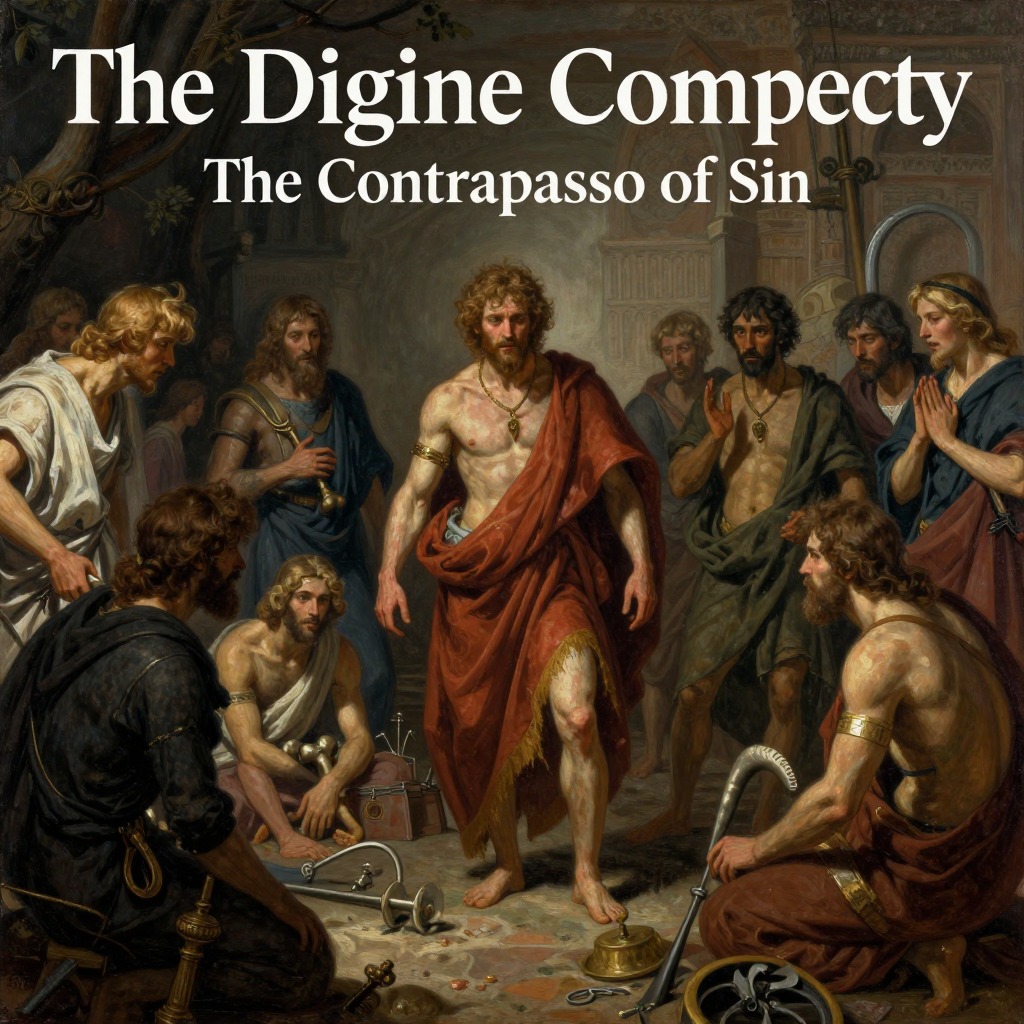
Third Circle
The Divine ComedyThe Third Circle of Hell is the domain of the gluttonous, a place of unending, vile precipitation and bestial torment. It is the first circle encountered after the judgment seat of Minos and the second circle of the lustful, and it marks a descent into a more physically degrading and repulsive form of punishment. The circle is defined by its punishing climate and its monstrous guardian, Cerberus, who rends and flays the souls submerged in the mire.
Environment and Punishment
The Third Circle is characterized by an eternal, maledict, cold, and heavy rain, a mixture of huge hail, sombre-hued water, and snow that pours down through the tenebrous air. The earth that receives this foul precipitation becomes noisome and filthy. The souls of the gluttonous are submerged in this mire, lying prone upon the ground, howling like dogs from the pain of the rain. They use one side of their bodies as a shelter for the other, constantly turning themselves in a futile attempt to escape the relentless downpour. This punishment is a direct application of the principle of contrapasso: the gluttonous, who in life indulged in excessive food and drink, are now forever battered and degraded by a repulsive, inedible storm.
Cerberus, the Guardian
The circle is guarded by Cerberus, a monster cruel and uncouth with three gullets, who barks like a dog over the submerged people. He has red eyes, an unctuous black beard, a large belly, and hands armed with claws. His primary function is to rend, flay, and quarter the spirits, adding physical torment to the environmental punishment. When Dante and Virgil approach, Cerberus becomes agitated, opening his mouths and displaying his tusks. Virgil, however, pacifies the beast by taking handfuls of earth and throwing them into his rapacious gullets. This action quiets Cerberus, who becomes preoccupied with devouring the dirt, much like a dog that ceases barking when given food. This act allows the poets to pass safely through the circle.
The Encounter with Ciacco
Within this circle, Dante encounters a Florentine soul named Ciacco, who sits upright upon seeing the poets. Ciacco explains that he is punished for the sin of gluttony, and that all the other souls in the circle suffer the same penalty for the same sin. Dante, moved by Ciacco's wretchedness, asks him for prophecies concerning the future of their divided city of Florence. Ciacco foretells a period of bloody conflict, the eventual victory of the "rustic party" (the Blacks), and their subsequent fall after a short time. He identifies the three sparks that have enkindled the city's hearts as Envy, Arrogance, and Avarice. When Dante asks about the fate of several worthy Florentines, Ciacco reveals that they are among the blacker souls in deeper circles, punished for different sins. After this prophecy, Ciacco falls back prone like the other blind souls, and Virgil explains that he will not wake again until the sound of the angelic trumpet on Judgment Day.
Narrative and Thematic Significance
The Third Circle serves as a vivid illustration of Dante's moral system, where the punishment for gluttony is a grotesque and humiliating degradation of the body. The encounter with Ciacco is the first instance in the Inferno where a damned soul provides a detailed political prophecy, linking the personal sins of individuals to the broader corruption of society. The circle also establishes a pattern of Virgil's protective intervention, as he subdues Cerberus, and introduces the theme of the damned's limited knowledge of the present and future, a concept that will be more fully explored in later circles. The circle's focus on the physical and the bestial contrasts sharply with the more intellectual sins of fraud and treachery found deeper in Hell.