Triumph of the Church
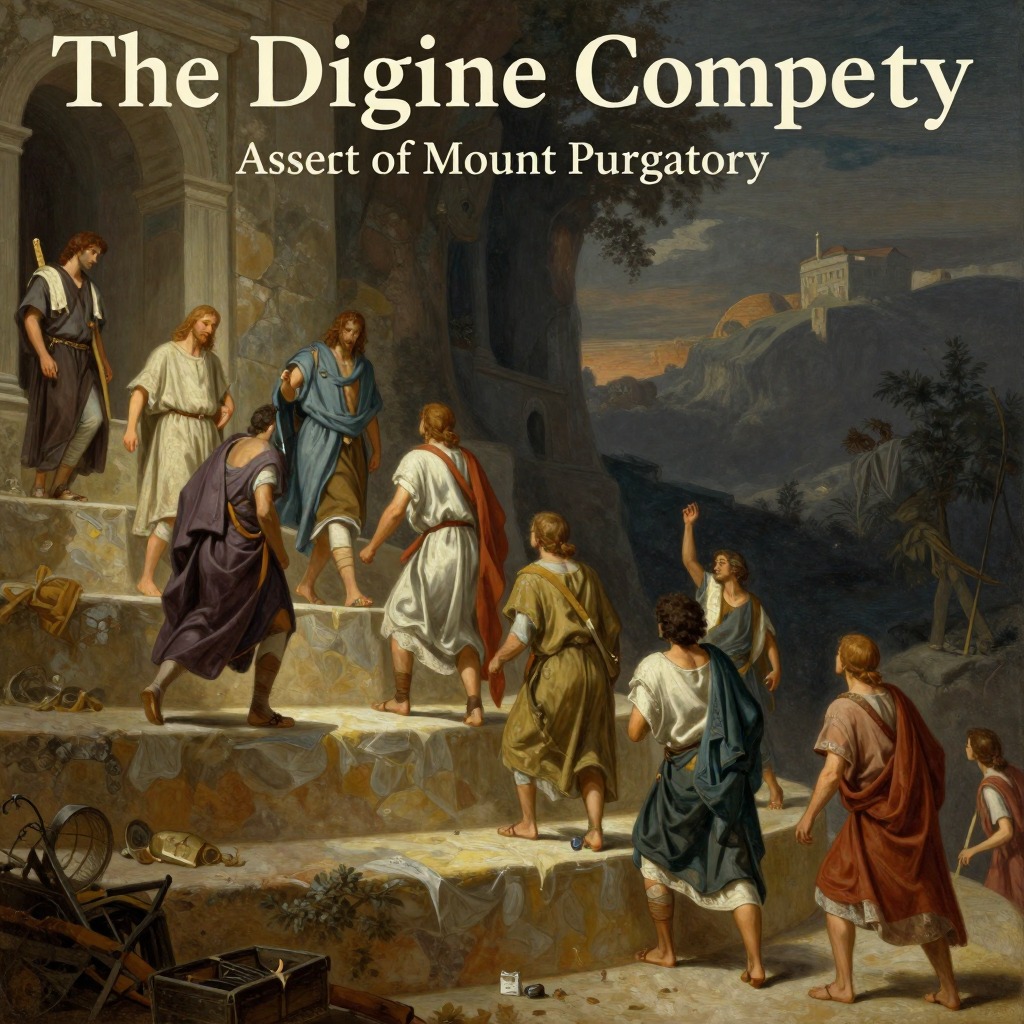
The Divine ComedyThe Triumph of the Church is the central allegorical vision of Purgatorio's final cantos, a majestic procession that unfolds in the Earthly Paradise and encapsulates the entire history of the Church as both a divine institution and a fallen human enterprise. It is the moment when Dante's purgatorial journey reaches its narrative and theological climax, replacing Virgil's guidance with Beatrice's authority and revealing the Church's trajectory from its apostolic purity through its historical corruptions toward an eschatological restoration. The procession is not merely a static tableau but a dramatic enactment of salvation history, in which every element carries layered meanings drawn from Scripture, classical poetry, and medieval political theology.
Structure and Participants of the Procession
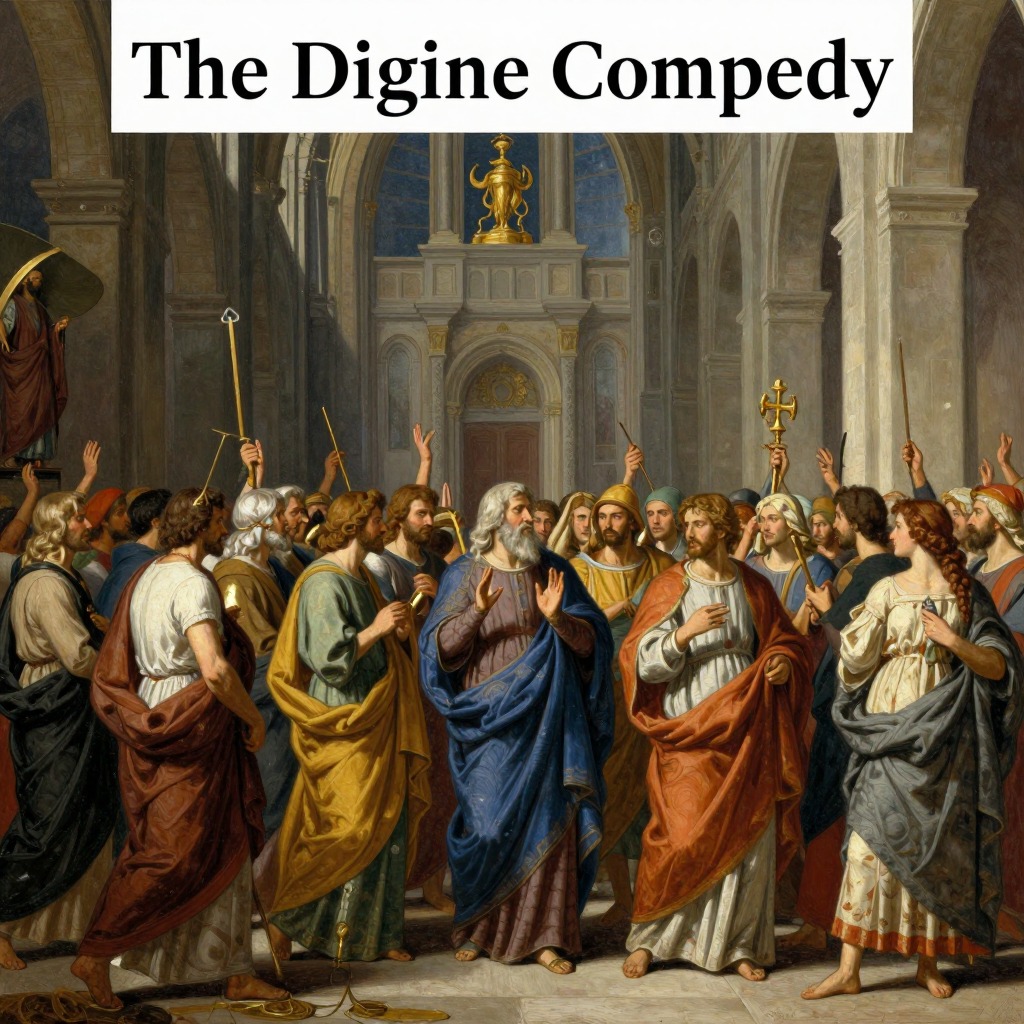
The Triumph of the Church is organized as a carefully ordered allegorical pageant. It begins with seven golden candlesticks, which Dante initially mistakes for trees of gold, singing "Hosanna!" and leaving behind them seven colored streamers in the sky, like the rainbow and the moon's girdle. Behind these come twenty-four elders, two by two, crowned with flower-de-luce, singing a blessing to the Virgin Mary. They are followed by four living creatures, each with six wings full of eyes, representing the Evangelists. Between them comes a triumphal chariot on two wheels, drawn by a Griffin whose upper half is golden and lower half white and red, symbolizing the dual nature of Christ. At the right wheel dance three maidens—one red, one emerald, one white—representing the three theological virtues; at the left wheel dance four maidens in purple, representing the four cardinal virtues, led by one with three eyes. Behind these come two old men, one bearing a sword and one a medical staff, then four more of humble aspect, and finally an aged man walking in sleep with a sharp countenance. This entire company halts when the chariot reaches Dante, and the thunder of its arrival signals the beginning of the climactic revelation.
The Appearance of Beatrice and Dante's Confession
When the procession halts, the twenty-four elders turn toward the chariot, and one of them sings "Veni, sponsa, de Libano" three times. At this summons, a hundred ministers and messengers of eternal life rise from the chariot, scattering flowers and singing "Benedictus qui venis." Within this cloud of flowers, a lady appears under a green mantle, vested in the color of living flame, with a snow-white veil and an olive crown. This is Beatrice, and her arrival marks the decisive turning point of the entire poem. Dante, overcome by the power of ancient love, turns instinctively to Virgil for comfort, only to find that Virgil has vanished. Beatrice addresses him directly by name, rebuking him for his waywardness after her death and demanding his confession. She recounts how she sustained him with her youthful eyes and led him in the right way, but after her death he turned to false images of good, so that only the vision of Hell could save him. Dante, overwhelmed with shame and grief, confesses his fault, and Beatrice accepts his repentance, ordering him to be immersed in the River Lethe to wash away the memory of sin.
The Allegory of the Chariot and the Tree of Knowledge
After Dante's confession and purification, the procession moves to the Tree of Knowledge, which stands despoiled of leaves and blossoms. The Griffin draws the chariot close to the tree and binds it to the trunk, whereupon the tree bursts into bloom, less than rose and more than violet. This act restores the tree that Adam's transgression had stripped, symbolizing the redemption of humanity through Christ's sacrifice. Dante then falls into a sleep, and when he awakens, he sees Beatrice seated alone on the ground beneath the tree, guarded by the seven nymphs with their lights. She commands him to fix his eyes on the chariot and to write down what he sees, for the sake of the world that lives in evil. What follows is a rapid sequence of allegorical attacks on the Church: an eagle descends and rends the tree and smites the chariot; a fox leaps into the chariot but is driven off by Beatrice; the eagle returns and leaves the chariot feathered with its plumes; a dragon rises from the earth and pulls out part of the chariot's floor; the chariot then grows heads—three on the pole and one at each corner, some horned like oxen, some with a single horn—and upon it appears a shameless whore with a giant beside her, who kisses her and then, when she looks at Dante, scourges her and drags the chariot away into the forest. This sequence allegorizes the Donation of Constantine, the rise of heresy, the corruption of the papacy, the Babylonian captivity of the Church in Avignon, and the eventual degradation of the institutional Church.
Prophecy of Restoration and the Rivers of Lethe and Eunoe
Beatrice responds to the lamentations of the seven maidens by prophesying that a "Five-hundred, Ten, and Five"—a mysterious figure sent from God—will slay the thievish woman and the giant who sins with her, restoring the Church to its rightful state. She speaks in riddling terms, comparing her utterance to Themis and the Sphinx, but promises that the facts themselves will soon make the enigma clear. She then commands Dante to remember what he has seen of the tree that has been twice pillaged, for it was made holy by God and its violation is a blasphemy. After this, the procession moves to the two rivers that spring from a single source: Lethe, which removes the memory of sin, and Eunoe, which restores the memory of good deeds. Matilda leads Dante to drink from Eunoe, and he emerges "regenerate, in the manner of new trees that are renewed with a new foliage, pure and disposed to mount unto the stars." This final purification completes the Triumph of the Church as a personal and cosmic drama, preparing Dante for his ascent to Paradise.
Thematic Significance
The Triumph of the Church is the hinge on which the entire Divine Comedy turns, bridging the purgatorial process of purification with the celestial vision of Paradise. It dramatizes the Church's identity as both the Bride of Christ and a historical institution subject to corruption, and it insists that the true Church will ultimately be restored through divine intervention. The procession draws on the Book of Revelation, the Song of Songs, and the prophetic tradition, while also engaging directly with the political crises of Dante's own time, particularly the corruption of the papacy under Boniface VIII and the transfer of the papal seat to Avignon. By placing Beatrice at the center of this allegory, Dante asserts that personal love and divine grace are the means by which the Church's true nature is revealed and its restoration accomplished. The Triumph of the Church is therefore not merely a doctrinal set piece but the poetic and spiritual resolution of Dante's entire journey, the moment when the individual soul and the universal Church are reconciled and set toward their final goal.