Virgil and Statius
The Divine ComedyVirgil and Statius, two poets from different eras and faiths, meet in Purgatory and form a relationship that is both a master-disciple bond and a mutual recognition of poetic and spiritual kinship. Their encounter, marked by Virgil's revelation that his own Aeneid inspired Statius's conversion to Christianity, dramatizes the power of classical poetry to prefigure divine truth and the continuity of literary tradition across the pagan and Christian worlds.
The Meeting in Purgatory
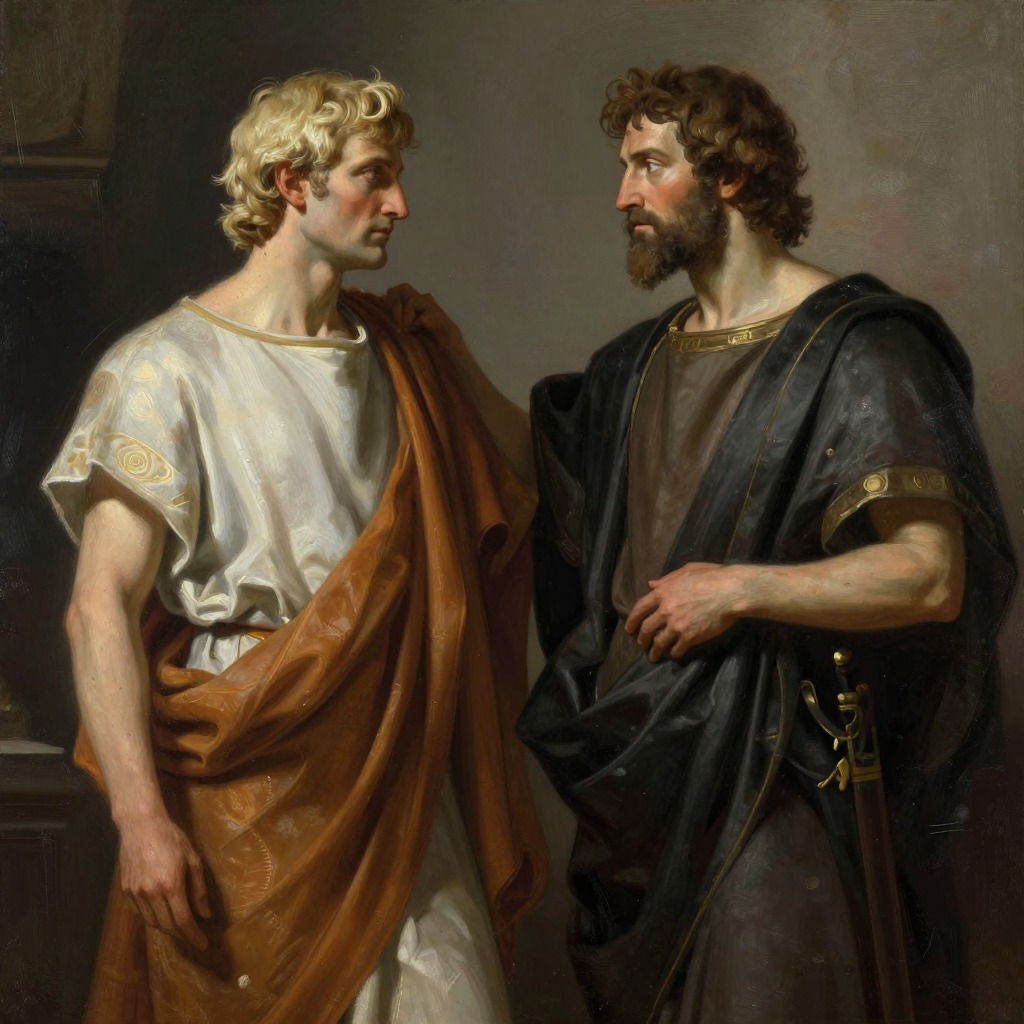
Statius, a first-century Roman poet who composed the Thebaid and an unfinished Achilleid, appears to Dante and Virgil on the fifth terrace of Purgatory, where the avaricious and prodigal are purged. He has just completed his purgation after more than five hundred years, and the mountain has trembled in celebration of his newly purified soul. When Virgil identifies himself, Statius is overcome with emotion. He stoops to embrace Virgil's feet, but Virgil stops him, saying, "Brother, do not; for shade thou art, and shade beholdest." Statius rises and replies, "Now canst thou the sum of love which warms me to thee comprehend, when this our vanity I disremember, treating a shadow as substantial thing." This moment establishes the profound reverence Statius holds for Virgil, whom he regards as his poetic father.
The Revelation of Virgil's Influence
As the three poets ascend together, Virgil asks Statius how avarice could have found a place in a heart so filled with wisdom. Statius laughs and explains that he was not avaricious but prodigal, and that his punishment for extravagance lasted thousands of lunar periods. He then reveals the deeper truth: it was Virgil's own poetry that led him to Christianity. Statius says, "Thou first directedst me towards Parnassus, in its grots to drink, and first concerning God didst me enlighten." He quotes Virgil's Fourth Eclogue—"The age renews itself, Justice returns, and man's primeval time, and a new progeny descends from heaven"—as the spark that made him a Christian. "Through thee I Poet was, through thee a Christian," Statius declares. Yet he remained a covert Christian out of fear, and this lukewarmness caused him to circuit the fourth circle for more than four centuries.
The Bond of Poetic Kinship
The relationship between Virgil and Statius is not merely one of influence but of deep mutual affection. Virgil tells Statius that from the hour Juvenal descended into Limbo and made known Statius's affection for him, his own kindliness toward Statius has been as great as ever bound one to an unseen person. He adds that the stairs of Purgatory will now seem short to him because of this bond. Statius, in turn, speaks of the Aeneid as his mother and nurse in song, saying, "Without this weighed I not a drachma's weight." He even declares that he would accept one more sun of earthly life to have lived when Virgil lived, rather than issuing from his ban. This exchange reveals that their connection transcends the mere transmission of literary technique; it is a spiritual and emotional kinship rooted in the power of poetry to shape a soul's destiny.
The Ascent and Shared Discourse
As the three continue their ascent, Virgil and Statius walk ahead, and Dante follows behind, listening to their speech, which gives him lessons in the art of song. Their conversation is interrupted by a tree with sweet-smelling apples, from which a voice cries out, "Of this food ye shall have scarcity." The voice then recounts examples of temperance, including Mary's concern for the marriage feast, the Roman women's contentment with water, and Daniel's disdain for rich food. The poets pass on, and later, when Dante asks how a shade can grow thin without need of nutriment, Virgil directs him to Statius, saying, "Lo Statius here; and him I call and pray he now will be the healer of thy wounds." Statius then delivers a lengthy discourse on the generation of the soul, explaining how the aerial body is formed after death and how the shade organizes its senses. This moment cements Statius's role not only as a fellow poet but as a teacher and explainer of metaphysical truths, complementing Virgil's guidance.
Thematic Significance
The relationship between Virgil and Statius embodies the poem's central theme of the continuity and transformation of classical culture within a Christian framework. Virgil, a pagan poet confined to Limbo for lack of faith, becomes the unwitting instrument of Statius's salvation through his own prophetic verses. Statius, who was both a poet and a secret Christian, represents the fulfillment of what Virgil's poetry could only foreshadow. Their bond illustrates how literary tradition can carry truths that transcend the author's own understanding, and how the love of poetry can lead to the love of God. The encounter also deepens the pathos of Virgil's own exclusion from salvation: he who inspired another to faith cannot himself attain it, yet he rejoices in his disciple's liberation. Their relationship thus becomes a model of the generative, self-transcending power of art, and a poignant meditation on the limits of reason and the necessity of grace.