White Rose
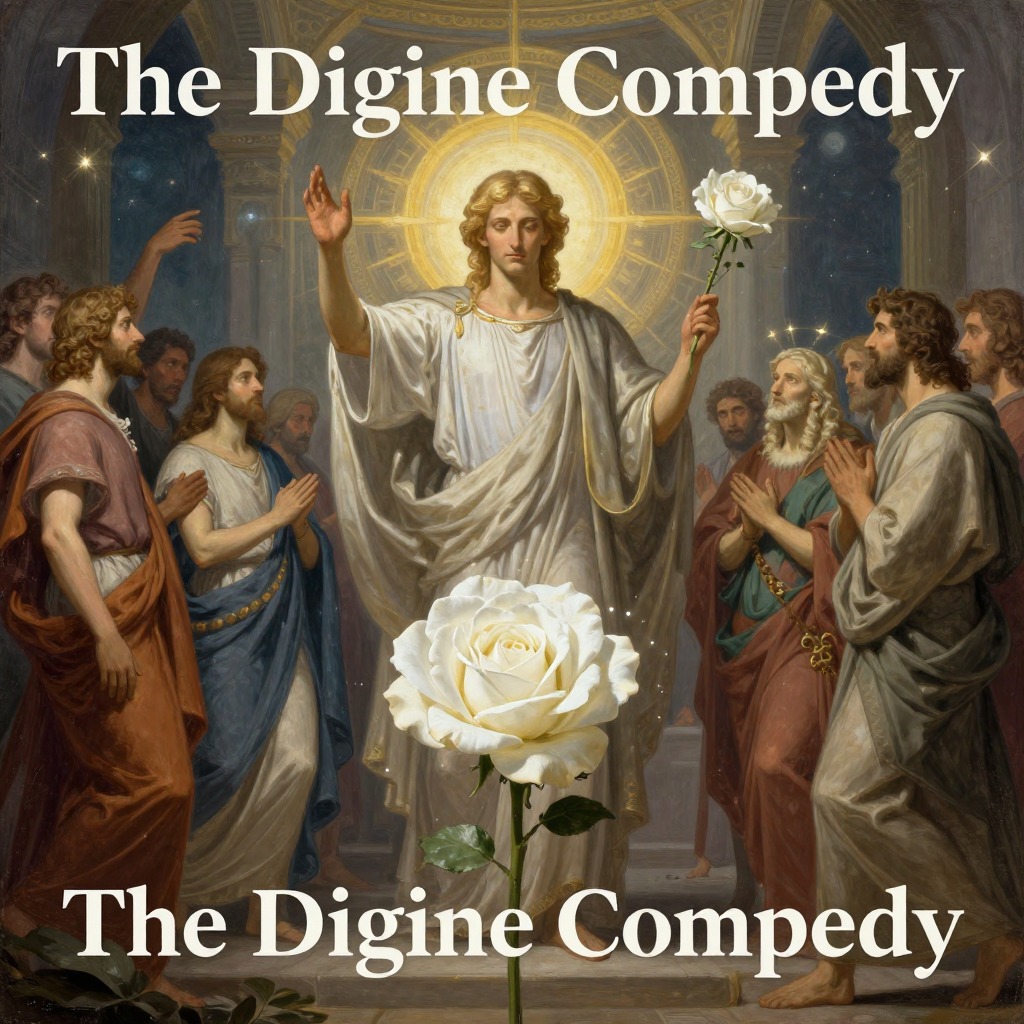
The Divine ComedyIn the final cantos of the Paradiso, Dante Alighieri beholds the ultimate form of the heavenly court: the White Rose, also called the Mystic Rose or Rosa Candida. This immense, snow-white rose is composed of the blessed souls themselves, arranged in concentric circles of petals that ascend toward the Virgin Mary at its center. It is the poem's culminating image of order, love, and unity, the point toward which the entire journey through Hell, Purgatory, and Paradise has been directed. The White Rose is not merely a decorative symbol but the structural and theological climax of the Divine Comedy, the place where the pilgrim finally sees the full assembly of the redeemed and prepares for the vision of God.
Structure and Appearance of the Rose
The White Rose is described as a vast amphitheater of light, its petals formed by the ranks of the saved. Dante sees it as "a snow-white rose" displayed to him by Beatrice, who says, "Behold of the white stoles how vast the convent is! / Behold how vast the circuit of our city!" (E14090–E14091). The rose is not static but alive with the movement of angels, who descend into it like a swarm of bees, carrying peace and ardour from God, and then reascend (E14117–E14122). The angels have faces of living flame, wings of gold, and bodies whiter than snow (E14123–E14125). The rose is so vast that its lowest row alone contains a great light, and Dante marvels at its amplitude (E14076–E14078). The vision is one of perfect order: "There near and far nor add nor take away; / For there where God immediately doth govern, / The natural law in naught is relevant" (E14082–E14084).
The Seats of the Blessed
The rose is divided into two great halves: on one side sit those who believed in Christ before his coming (the Old Testament saints), and on the other those who believed in Christ after his coming (the New Testament saints) (E14275–E14280). Within this division, the seats are arranged hierarchically. At the very top, directly below the Virgin Mary, sits Rachel, and lower down sits Beatrice (E14260–E14262). Other notable figures include Sarah, Rebecca, Judith, and Ruth, the ancestress of King David (E14263–E14265). Below the seventh row, the Hebrew women continue the pattern, dividing the flower according to the view of faith (E14269–E14274). On the opposite side, directly across from Mary, sits John the Baptist, who endured desert and martyrdom and two years in Hell (E14284–E14286). Beneath him are Francis, Benedict, and Augustine, and then the rest of the saints descending from round to round (E14287–E14289). The lowest ranks are filled with the souls of infants who were saved not by their own merit but by the faith of others, and they are distinguished by their puerile faces and voices (E14295–E14301).
The Center of the Rose: The Virgin Mary and the Angels
At the very center of the rose, the Virgin Mary sits enthroned, surrounded by more than a thousand jubilant angels, each differing in effulgence and kind (E14240–E14242). The angel Gabriel, who bore the Annunciation to Mary, hovers before her, singing "Ave Maria, gratia plena" and looking at her with such love that he seems made of fire (E14347–E14349, E14356–E14358). Mary's face is the one that most resembles Christ, and her brightness alone is able to prepare the soul to see Christ (E14338–E14340). Bernard of Clairvaux, who becomes Dante's final guide, points out that Mary is the Queen of Heaven, to whom the entire realm is subject and devoted (E14210–E14212, E14226–E14227).
The Key Figures: Adam, Peter, and the Patriarchs
Bernard identifies the two great roots of the rose: on Mary's left sits Adam, the first father, whose audacious taste brought such bitterness to the human species (E14374–E14376); on her right sits Saint Peter, to whom Christ committed the keys of the kingdom (E14377–E14379). Beside Peter sits John the Evangelist, who beheld the evil days of the Church before his death, and next to him sits Moses, the leader under whom the people of Israel lived on manna (E14380–E14385). Opposite Peter sits Saint Anne, Mary's mother, so content to look upon her daughter that she never moves her eyes (E14386–E14388). Opposite Adam sits Saint Lucy, who moved Beatrice to descend to Hell to rescue Dante (E14389–E14391).
The Pilgrim's Response and the Final Prayer
Dante, overwhelmed by the vision, turns to speak to Beatrice but finds that she has been replaced by Bernard, who has come to lead him to the final vision of God (E14168–E14176). Dante addresses a prayer of gratitude to Beatrice, acknowledging that she has brought him from slavery to freedom by all the ways and expedients within her power (E14189–E14200). Bernard then instructs Dante to look upon the rose and especially upon the Virgin Mary, and he offers a prayer to Mary on Dante's behalf, asking her to grant him the power to see God and to preserve his affections after the vision (E14406–E14444). Mary, in response, turns her eyes to the Eternal Light, and Dante, now purified, is able to look directly into the divine radiance (E14448–E14450).
Thematic Significance
The White Rose is the ultimate expression of the poem's central themes: order, unity, love, and the fulfillment of the soul's journey toward God. It is the place where all the scattered leaves of the universe are bound together in one volume of love (E14490–E14492). The rose is not a static image but a living, dynamic assembly, where the blessed are arranged not by chance but by eternal law, each in the seat that corresponds to their degree of grace (E14308–E14310). The vision of the rose prepares Dante for the final Beatific Vision, in which he sees the threefold circle of the Trinity and, within it, the human form of Christ (E14520–E14536). The White Rose thus stands as the poem's great architectural and theological symbol, the point where the journey of the pilgrim and the journey of the reader converge on the love that moves the sun and the other stars.