AR-15
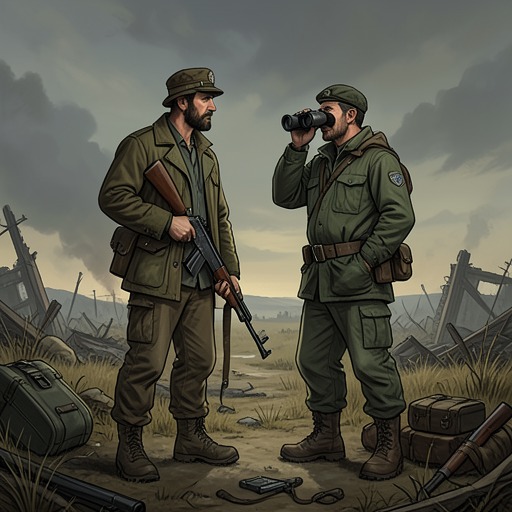
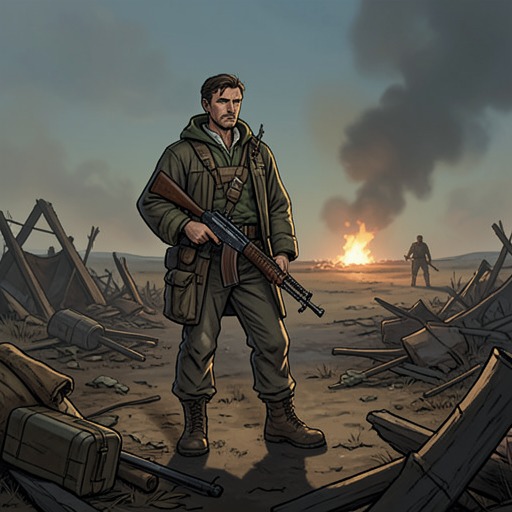
The Dog StarsThe AR-15 is a practical instrument of the defensive partnership between Hig and Bangley, but its importance also lies in what its handling records: Hig’s reluctant entry into combat, his reliance on Bangley’s preparation, and the repeated work of staying ready. The evidence places the semi-automatic rifle in both an early airport firefight and a later roadside confrontation, where it is stored within immediate reach.## Weapon and preparation Hig identifies the AR-15 as a semi-automatic rifle he is good with. Bangley equips him with a night scope, making the weapon part of a deliberate defensive setup rather than an isolated possession. The detail arrives at a moment when Hig is being pressed to participate: Bangley tells him he will have to take part, and Hig’s brief acknowledgment that he did establishes a change in role. The rifle therefore belongs to a larger shift from relying on Bangley’s readiness to sharing the work of defense.
That preparation is notably practical. Hig has a weapon he already knows how to use, while Bangley supplies an optical aid suited to observing threats in darkness. The account does not treat the rifle as a symbol detached from its use: it is equipment brought into a dangerous situation, and its value depends on Hig’s skill, the scope, and the defensive knowledge Bangley provides. At the same time, the narration leaves Hig’s hesitation visible. Being competent with the rifle does not mean he welcomes what using it entails.
The first firefight
The AR-15 is associated with the airport’s first sustained exchange of gunfire. The largest group the defenders had faced numbered seven, and Bangley had been counting nearby before insisting that Hig participate. After the first volley, three attackers remained; the encounter then became what Hig describes as their first bona fide firefight. The attackers lacked night goggles and did not know the terrain, and the confrontation did not last long.
Those circumstances clarify the rifle’s place in the defense without making it a solitary explanation for the outcome. The defenders’ advantage rests on more than firepower: the night conditions, familiarity with the ground, and Bangley’s preparation all matter. Hig’s participation is the crucial personal change. His account does not dwell on the mechanics of shooting; instead, it connects the rifle to the point at which the danger can no longer be met solely by watching and waiting for Bangley to act.
The encounters do not end with that first firefight. After the second summer, visitors become less frequent, eventually dwindling to one group in a season and then none for almost a year. A band of four desperados later nearly overwhelms the defenders. Hig’s response is to begin flying regularly, as if it were a job. The rifle belongs to this longer defensive history: it is part of a life organized around preparing for threats that arrive irregularly, not a weapon associated with a single decisive victory.
Readiness and handling
In a later threat sequence, Hig waits behind sandbags with a rifle positioned at the top of the defensive line. He keys the radio repeatedly, counts while expecting Bangley to arrive, and sights toward people crouched roughly ninety feet away. When Bangley does not appear on schedule, Hig’s uncertainty grows. He removes the scope from its rail and sets it aside, widening his field of view through the rifle’s iron peep sight. This handling shows an adjustment made under pressure: the scope offers a narrow view, while the open sight picture lets him see more broadly.
The scene also locates readiness in small, deliberate actions rather than confidence alone. Hig checks the radio, waits for the partner who normally comes before the count reaches two hundred, and changes the rifle’s sighting arrangement when the immediate situation calls for a wider view. The weapon is useful, but using it requires judgments about what he can see and whether the expected support is present. Bangley’s absence, brief and unexplained in the moment, makes those judgments Hig’s responsibility.
Storage and narrative significance
The rifle appears again beside a Coca-Cola semi-trailer. Jasper fixes his attention on the trailer’s partly open rear doors, and Hig reaches for the AR-15 without taking his eyes off the vehicle. It is held vertically in a bracket on the front-left side of Jasper’s seat, beside a machine pistol, and secured by chrome strapping. Hig lifts it free; the narration identifies it as equipment supplied by Bangley. The arrangement makes the rifle immediately accessible while also showing that Bangley’s preparations extend into the way the pair travel.
Across these scenes, the AR-15 connects equipment, training, and trust. Bangley supplies and prepares it; Hig knows how to use it, participates in the first firefight, and later handles its sights and storage in distinct moments of alertness. Its recurring presence does not erase Hig’s reluctance about killing, nor does competence make danger predictable. Instead, the rifle gives concrete form to the uneasy work of defense: readiness must be maintained between attacks, and Hig must act when Bangley is not yet beside him.