Bangley Shoots the Girl Chasing Hig
The Dog StarsBangley’s shooting of the girl chasing Hig turns their practical survival partnership into an explicit moral dispute. Bangley treats the pursuit as a threat that must be stopped; Hig sees a possible plea for food and cannot accept that possibility being answered with a shot. The encounter makes their dependence on one another inseparable from their disagreement over what survival permits.
Circumstances and Division of Roles
The shooting occurred the previous summer, during Hig’s travels across open country. Such trips were dangerous, and Bangley provided cover while Hig moved beyond their shared base. Their arrangement divided work according to skill: Hig flew the plane and gathered information, while Bangley supplied armed protection on the ground. The handsets they used could be recharged with solar panels, allowing them to remain in contact while separated.
Bangley’s .408 CheyTac sniper rifle was mounted on a platform he had built, with a rangefinder for estimating distance. He claimed he could hit a person from a mile away, and Hig had seen him make long-range shots more than once. The girl’s pursuit was therefore met not in a sudden face-to-face struggle but by force delivered from a distance. Bangley’s established role as the pair’s armed protector helps explain how quickly he acted; it does not settle Hig’s question about whether he should have.
The Shooting and Hig’s Return
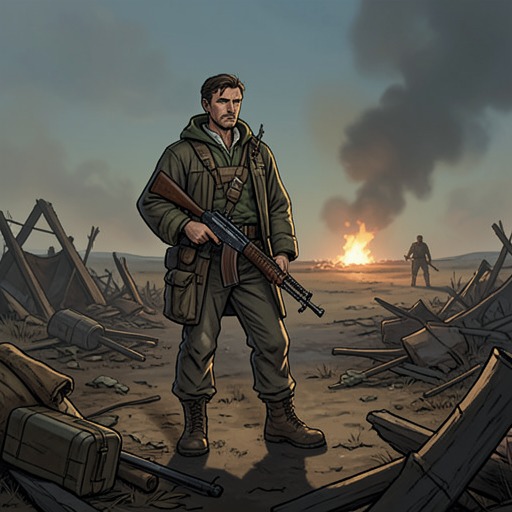
The girl was chasing Hig across an exposed plain when Bangley fired. Hig heard the shot, stopped, left his sled, and went back to her. She had a small knife, while Hig himself had a gun. When he reached her, she was still alive and looked toward him with an expression Hig remembered as questioning. The scene stays with him not simply as another instance of danger, but as an encounter whose meaning he could not resolve.
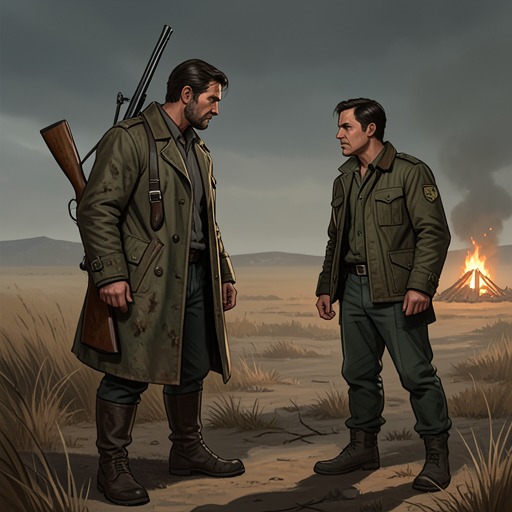
Hig asked Bangley why he had shot her. His question was not based on certainty about the girl’s intentions: he suggested that she might have wanted food, while acknowledging the uncertainty. But the difference between a gun and a small knife mattered to him. In his view, he had been armed and could have assessed the encounter himself; the girl’s weapon might have been for protection rather than proof that she intended to attack him.
Competing Assessments of the Threat
Bangley answered by imagining what might happen if the girl reached Hig: she could have killed him while he slept. The possibility was speculative, not something Hig had observed, but it expressed Bangley’s governing approach to risk. In a world where a stranger’s intentions could not be safely known, he treated the worst possible outcome as a reason to act before it occurred.
Hig’s objection rests on a different uncertainty. The girl might have been dangerous, but she might also have been hungry, and he had no way to know which. The force of the episode comes from that unresolved gap between what happened and what each man believes could have happened. Bangley interprets the chase as a threat with potentially fatal consequences; Hig cannot accept that the imagined threat alone makes shooting her necessary. Neither account establishes what the girl intended.
Consequences for the Partnership
The argument exposes a tension built into the men’s interdependence. Bangley had saved Hig’s life repeatedly, and Hig recognized that protection as essential. Bangley had the weapons and served as the pair’s muscle; Hig had the plane and acted as their eyes. Their arrangement worked because each supplied something the other lacked, but the shooting shows that practical dependence did not produce agreement about how those abilities should be used.
Hig also knew the limits on both sides of their arrangement: Bangley could not fly, and Hig did not have the stomach for killing. Their survival partnership therefore depended on a division of labor that could also sharpen their conflict. Bangley could make a lethal decision to protect Hig; Hig had to live with the consequences and question whether protection had become excessive. The scene leaves their alliance intact in the evidence presented, but it makes clear that trust does not erase moral disagreement.
Memory and Significance
Hig recalls the incident while describing excursions into the greener woods, where he goes to breathe and hunt despite the danger. Before setting out, he checks the route by day and at night with night-vision goggles, then reports his plans to Bangley. Those precautions frame the shooting as part of an ongoing system of vigilance, not an isolated disagreement detached from the conditions in which the men live.
The memory also complicates the protective logic of that system. Bangley’s cover helps Hig travel, but the girl’s presence forces Hig to confront the human cost of being protected at a distance. His return to her after the shot marks the difference between Bangley’s rapid response to danger and Hig’s need to face what that response has done. The episode’s significance lies in that contrast: the men survive through complementary roles, yet the very act that demonstrates Bangley’s protection becomes a lasting question for Hig.