Bruce Bangley
The Dog StarsBruce Bangley is Hig’s only neighbor at a small country airport, and the armed half of a survival partnership built around a simple division of labor: Hig flies and watches, while Bangley defends. His hard security rules can turn lethal, but the partnership is not merely a tactical arrangement. Over time, shared work and dependence give way to a familial bond that Bangley himself acknowledges.
Identity and Capabilities
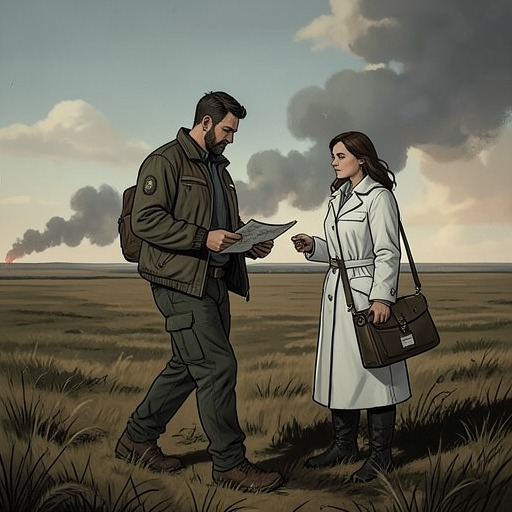
Bangley lives within an unusually wide radius of isolation: he and Hig are the only neighbors for miles across open prairie. Hig learns his name from the registration in an old truck that no longer runs, but generally calls him Bangley rather than using his given name. The spare way they address one another suits a relationship formed under immediate practical pressures, with little need for social ceremony.
His defining skill is firearms. Bangley understands guns, can modify and improve them, and can make one from salvaged materials. When he first arrives at the airport, he brings a heavy drill press, welder, generator, grinders, and band saw in a trailer. Hig recognizes that Bangley’s metalworking skills could be applied beyond weapons, but Bangley’s expertise remains sharply specialized: he knows little about engines, agriculture, carpentry, cooking, or many other ordinary forms of work. He cannot fly. The contrast with Hig is the basis of their usefulness to each other, but it also leaves parts of their shared survival system dependent on Hig’s knowledge.
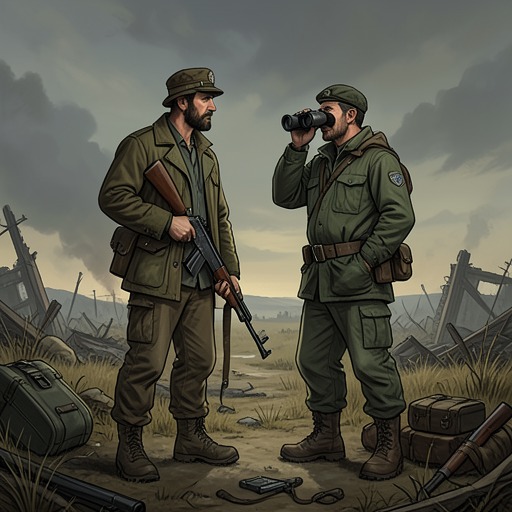
Bangley’s defensive capacity is formidable. He keeps a .408 CheyTac sniper rifle on a platform and uses a rangefinder; he says he can hit a person from a mile away, and Hig has seen him do so. The strength he contributes is not abstract. Their airport, homes, water, and power attract intruders, making Bangley’s ability to guard the perimeter central to their continued survival.
The Partnership and Its Rules
The alliance begins without a formal negotiation. Bangley appears while Hig is working on The Beast, and the arrangement resolves into a blunt division: Hig flies, Bangley kills, and Jasper growls. They leave each other room to operate, relying on different abilities rather than pretending to share the same temperament. Hig has the aircraft and serves as the pair’s eyes; Bangley supplies the guns and muscle. Hig knows that Bangley has saved him more than once, while Bangley knows that Hig does not have the stomach for killing. Their dependence runs both ways: Bangley cannot fly, and either man would likely be in danger alone.
The airport’s infrastructure helps explain why this arrangement matters. The site has a creek, fuel, solar panels, and wind power, but those advantages also make it an attractive target. Attacks come at night, sometimes from individuals and sometimes from groups carrying rifles or knives. Hig patrols and gathers information; Bangley’s defense makes staying possible. Their hand-held radios, which can be recharged with the panels, connect them when Hig travels beyond the airport. Survival here depends as much on keeping equipment and routines working as on the weapons themselves.
Bangley’s conception of security is severe. When a young girl pursues Hig across open ground, Bangley shoots her. Hig returns to the scene and challenges the decision, reasoning that he was armed and she carried only a small knife; she may have been looking for food. Bangley counters that she might have killed Hig while he slept. The disagreement reveals the cost of his protective logic: a possible future threat is treated as enough to justify lethal force, while Hig remains attentive to the possibility that a stranger is simply trying to live. Yet the conflict does not dissolve their partnership. Hig continues to understand Bangley as the person responsible for saving him, even as he questions the judgments that responsibility produces.
Security, Judgment, and Cooperation
The perimeter becomes the compact that allows the two men to share space without becoming alike. Bangley’s insistence on defense answers the repeated danger of the airport, where intruders arrive from a devastated world and where resources such as water and fuel make the site worth approaching. Hig accepts the need for protection but resists making suspicion the only measure of other people. When he argues that nearby families are no threat, he addresses Bangley by his given name, Bruce. Bangley’s widened eyes register the unusual intimacy of hearing it from Hig: until then, he had introduced himself simply as Bangley.
Their differences also surface in the practical labor of maintaining life. Hig has to show Bangley how to water the garden, direct water from the header into the furrows, clear the rows, and distinguish crops from weeds. Bangley is ornery during the lesson and admits that he had sworn never to farm, except to dig the dirt of a grave. Then he explains that his father was a farmer. The disclosure complicates the apparent certainty of Bangley’s identity as a weapons specialist. He is capable of rejecting agricultural work even while carrying a piece of family history that connects him to it; under changed conditions, he nevertheless learns the tasks Hig teaches.
Bangley’s account of their security arrangement is also an argument for keeping their community small. He points to the perimeter, water, power, food, and firepower, and to the nearby mountains as a fallback if game becomes scarce. With only Hig and himself, he says, they have no internal politics or factional struggle to tear them apart. His confidence rests on simplicity: limit the group, secure the resources, and avoid the divisions he associates with failed communities elsewhere. The principle gives their partnership coherence, but it also exposes its limits. A system organized around two people depends on both continuing to perform their separate roles.
From Partners to Family
Bangley does not express affection easily. His customary manner is blunt, and his practical contributions often speak in place of tenderness. Against that reserve, his later acknowledgment that Hig has been a good partner carries particular weight. He adds that Hig can be goofy, then says that Hig is like family. Hig reacts with a constricted chest, recognizing the emotional force of words Bangley rarely offers. The exchange confirms a change in their relationship without erasing its foundation in labor and danger: the person who once became Hig’s neighbor because the perimeter required it has become a member of his chosen family.
Bangley’s role therefore holds two truths together. He is a protector whose certainty can make survival brutally narrow, and he is a dependent partner who cannot sustain the airport alone. His weapons, equipment, and readiness secure the conditions in which Hig can scout, maintain the aircraft, and help others. Hig’s teaching and judgments, in turn, make room for work beyond defense. Their bond is neither uncomplicated friendship nor a purely instrumental bargain; it is a durable arrangement in which difference is necessary, conflict remains possible, and loyalty grows out of repeated dependence.