Cattle
The Dog StarsCattle are both a source of food and a vulnerable part of the dwindling life sustained at Cima and Pops’s Box Canyon Ranch. As drought steadily reduces the water available to the family, the animals’ survival becomes uncertain; when departure is considered, the family cannot simply take them along, and leaves their future dependent on rain.
Presence at the Canyon Ranch
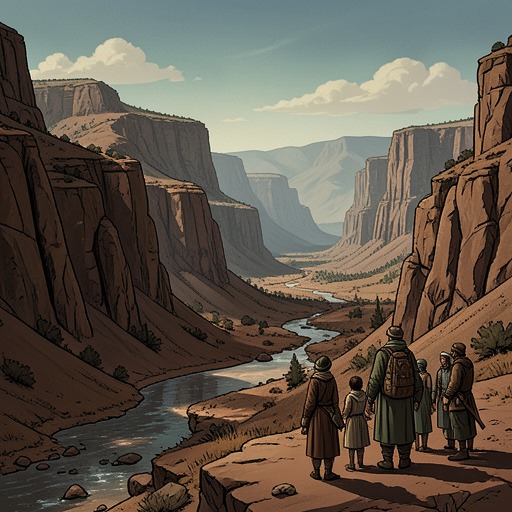
When Hig surveys the canyon refuge, the cattle remain in the meadow, their heads down and facing downstream. The place otherwise appears suddenly unoccupied: a bucket lies overturned, and the few sheep are there with the cattle. Their presence marks a continuing daily life even while the people are absent. The scene does not present the animals as an abstract store of food; they are living dependents within a settlement whose human occupants may have had to leave quickly.
The account also shows the animals in poor condition. They are described as thin, with their hips sharply visible, a sign that the scarcity at the ranch has become bodily and immediate. This condition contrasts with the green meadow and running water that Hig sees elsewhere in the canyon. A landscape can still appear alive while its inhabitants are already struggling to endure it.
Drought and Declining Water
The family identifies drought as the reason it may have to leave. During the previous summer, the creek nearly dried up, and they had to dig into its bed to collect enough water for drinking. Half the cattle died. The stream’s decline therefore threatens people and livestock together: water is not merely a convenience for the ranch but a prerequisite for maintaining life there.
The crisis is described as cumulative rather than sudden. The weather is getting warmer, conditions have worsened year by year, and the family expects the problem to continue. Earlier observations of increasingly unreliable mountain snow and warmer streams place the ranch’s shortage within a wider pattern of environmental change. In the canyon, however, that large pattern is registered in concrete terms: a nearly dry creek, a laborious search for drinkable water, and a herd reduced by half.
Livestock and the Limits of Departure
When Hig and Cima consider leaving, carrying capacity makes the animals part of a difficult practical calculation. They already have about twenty pounds of venison and cannot take more weight. There is no point in slaughtering livestock to make additional jerky if there is no room to transport it. The decision is not described as a judgment that the cattle are unimportant; it follows from the physical limits of what the travelers can carry.
The plan is to leave the livestock to fend for themselves, with the hope that enough rain will fall to help them survive the season. That hope is explicitly uncertain. The cattle are not given a guaranteed rescue or a known fate after the family goes. Their immediate future depends on the same weather that has already depleted the creek and killed half the herd.
The family does make room in its plans for two lambs, a male and a female, whose combined weight is considered manageable. This does not mean the cattle are interchangeable with the sheep; rather, it clarifies how sharply the journey’s limits govern what can be taken. Later, the remaining animals are still seen feeding in tall grass, while the lambs nurse and move about with the mixed group. Their continued presence makes departure a transfer of risk: some animals may travel with the people, while the cattle and much of the livestock remain exposed to the drought at the ranch.
Significance
Cattle give the environmental crisis a local measure. The changing climate is not conveyed only through general warnings or descriptions of distant ecological loss: it alters the water supply on which a particular family and its animals depend. The herd’s decline makes the cost of staying visible, while the decision to leave shows that escape is constrained by weight, food, and the uncertainty of finding water elsewhere.
Their situation also resists a simple distinction between wilderness and human settlement. The ranch’s meadow and creek sustain a human household, livestock, and other wildlife, but those surroundings are not reliably abundant. Even a place that appears green can be losing the conditions that make habitation possible. The cattle’s survival remains unresolved, turning the family’s departure into more than a change of location: it leaves behind animals whose prospects are bound to an increasingly unreliable season.