Choosing not to kill
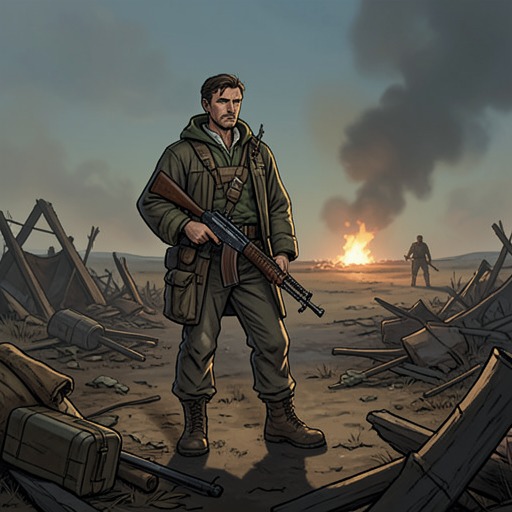
The Dog StarsChoosing not to kill is a hard-won possibility for Hig: he begins to see that survival does not require treating every stranger as a target, or allowing Bangley to do so in his place. The idea does not erase the danger around him. It changes what he believes he may choose when he enters someone else’s territory, and makes room for a relationship not organized in advance around violence.
A Choice Made in Someone Else’s Territory
During a low pass over a canyon house, Hig berates himself for losing focus, then recognizes what has changed in him. His hesitation is not simply attraction to one particular person; he understands it as a new relation to people of any gender. He is under no obligation to kill them, he realizes, and equally under no obligation to let Bangley kill them. The house belongs to its occupants. Hig is the visitor.
That distinction gives restraint a concrete setting. Hig does not know who may be inside or whether anyone is waiting to attack him. He considers the possibility of an armed group concealed in or near the house, and imagines that the occupants may already have heard his aircraft. These remain possibilities, not facts established by the scene. Instead of resolving the uncertainty by firing, he circles low twice and studies the rutted road, noting where the ditch begins and ends. He marks the approach with bushes and gaps, preparing to land while keeping the hazards in view.
The practical care of that survey matters: choosing not to kill is not a refusal to protect himself. Hig continues to assess the ground and the risk, but does not convert uncertainty alone into a reason to attack. He describes the freedom of being able to approach the house and either shoot or not shoot. The choice itself loosens the assumed connection between encounter and violence.
Against Bangley’s Perimeter
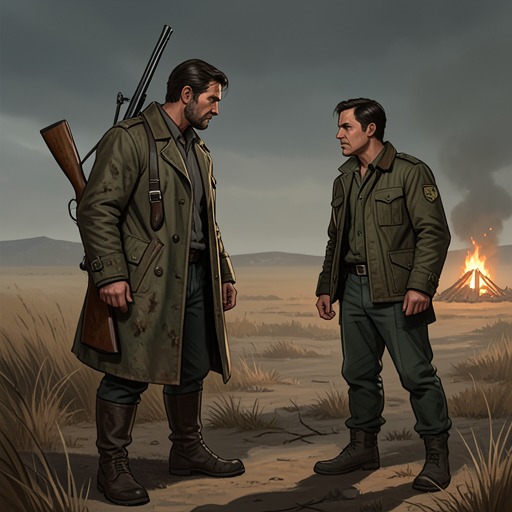
The possibility of restraint is especially stark beside Bangley’s model of survival. Cima points out that Bangley brought Hig along, trained him, and established a perimeter; Bangley had no hesitation about killing anyone who crossed it, regardless of age or gender. Hig, she says, did have a problem with that. Her reminder frames his reluctance not as ignorance of the rules he has lived under, but as a difference in how he responds to them.
Cima also tells Hig that he got over his earlier resistance. Her observation prevents the concept from becoming a simple portrait of unchanging moral purity: a person can become accustomed to killing. Pops presses the same possibility more directly, asking whether killing is something Hig can get used to. Hig answers no. Pops replies that this is what Hig says, leaving open the distance between Hig’s stated conviction and the habits the surrounding violence may have formed in him.
Pops then invokes the pheasant encounter as evidence of the danger on both sides. He says that, had Hig been close enough, he would have cut his throat, and acknowledges that he is glad Hig was not. Hig is shaken by the admission and recognizes that Pops could have harmed him while he slept. The scene refuses to make restraint equivalent to safety: Hig’s choice not to kill does not prove that others share it, and it cannot undo the threats already made.
A Refusal After Loss
When Hig confronts Pops, he says he came in peace and that Pops has tried to kill him twice. He says he came looking for something he cannot name, but not for death; the deaths at the airport have already been enough. The statement places his refusal in the aftermath of violence rather than outside it. He knows what killing and death have meant in his recent life, and rejects the idea that another encounter must continue that sequence.
Hig’s grief over Jasper sharpens the moment. He tells Pops that he lost his dog a week earlier and has nothing left to lose; Pops can subtract twenty points and shoot him if he wishes. This is not a calculated demonstration that Hig controls the situation. Bound and facing a threat, he speaks from despair and exhaustion. Yet his appeal still distinguishes what he wants from what the point system threatens: he came seeking something other than death, and he is not asking to be rewarded for violence.
Cima intervenes, telling her father to let Hig up. Her interruption ends the immediate restraint imposed on him and makes room for the encounter to continue without the threatened execution. The outcome does not establish that the conflict has vanished. It shows instead that another person’s intervention, as well as Hig’s own refusal to retaliate, can interrupt a violent course.
Restraint Without Innocence
Hig’s position is not that everyone involved is innocent. Pops tells him that nobody at the table is innocent, and Hig’s account of the exchange gives no basis for treating the earlier threat as harmless. The concept therefore rests on a narrower and more demanding claim: a person may recognize danger and culpability without deciding that killing is the only available response. Hig can acknowledge the possibility that Pops might have killed him and still deny that he must kill Pops in return.
Across the canyon approach and the confrontation with Pops, restraint changes from an internal realization into a contested practice. At the house, Hig can map a dangerous landing without attacking its occupants; at Pops’s table, his plea for an end to further death is tested against past threats, Bangley’s training, and the possibility that violence can become habitual. Choosing not to kill is not presented as a guarantee of reconciliation. It is the decision to keep another outcome possible, even when fear, grief, and the people around Hig make that decision costly.